|
 This
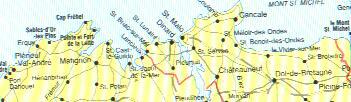
tour of Brittany will begin with the classic intro: one of the most visited
areas of Brittany, called “Cote d’Emeraude”. And one of the pearls of this
coast is undoubtedly SAINT-MALO. This
tour of Brittany will begin with the classic intro: one of the most visited
areas of Brittany, called “Cote d’Emeraude”. And one of the pearls of this
coast is undoubtedly SAINT-MALO.
“A crown of stone above the waves”, wrote Gustave Flaubert, and he had it
right. No approach to Brittany can match that to Saint-Malo, certainly seen from
the sea. The glass-blue clarity of the water, the coastline serried with rocky
inlets, the’ backdrop of heather and bracken covered cliffs which, if you
catch them before they have turned to the purples and russets of high summer,
demonstrate in a glaze of green why the French called this area the “Emerald
Coast”.
 |
|
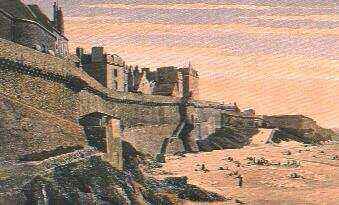
Ramparts StMalo 15th century |
You will be bewitched by its charm, unless you have no feelings and a
heart of granite like the ones at the Iles de Chausey.
Saint-Malo is a walled city and during 17th and 18th centuries, it was one of
France's most important ports, serving both merchant ships and privateers alike.
It was at this time that a system of walls and fortifications were built -
largely to offset the menace of English marauders - but these defences remained
weak, and the pickings rich. Flattened by the Germans in WWII, the port was
faithfully reconstructed and is today one of the most popular tourist
destinations in the region. Busy almost whole year with all the disadvantages of
high tourism off course. Buses taking away the views in the narrow, crooked
streets, cafés and restaurants loosening a bit their discipline in prices,
service and quality. But let’s shrug that off and admire the tall houses of
the “cite intra-muros”, rising above the rampart walls, their high-pitched
slate roofs broken by rows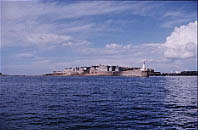 of dormers. Loiter around in the harbour, admire the
extreme variety of different boats, yachts, freighters, cross-Channel ferries,
perhaps a Cancale “bisquine”, loveliest of all fishing vessels. It will
remind you that here, in this very place, the sea and land commingle
inextricably. of dormers. Loiter around in the harbour, admire the
extreme variety of different boats, yachts, freighters, cross-Channel ferries,
perhaps a Cancale “bisquine”, loveliest of all fishing vessels. It will
remind you that here, in this very place, the sea and land commingle
inextricably.
But, but, do you know that in fact the citizens of Saint Malo have the same
feelings towards Brittany, as Brittany against France? They don’t consider
themselves French, neither Breton but “Malouin”! It’s a fact that
Saint-Malo has been an independent republic for 4 years in the 16th century, a
proud and springy city.
The most representative flag for this city would be, see its historical past,
the pirate flag! Saint-Malo has the nickname of “ville corsaire”, (Corsair
city). Indeed, many ships ware attacked by pirates and corsairs, in the 17th and
 |
|
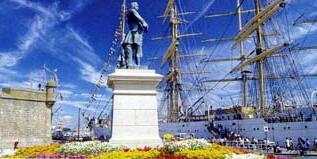
Statue of Surcouf |
18th century by pirates whose base was this walled city. The most famous of
them, a symbol of courage and combativity, THE child of St.Malo is Robert
Surcouf. He made a fortune as corsair, with the permission of the king of France
to attack and loot war ships without being stringed up as a pirate.
And who do you think also got rich and wealthy of all this piracy? The
“armateurs”, ship owners who received two thirds of the lute. It’s thanks
to these ancient crooks (nothing really changed today:-)) that Saint-Malo
possesses such beautiful mansions and hotel particuliers.
In some of the cellars are the remains of mooring posts where vessels would tie
up after a season’s cod fishing, or after voyages of discover or slave trading
for preying as privateers on British and Dutch shipping. If you want a glimpse
of the affluence these activities provided, try strolling along the ramparts at
twilight, when window-shutters are yet unclosed but room-lights have been turned
on.
Bibliography
Saint-Malo
et ses environs, by Gaston Robert de Salles-Hotels et maisons de Saint-Malo :
XVIe-XVIIe-XVIIIe siáecles, by Philippe Petout -Les derniers corsaires malouins
by F. Robidou-Saint-Malo et le pays d' Emeraude, by Jean-Yves Ruaux
|