Saint Malo stroll in old town Site Home - What's New? -Feedback - About Jack- Travel/Art Links

Brittany
|
Saint Malo stroll in old town Site Home - What's New? -Feedback - About Jack- Travel/Art Links |
|
|
|
Brittany |
|
Brittany
main page
Strolling in old town
|
Brittany-Saint Malo-Saint MaloBrittany-Saint Malo-Strolling in old town strolling in old town |
|
|
| restaurant recommendations | hotel recommendations | ||
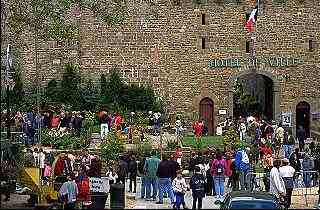 Intra-muros Saint-Malo is flooded during the French holiday season, which is from begin July to end of August. Not by water, but by tourists. From early on the morning, the narrow streets thronged, its cafes and souvenir arcades offering goods that can be found anywhere else in their counterparts up Intra-muros Saint-Malo is flooded during the French holiday season, which is from begin July to end of August. Not by water, but by tourists. From early on the morning, the narrow streets thronged, its cafes and souvenir arcades offering goods that can be found anywhere else in their counterparts up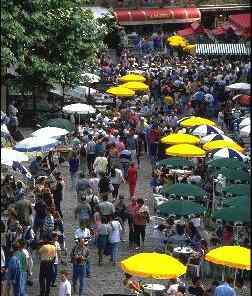 and down France, stiff with humanity. The odour of fresh patisserie, croissants and strong coffee tickles your nose. But despite all this, Saint Malo keeps its fairground colour and vibrancy. Prices are high at this season, but to see all the street performers and enjoying the passing show cost you no more than a cup of coffee or a draught beer when you grow footsore. You see funny thins, like several run-of-the-mill confectionary stalls piled with tins of silver-foil wrapped chocolate sardines, or with sweets which are the perfect replicas of peach and down France, stiff with humanity. The odour of fresh patisserie, croissants and strong coffee tickles your nose. But despite all this, Saint Malo keeps its fairground colour and vibrancy. Prices are high at this season, but to see all the street performers and enjoying the passing show cost you no more than a cup of coffee or a draught beer when you grow footsore. You see funny thins, like several run-of-the-mill confectionary stalls piled with tins of silver-foil wrapped chocolate sardines, or with sweets which are the perfect replicas of peach
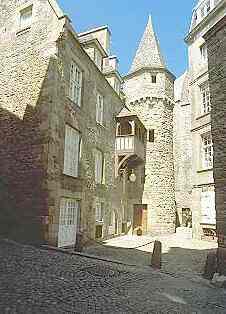 pebbles packed in scallop shells. pebbles packed in scallop shells. Have a walk through old town, starting at the place Chateaubriand, leading to and along old houses, mansions and restored hotels particuliers, picturesque interior courtyards, passages and reminiscences of the past. The most typical street of old town is the rue du Pelicat. Watch nos.3, 5 and 11. It is needless and impossible to name all historical houses in this area. You will just have to discover them yourself during your walk. The Tourist Office gives you brochure: "Saint-Malo, cité de la mer", where you can find most of them. Did you know that the city was practically totally rebuilt after WWII, after being destroyed 80 % in August 1944 by the troops of General Patton who bombarded and shelled the city for two weeks to kick the Germans out of town? But using the granite from neighbouring isles of Chausey, the city was rebuilt 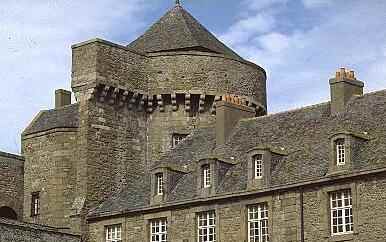 in such a way that it is very hard to tell where the old and the new meet each other. in such a way that it is very hard to tell where the old and the new meet each other. At he southeastern corner of the walled town, is part of a chateau now used as Town Hall. The castle, built in 1415 by duke Jean V of Brittany, more to keep an eye on the turbulent Malouins than to protect them from an invasion! A tower, the Tour Quic-en Groigne, was added later. This strange name means: "complain who might" and it is said that the young duchess Anne de Bretagne, who had a strong will of her own, although she was very devoted to her subjects, was fiercely opposed to this construction. She defiantly called it "Quic en Groigne". It houses today the local aquarium, doll museum and historical wax figures. The enormous spire you see from everywhere in St.Malo is that of the St.Vincent cathedral, begun in the 11th century, a repository of an excellent collection of medieval and modern stained-glass windows, heavily damaged in 1944, and restored until 1971.
On sunny days its glass stained windows produces a genuine light show. Notice these stained glass are modern, put into the rose window 20 years ago. A mosaic on the floor reminds that Jacques Cartier was here before he departed for the New World where he founded Canada (16th of May 1635). During July and August, it is also host to a number of classical concerts. Bibliography |
|||