|
MORBIHAN,
(Breton for "small sea") is the only of the four French departments that form
Brittany, wearing a Breton name. The Golfe du Morbihan is the estuary, south of
the port of Vannes, the medieval capital of Morbihan. The gulf is scattered with
islands in all sizes. From to 43 to 365 up. In no other region of Brittany,
there is such a variety within such a small area. There are also enchanting
medieval towns, fishing villages, peninsulas marinas and deep-probing rivers.
Confined within it's limits are a large industrial port, Lorient, a unique
inland, a sea sprinkled with islands, saltpans and Brittany's most sophisticated
beach resort: La Baule. The climate is unusually mild, thanks to the Gulf
Stream, and often the vegetation makes us more think about the Mediterranean as
the West of France.
Two islands attract especially attract the attention off the coastline: "Belle-Ile",
already the subject of a review on /Brittany/Text/Brittany_Belle_Ile1.htm
and on /Brittany/Text/Brittany_Belle_Ile2.htm
 The
other one is the exotic island of GROIX, which you can reach via Lorient. The
ride of 45 min enables you to reach popular, sandy beaches of 8 km wide, and
hundreds of different bird species. The beach huts and cafes snap shut abruptly
at the end of the school holidays, so that on a fine September day you could
have the breach and prospect all to yourself. The
other one is the exotic island of GROIX, which you can reach via Lorient. The
ride of 45 min enables you to reach popular, sandy beaches of 8 km wide, and
hundreds of different bird species. The beach huts and cafes snap shut abruptly
at the end of the school holidays, so that on a fine September day you could
have the breach and prospect all to yourself.
Let's start with LORIENT. Almost completely destroyed (like Brest) in 1944, by
the troops of Patton coming south of Avranches. It was high price to pay and
they did. From the pre war patrimony, only 4,000 houses remained of which 250 in
beautiful art deco.
Lorient is one of the three largest fishing ports of France. The origin and name
date back from the East India company decision in the 17thyh century to build a
new port for its trade vessels in the wide estuary formed by the confluence of
two rivers, the Blavet and the Scorff. The port took a part of the name of the
company "l'Orient" and became Lorient.
Lorient has a very industrial character but if you insist to visit the city, do
it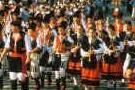 during the
"Fetes InterCeltiques", begin August. It turned to one of the greatest Celtic
music festivals of France. during the
"Fetes InterCeltiques", begin August. It turned to one of the greatest Celtic
music festivals of France.
Or else it is worth getting up early to watch the trawlers unload their catch in
the efficiently organized harbour, active all year round.
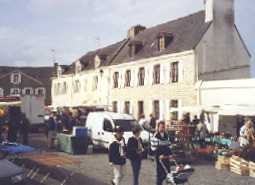
On the shores of the river Blavet lies PORT LOUIS, a quiet fisher place, small
bath resort looking out on Lorient and where the more prosperous businessmen
prefer to live. They even have a small museum: "Musée de la Compagnie des Indes".
 |
|
Port Louis |
It has been a
fortress since medieval times, reinforced in 1636 by Richelieu, and today it
still welcomes returning sailors and fishermen. Between here and the beach lies
the town. Preoccupied Sunday with its market, along the main street, filling the
main square with colour and babble. And if you pass through a gap in the 16th
century ramparts, you will find extensive fine sands across the estuary to
LARMOR PLAGE, the beach of the Lorient citizens.
Next article we will visit the famous monoliths of CARNAC.
Bibliography
A Breton Landscape , by Grenville Astill, Wendy Davies (1998)
Le Golfe du Morbihan , by Yvon Mauffret -En Bretagne Morbihanaise (guide Arthaud-Hotels
de ville et mairies du Morbihan by Yveline Helias )-Secrets et gloires du
Morbihan, by Claude Dervenn
|