|
15 km east of Auray, lies the magnet of this area in this area: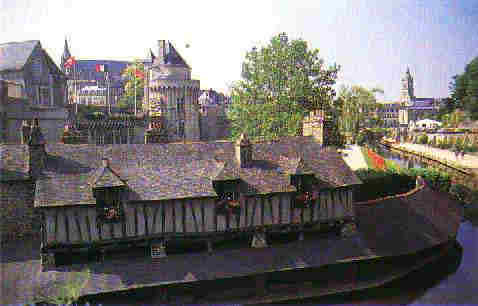 VANNES.It's one of this pretty, quite chique provincial towns with a centuries old history, and you have only to look at the map to make a fair guess about its attractions. Surrounded by inlets, creeks and islands (Golfe du Morbihan) it can hardly fail to appeal. The canalised waterway goes deep into town, so that you see boats, masts, rigging and chug chugging as an integral part of the scene in old town. VANNES.It's one of this pretty, quite chique provincial towns with a centuries old history, and you have only to look at the map to make a fair guess about its attractions. Surrounded by inlets, creeks and islands (Golfe du Morbihan) it can hardly fail to appeal. The canalised waterway goes deep into town, so that you see boats, masts, rigging and chug chugging as an integral part of the scene in old town.
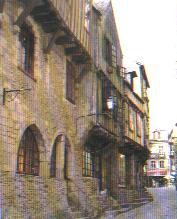 VANNES is an old town with ramparts, pretty squares, narrow streets and heavy built ateliers. Cars are best left outside the steep, narrow and cobbled streets of old town. The modern Vannes is outside the walls. VANNES is an old town with ramparts, pretty squares, narrow streets and heavy built ateliers. Cars are best left outside the steep, narrow and cobbled streets of old town. The modern Vannes is outside the walls.
Vannes has a landmark that everyone can see, the Cathedrale Saint Pierre, built during six centuries, which influenced of course different architectural styles. It's a veritable hotch potch of styles and ideas. The whole building is lopsided,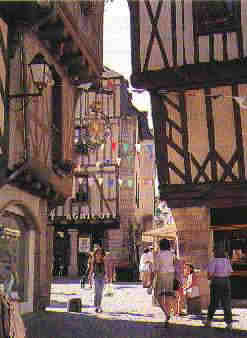 and no wonder. Its high-vaulted knave is bordered with chapels. If you care to enter, you will notice the unusual, round chapel, built in the 16th, in the style of Italian Renaissance, almost inexistent in Brittany. The Treasure on view in the chapter house includes chalices, pyxes, volumes of illuminated manuscripts and a 12th century wedding chest in vellum-covered decorated wood. and no wonder. Its high-vaulted knave is bordered with chapels. If you care to enter, you will notice the unusual, round chapel, built in the 16th, in the style of Italian Renaissance, almost inexistent in Brittany. The Treasure on view in the chapter house includes chalices, pyxes, volumes of illuminated manuscripts and a 12th century wedding chest in vellum-covered decorated wood.
A pleasant, sunny square is the place du Maréchal Joffre, with café tables at which to sit and take stock. The prospect is one of dignified old grey houses lining the banks, whilst in the background is the Porte Saint-Vincent, leading away from the activity of the port to the shaded seclusion of old town.
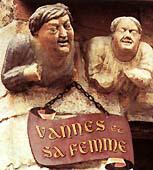
If you want to have an idea how Vannes looked in the Middle Ages, loiter over the photogenic place Henry IV, lined with 16th century, narrow timbered houses with steep roofs, overhanging pointed facades and small windows. Some of the finest gabled and half-timbered houses may be found in Place Henri IV. The most intriguing of these is perhaps the House of Vannes in Rue Rogue. The façade is decorated with two jolly woodcarvings of peasants referred to as Vannes and his Wife. The Archeological Museum in the nearby château has fine prehistoric artefacts from all over the region. One advantage is that most of the items on display are also labelled in English. It is the best museum of its kind in Brittany.
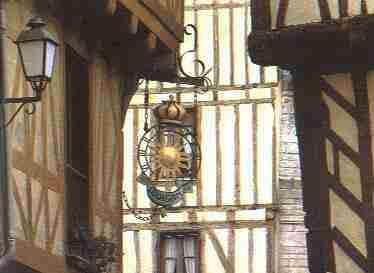 Even older houses are to see in the rue St. Salomon and rue des Halles. In this last street is the entrance of "LA COHUE". These medieval market halls (13th century) have undergone major refurbishing in the 17th century. Until the end of the 19th, a daily market was held here. It's restored and houses today two museums: Musée des Beaux-Arts and Musée du Golfe et de la Mer. Even older houses are to see in the rue St. Salomon and rue des Halles. In this last street is the entrance of "LA COHUE". These medieval market halls (13th century) have undergone major refurbishing in the 17th century. Until the end of the 19th, a daily market was held here. It's restored and houses today two museums: Musée des Beaux-Arts and Musée du Golfe et de la Mer.
Although there are more tourists here, there are fewer fumes, and the higher you climb, the deeper the cxalm. Tall, gabled houses meet their opposite numbers so that it as always restfully dark and cool.
On the place des Lices, in the old town, you get a taste of the medieval past, it's here that all tournaments took place, knights fought tournaments 'in the lists' and that Sint Vincent preached. François I was present at the great celebrations held here in 1532 to mark Brittany's union with Francs-Comtois.
 |
|
PLace des Lices:
niche |
The Place des Lices is crammed with market stalls on a Wednesday, and packed with people from the surrounding countryside as well as tourists. However there are plenty of large car parks nearby. Be sure to saunter through the Promenade de la Garenne, a colorful 17th century park, and admire the magnificent gardens nestled beneath the adjacent ramparts. Between the ancient Postern Gate and the Prison Gate you look down on the unusually shaped grey-tiled roofs of the Wash Houses curving along the riverbank. This is the most photographed corner of Vannes. It is particularly impressive in summer, when floodlighting does the dumpy medieval towers into dramatic relief.
Another very sought spot for photographers is the view from a narrow, little bridge, on the flower filled moats of the 16th century washhouses, with their crazy roofing. They are still occupied!
If you want to check up the Golfe du Morbihan, there are good cruises offered by "Vedettes Vertes" company. The depot is on the Promenade de la Rabine.
Bibligraphy
A holiday history of France, by Ronald Hamilton (London-Hogarth press), Region Normandie, ses merveilles, ses cicatrices, by Louis Letellier (ed. Cloison, Rouen 1995, La France des petits chemins: Normandie, by J. de la Valléé (ed. Cité presse, Paris 1998-En Bretagne Morbihanaise, Coutumes et traditions du Vannetais Bretonnant au XIX°(Arthaud-Les origines historiques de Vannes (Vannes, 1904)-Fouille historique de l'ancien diocese de Vannes, by L.LUCO,(2nd ed., Vannes, 1908.
|