|
Caen Normandy Musee pour la Paix emotional and moving visit Site Home - What's New?-Feedback - About Jack-Travel/Art Links |

NORMANDY
Normandy-Caen Peace memorial-Emotional and moving visit
Memorial sites
and beaches main page
D-Day beaches and war memorials
Pegasus Bridge
Benouville
Ranville
| To Introduction and creation | to Caen memorial contents |
The Memorial is on the Caen
Ring road (N 13) to the west of its junction with the D 17. By bus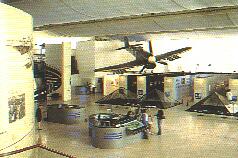 take a no.17 from the place Courtonne.
The main building of the Memorial is built on the remains of a German commanding
bunker, a massive edifice in "pierre de Caen". Built on three levels,
it uses a lot of audio-visual techniques to set the Battle of Normandy into the
context of WWII, with thematic links to previous and related conflicts.
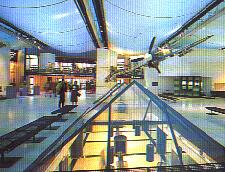
First symbol: the large central
fracture, evoking the Allied breakthrough in the Atlantic Wall.
Shot with symbolism, its centrepiece
starting from the large central hall is a walk-down spiral gallery with a wall,
the "CERCLE DU TEMPS" (circle of time), covered by names of
philosophers who counted in History. It’s chronicling now our century’s
descent into war with a second fracture: the red line indicates the appearance
of the anti-Semitic "sentiment". The visit can start.....We enter a
dark corridor who will decline all along a brilliant explanation about the roots
of WWII.
"FAILLITE DE LA PAIX" (failure of peace): from 1918 on,
different facts will oppose the European understanding: the Mussolini march on
Rome, the 1929 crash of Wall street, the power demonstrations of the nazis in
Nuremberg, all this on small screens proffering also multiple Nuremberg rallies.
End of hostilities, the Allies retreat at Dunkirk. White veil…now we are taken
in a bubble.
 Suddenly the
amplified voice of the Fuhrer shrieks in our ears! It’s mass conditioning.
Today nobody admits that they were bewitched. Try to speak: your voice can also
be very loud! Could the individual be treated as an equal with a dictatorship?
Suddenly the
amplified voice of the Fuhrer shrieks in our ears! It’s mass conditioning.
Today nobody admits that they were bewitched. Try to speak: your voice can also
be very loud! Could the individual be treated as an equal with a dictatorship?
"LA FRANCE DES ANNEES NOIRES", (France in the black years),
arrival of the Germans in France, the dishonour for the French at Compiegne you
can hear a surrealistic phone conversation just after the signing between
Weygand and Huntzinger), darkened rooms evoke the years of occupation, wide
space mirror the world widening of the 1942 conflicts. The ignoble collaboration
of the Vichy militants is not forgotten, the Resistance, the Genocide...... A
room you will never forget: the one where the faces of the deportees fade
slowly, in the dark. On the floor, little flames of hope and tortures. Only Yad
Vashem in Jerusalem outpaces this in emotion.
"GUERRE MONDIALE, GUERRE TOTALE" (World War, Total War):
America joins the war! A light is beginning to shine. All is well mapped and
explained to follow the evolution and the slow backing off by the Teutons. In
bulk: posters of the war effort), photographs of the first test of the atomic
bomb (on the wall, a letter from Einstein), the preparations of the Overlord
operation (seen from the British side), etc...
 |
|
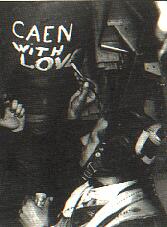
Gift from the US 8th AAF |
PROJECTED MOVIES: Three not
to miss and if you are pushed for time, see these first. First a film-montage of using both real and fictional footage, vividly
recounts D-Day as simultaneously experienced by both the Allies and the Germans,
then in a stunning turning decor, the "Bataille de Normandie" and its
subsequent progress in a series of illuminated maps, and finally, “Hope”, a
documentary film by the French actor Jacques Perrin, "Esperance",
retracing the strong and important peace time moments since the liberation of
Paris and concluding with images of continuing conflict and idealistic calls for
world peace.
Exit the main building, and take the
stairs or elevator to the inferior platform. Here is the GALERIE DES PRIX NOBEL
DE LA PAIX, first museum ever dedicated to these benefactors of humanity. A long
corridor with portraits. No prize was given during the Word Wars (except in 1917
to the Red-Cross). The first coloured man was named Lutulli, the last Frenchman
to have obtained it, in 1968, was Rene Cassin (editor of the Human Rights
Declaration). Amnesty International got the prize in 1977, the Dalai-Lama in
1989. Women? Aun San Kuyi, the pretty and courageous Burmese, and Roberta
Menchu, who defends the Indians of Guatemala)
Bibliography
A holiday history of France,
by Ronald Hamilton (London-Hogarth press), Region Normandie, ses merveilles, ses
cicatrices, by Louis Letellier (ed. Cloison, Rouen 1995), Holt’s battle field
guides, Normandy Overlord by Holt, Tonie and Valmai (Sandwich, Kent), Guides du
Routard, (ed.Hachette), La France des petits chemins: Normandie, by J. de la
Valléé (ed. Cité presse, Paris 1998), Six armies in Normandy, by John Keegan,
(paperback ed. Pimlico)-“Memorial
pour le Paix, brochure”.
Back to Normandy main page and cities
Ouistreham
Omaha beach
Pointe du Hoc
Utah Beach