|
Caen Normandy Musee pour la Paix History Site Home - What's New?-Feedback - About Jack-Travel/Art Links |

NORMANDY
Normandy-Caen Peace memorial (Musée pour la paix)-Introduction and creation
Memorial sites
and beaches main page
D-Day beaches and war memorials
Pegasus Bridge
Benouville
Ranvillesus
Bridge
Caen is undoubtedly an unavoidable halting-stage for anyone
visiting the region. Martyr city in the heart of the bloody and ruthless
“bataille de Normandie”, this city suffered heavily from the bombings and
war misery but majestic and historical building remind us that there were times
when it was different. A pleasant city, with some charm, with some medieval
streets that escaped the 75% destruction of Caen during the war. Most of its
citizens sought refuge in church caves, which was the reason that the allied
spared these buildings. Today life is relaxed, the cuisine above average to
delicious and the population very friendly. But despite the good-nature
atmosphere, the city didn’t forget the past and it’s incredible "Musee
pour la Paix". The best way not to start war over again is to consolidate
peace….
In following essays I will only lead you through the Caen
War Memorial. The usual way of visiting a town and its history will be described
in the Normandy cities section.
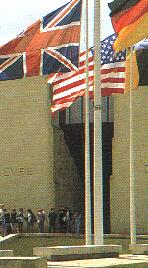 On
the northwest outskirts of Caen, very well indicated when you come from centre
town on the Eisenhower Esplanade (Direct bus 17 from the SNCF station.) stands a
smooth, monolithic building. It might be the HQ of some international company
until you read the text carved in the façade: ”La Douleur m’a brisée, la
Fraternité m’a relevée, de ma blessure a jailli un fleuve de liberté.” "Broken by pain, I was raised up
again by comradeship, and from my wounds there flowed a river of freedom."
(translation with te graceful collaboration of Mrs. Anne Forrest)
On
the northwest outskirts of Caen, very well indicated when you come from centre
town on the Eisenhower Esplanade (Direct bus 17 from the SNCF station.) stands a
smooth, monolithic building. It might be the HQ of some international company
until you read the text carved in the façade: ”La Douleur m’a brisée, la
Fraternité m’a relevée, de ma blessure a jailli un fleuve de liberté.” "Broken by pain, I was raised up
again by comradeship, and from my wounds there flowed a river of freedom."
(translation with te graceful collaboration of Mrs. Anne Forrest)
Inaugurated at the symbolic date of 6th of June 1988 by
Francois Mitterand, it differs spectacularly from the D-Day museums found
elsewhere in Normandy. It’s one
of the unavoidable and obligatory passages in Normandy. Regarded as one of the
most modern museums of France, the Memorial is conceived not only as a cultural
centre (museum, cinema, exhibitions.....), but also an exchange forum, a data
bank (documentation, specialized libraries, research offices), but also a
"monument to peace " (gallery of the Nobel prices), an gathering place
(conferences, international encounters, concerts, flour shows...), but also, and
above all, a centre of meditation: "how to prevent other wars?".
Didactilly seen, I must praise the concept and multi-media
presentation. And what is presented pricks the visitors to put themselves in
question, question themselves about the evident fact that peace, democracy and
human rights are very labile concepts.
Sobriety, limpidity of the design, intelligence of the
setting, rigorous selection of the documents make this Memorial an original and
passionate museum, where your visit will turn out extremely enriching.
Open every day from 9-19 (21 from July 11 to August 23n and
18 h in the winter). Closed from January 1 to January 15, on January 25 and on
Christmas day. Entrance fee: 67 FF (59 students), free for the less than 10
years old. Count a minimum of 3 hours of visit.
Bibliography
A holiday history of France, by Ronald Hamilton (London-Hogarth press), Region Normandie, ses merveilles, ses cicatrices, by Louis Letellier (ed. Cloison, Rouen 1995), Holt’s battle field guides, Normandy Overlord by Holt, Tonie and Valmai (Sandwich, Kent), La France des petits chemins: Normandie, by J. de la Valléé (ed. Cité presse, Paris 1998), Six armies in Normandy, by John Keegan, (paperback ed. Pimlico)-“Memorial pour le Paix, brochure”.
Back to Normandy main page and cities
Omaha beach
Pointe du Hoc
Utah Beach