|
Paris main page Back
to 3rd arr
contents
Introduction
The
new Centre
Modern
Art collection
Contemporary
collection
Brancusi atelier
Place
Igor Stravinsky
|
The area of Beaubourg 18th
century: butchers, needle makers, harness-makers, confectioners, stockjobbers,
cutlers, curriers, bawlers, glassmakers but also moneychangers and usurers.
It
was the area of all celebrations, follies and entertainment with its theatres,
cabarets and “gilded belts”, ribalds and prostitutes. Under Napoleon II, the
great Parisian urban works 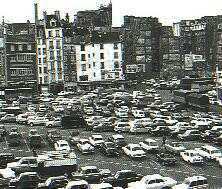 of
baron Haussman squeezed the area between two large arteries and the quarter
started to die out. The area stayed empty and desolated, just housing a large
open-air parking (see picture). of
baron Haussman squeezed the area between two large arteries and the quarter
started to die out. The area stayed empty and desolated, just housing a large
open-air parking (see picture).
1963: the minister of Culture, André Malraux, announces an ambitious project
set up by le Corbusier. These plans are changed when Le Corbusier dies two
years later.
In 1969 president Pompidou, who dreamt of giving Paris an art centre up to the
ambitions of a glorious France, takes up the idea again. Remember 1971, when Georges Pompidou said,
discovering the "maquette" (small scale model) of the future art
centre: "This is gone make a hell of a noise and uproar!!". He was
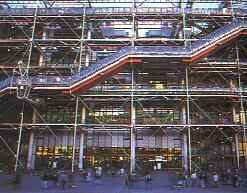
damn right. Proposing a steel and glass box having the looks of a petrol
refinery to bring art to everybody! That's what I call audacity! Green and blue
pipes, pillars, footbridges, portals, chimneys: with its giant Meccano allure,
indeed the Centre Pompidou had its violent opponents and still has. “” I
would like passionately that Paris would possess a centre for creation where
plastic arts would go together with music, cinema, literature, audiovisual
research, etc..This museum can only be of Modern Art since we have the Louvre.
The creation would be modern and evoluating all the time. The library would
attract thousands of people who would be directly confronted with all arts.
“” (Pompidou, 1976)
 But, despite some
called it the "cultural supermarket" or "architectural
King-Kong", its success crushed all previsions: 25, 000 visitors a day when
they had counted on 7,000! (that's more than the Eiffel tower!!) and about 8
million a year. More than 160 millions since it opened. But, despite some
called it the "cultural supermarket" or "architectural
King-Kong", its success crushed all previsions: 25, 000 visitors a day when
they had counted on 7,000! (that's more than the Eiffel tower!!) and about 8
million a year. More than 160 millions since it opened.
And above all, Beaubourg took away the "fear" to access cultural
sites. Without even looking at a painting or sculpture, there is so much to do
in Beaubourg: learn to speak Mongol or Tamoul at the Public Library of
Information, discover Armenian motion pictures at the Salle Garance, clips of
any star in the videodisk documentation centre, or even get rid of your kids at
the "children atelier". Poetic evenings, philosophic debates, thematic
conferences, cycles, festivals, spectacles....There was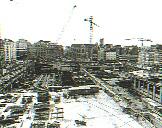 always something going
on in Beaubourg. always something going
on in Beaubourg.
But let’s get back to history.
More than 600 architects worked day and night to get the contract. A strange
Italo-British project won the contest: Piano and Rogers. The works were executed
in a record tempo (1972-1977) and one day of February 1977 Parisians woke up,
pinched their cheeks and didn’t believe what they saw! President Giscard d’Estaing
just inaugurated the “Centre National d’art et Culture Georges Pompidou”.
Huge discussions of pro and contra created a storm, a passionate debate about
its inside –out architecture, but soon this highly controversial edifice grew
to one of the most popular tourist destinations in the city. Anyway, the fact
was there, Pompidou, an immense, an inextricable metal heap, glass, pipes,
whatever that makes us think of a steamship. But what is remarkable, is that all
the different functions in the building have their specific colours: red for the
people’s and goods transport, yellow for the electrical circuits, green for
the water circulation and white for all architectural functions.
The building is made entirely of glass and surrounded by a white steel grid,
five floors supported by steel beams set into external scaffolding made up of 84
steel girders, each one weighing 83 tons.
In 1997, after 18 loyal and good services, the centre Pompidou had to close for
renovations. Major lifting and …(but that’s a secret), the asbestos
initially put in the building was taken out).
Renzo Piano was charged with the renovation of the reception areas, spectacles,
exhibitions at first level, terraces, service areas and circulation. After
another contest, two young architects Jakob and Mac Farlane got the restaurant at
the upper floor, decorated by Stark. The spaces dedicated to the permanent
collections were redone by Jean-François Bodin.
Next essay, the real start of a visit to Centre Pompidou with first: the famous
esplanade in front of the building. On January 1st, year 2000, at 11.00 hours the new CENTRE POMPIDOU
opened its doors again, after closing for renovation works during 27 months.
Bibliography:
--Vie
et histoire des arrondissements de Paris, ed.Hervas (1985-1988--Nouvelle
Histoire de Paris, ed.Hachette--Le Pieton de Paris, by L.P.Fargue, ed.Gallimard
-Paris, 2000 d'histoire, by J.Favier, ed.Fayard 199--Paris 19eme siecle,
l'immeuble et la rue, by F.Loyer, ed.Hazan, 1994-Historique des rues de Paris,
‘Soc.Contact Communication, Paris), Beaubourg, l’esprit du lieu, by Philippe
Bidaine (Ed.Scala , Paris)
|
Paris dining world!!!!
Book a Paris hotel on line
|
