|
Paris main page Back
to 3rd arr
contents
Introduction
The new centre
Modern
Art collection
Contemporary
collection
Brancusi atelier
Place
Igor Stravinsky
|
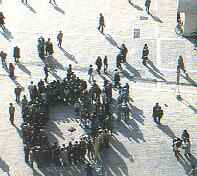 By
creating a vast esplanade in front of Centre Pompidou, thearchitects
had the clear intention to integrate the Centre into the city. The piazza became
the kingdom of street performers: fire-eaters, jugglers, musicians, cartoonists,
and narrators entertain the by passers and By
creating a vast esplanade in front of Centre Pompidou, thearchitects
had the clear intention to integrate the Centre into the city. The piazza became
the kingdom of street performers: fire-eaters, jugglers, musicians, cartoonists,
and narrators entertain the by passers and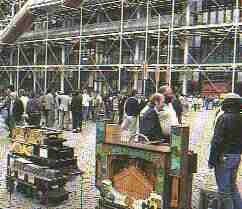 plunge the Centre Pompidou in a
playful atmosphere. Very lively spot, Beaubourg exploits this situation and
built the esplanade in slight declivity towards the entrance of the Centre. plunge the Centre Pompidou in a
playful atmosphere. Very lively spot, Beaubourg exploits this situation and
built the esplanade in slight declivity towards the entrance of the Centre.
It’s for the first time that all forms of modern culture are reunited in the
same spot and
extraordinarily accessible.
By entering the
Centre, millions of people enter a museum of modern art for the first time (and
even any sort of museum). No more heavy concepts of classical exhibition places,
psychological blockages against culture with a big “C”. It’s one of the
miracles of Centre Pompidou.
Since it’s opening in 1977
the Centre had an immense success. About 8 million a year visitors came to
discover this new Mecca dedicated to modern and contemporary culture. In an
atypical architecture, I concede, but prodigiously interesting. It is now one of
the most visited sites in  France
(beats the Louvre), one of the most visited cultural places in the world. France
(beats the Louvre), one of the most visited cultural places in the world.
As you all know, the Centre was closed for almost three years.
The building yard was enormous: the external architecture was redone but not
modified, still looking as a big refinery. But the interior spaces have been
completely changed. The principal beneficiary is the MNAM (Musee National d'Art
Moderne), now on two levels and more than 14,000 square meters which enables it
to expose more than 1400 works (instead of 800 before) With its new displays of
paintings and sculptures, judicious restorations, spectacular acquisitions, the
Centre Pompidou can be considered today as one of the first museums in the world
in his category: modern and contemporary art.
With its reopening the Centre loses nothing of its welcoming quality, the museum
is (like before) divided between level 4 and 5. From 1900 to 1960 on level 5,
from 1960 until today on
 level 4. It gained
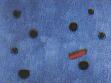
4,500 square meters superficies. On level 5, nine hundred works retrace and tell
art history of the first half of the 20th century, from fauvism to American
abstract expressionism, insisting on the strong points of the collection: the
ensemble of cubist sculptures, works of the great gurus of art, very well
represented: Matisse, Picasso, Kandinsky, Miro, Ernst, Giacometti, etc... or
insisting on the important schools and movements like surrealism, abstraction,
informal art. level 4. It gained
4,500 square meters superficies. On level 5, nine hundred works retrace and tell
art history of the first half of the 20th century, from fauvism to American
abstract expressionism, insisting on the strong points of the collection: the
ensemble of cubist sculptures, works of the great gurus of art, very well
represented: Matisse, Picasso, Kandinsky, Miro, Ernst, Giacometti, etc... or
insisting on the important schools and movements like surrealism, abstraction,
informal art.
Level 4 houses the contemporary. Opening with a work of Jean Tinguely, grand
ensembles illustrate artistic life from 1960 until today. Pop art with Roy
Liechtenstein, Oldenburg, Rauschenberg, new realism of Arman, Cesar, Nikki de
Saint-Phalle, op art and cinetism with Albers, Agam, Vasarely and not to forget
the Arte Povera and conceptual art ending with the new tendency to figurative
painting.
The collections of the museum are composed by 44,000 works of which 1400 will be
exposed .The works will be replaced every 18 months for the
moderns, every year for the contemporary.
At level six the new cafeteria was designed by Costes, now a trendy meeting
place.
Cost of this formidable lifting: 576 millions FF of which 40 come from private
maecenas (Pierre Bergé, Yves Saint-Laurent, Pernod Ricard and others). It's the
indispensable price of a reorganisation when the MOMA of New York and the TATE Gallery of London are reorganising and increasing their surfaces. Beaubourg, by
excellence the passage between the 20th and 21st century, couldn't stay and watch.
Next post a more detailed visit of the Art Museum with a lot of pictures.
Bibliography:
Vie
et histoire des arrondissements de Paris, ed.Hervas (1985-1988--Nouvelle
Histoire de Paris, ed.Hachette--Le Pieton de Paris, by L.P.Fargue, ed.Gallimard
-Paris, 2000 d'histoire, by J.Favier, ed.Fayard 199--Paris 19eme siecle,
l'immeuble et la rue, by F.Loyer, ed.Hazan, 1994-Routard 99 (Ed.Hachette),
Beaubourg, l’esprit du lieu, by Philippe Bidaine (Ed.Scala , Paris)
|
Paris dining world!!!!
Book a Paris hotel on line
|
