|
Paris main page Back
to 3rd arr
contents
Introduction
The
new Centre Modern
art collection Contemporary
collection
Brancusi atelier
Place
Igor Stravinsky
|
Let’s give
first some precisions: this Centre is a cultural adventure, not only a museum
like too many people still believe. Open every day except Tuesday from
11.00–22.00. The library open only at 12.00 but also until 22.00. Phone number is 0144781233.
Unfortunately you have to pay today to get on the escalator leading to the upper
parts.
Let’s start with the most important: the Musée National d’Art Moderne.
It’s an extraordinary museum, with superb collections of modern and
contemporary art. I assure you, even if you don’t like modern art, even if you
hate it, and a lot do, it is worth to come and have a look. I’m sure it will
trigger something inside yourself, which you didn’t even suspect. Anyway, hundreds
of master pieces are lined along your route. Everything is disposed and
placed in
an intelligent, airy and chronological way.
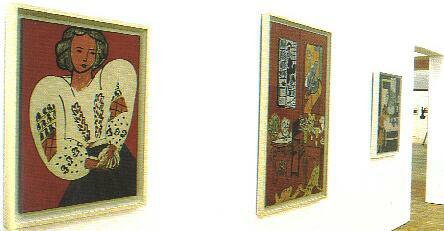 |
|
Matisse gallery |
This collection started a long time ago, heir of the musée du Luxembourg
(1818-1940) dedicated to living artists, heir of the musée du Jeu de Paume,
dedicated to foreign Schools (1932-1945), the Musée national d’Art moderne du
Palais de Tokyo (1947-1976). The museum in the Centre is now the final depositor
of the modern and contemporary art collections inherited, bought or donated.
Like said before, its’ one of the main collections in the world (more than
40,000 works) not only of painting but also sculpture, drawings, video
installation, artistic films, architecture, design and industrial creation.
The spaces are of course not large enough to present a small fraction, even
after the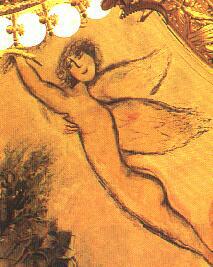 renovation works. That’s why the collections ‘turns” periodically. 900
works present the history of art of the first half of the 20th
century. Fauvism, trying to express everything in exalting colours, applied in a
savage way, brutal without any plastic concern, sometimes right out of the
colour tube. The name “fauve” meaning “wild beast, animal” is said to be
invented by a critic who saw the works at the salon d’automne in 1905 and
cried out loud “Ce sont des fauves!!”. The name stayed.
renovation works. That’s why the collections ‘turns” periodically. 900
works present the history of art of the first half of the 20th
century. Fauvism, trying to express everything in exalting colours, applied in a
savage way, brutal without any plastic concern, sometimes right out of the
colour tube. The name “fauve” meaning “wild beast, animal” is said to be
invented by a critic who saw the works at the salon d’automne in 1905 and
cried out loud “Ce sont des fauves!!”. The name stayed.
The itinerary ends with abstract American expressionism and different movements
of the 50’s (Yves Klein, Soulages, Hantai) and an important Matisse section.
Further on, the museum reveals all its treasures: cubist sculptures, grand masters of the
century (more Matisse, Picasso, Braque, Duchamp, Kandinsky, Dealunay Leger, Miro,
Ernst, Giacometti, Dubuffet..), a diversity of groups and movements (Dada,
Bauhaus, abstraction, informal art…), terraces with monumental sculptures and
rooms with cut out cardboards from Matisse. Sometimes, this reveals some very
agreeable surprises.
I will not stand still at Duchamp’s works, not really being a fanatic and his
art doesn’t speak to me.
But Fernand Leger is something else. His cubist works are a reaction to the
naturalism and positivism of the 19th century and he describes
objects in a totally different way, taking into consideration that the machines
are taking over humanity.
Just a few words about Kandinsky. He was the instigator and first to have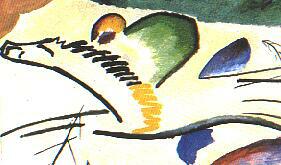 set up
an “abstract” painting. Delaunay was a faithful follower. Paul Klee, the
Swiss and Piet Mondriaan, the set up
an “abstract” painting. Delaunay was a faithful follower. Paul Klee, the
Swiss and Piet Mondriaan, the 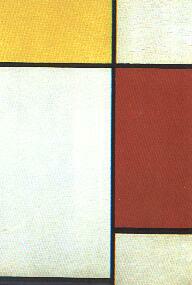 Dutchman stepped
in, each in his own style. Mondriaan
with its geometric rigour and precision, Kandinsky with its poetic, magic and
joyful world, Klee with its abstract lyrical works, a popular realism. Dutchman stepped
in, each in his own style. Mondriaan
with its geometric rigour and precision, Kandinsky with its poetic, magic and
joyful world, Klee with its abstract lyrical works, a popular realism.
And what about our Belgian celebrities Magritte and Delvaux? And Yves Tanguy,
Salvador Dali?
The pop-art, another trend of the 50’s, reflects a new consumers society.
Floor 4 houses the art mid to end 20th century. That's for next
essay.
Bibliography:
--Vie
et histoire des arrondissements de Paris, ed.Hervas (1985-1988--Nouvelle
Histoire de Paris, ed.Hachette--Le Pieton de Paris, by L.P.Fargue, ed.Gallimard
-Paris, 2000 d'histoire, by J.Favier, ed.Fayard 199--Paris 19eme siecle,
l'immeuble et la rue, by F.Loyer, ed.Hazan, 1994-Historique des rues de Paris,
‘Soc.Contact Communication, Paris), Beaubourg, l’esprit du lieu, by Philippe
Bidaine (Ed.Scala , Paris)
|
Paris dining world!!!!
Book a Paris hotel on line
|
