|
Coming out of the rue de l’Ancienne Comédie,
it is time to take the metro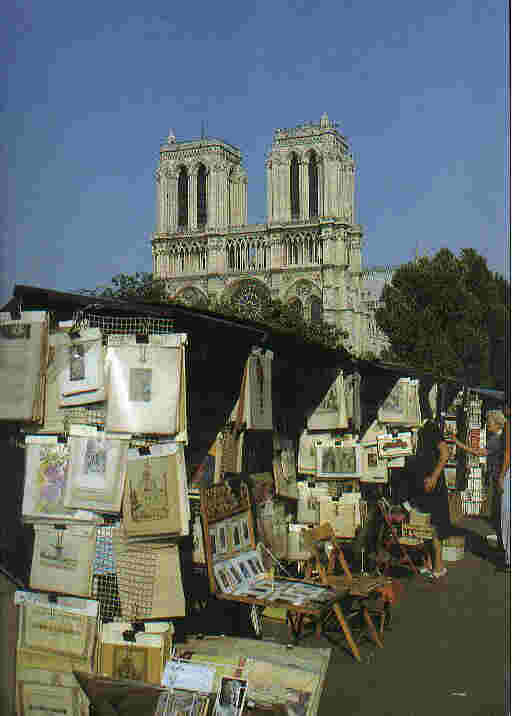 for once…or maybe you’d like to walk the whole
boulevard Saint-Germain until the Seine, it’s quite a distance. Anyway get off
at the station Jussieu (direction Gare d’Austerlitz) and have a look at the Science
Faculty of Paris. A massive edifice in glass and steel around a courtyard and
dominated since 1970 by a tower (called Zamansky) . I will not mumble my
disapprobation too much upon the opportunity to build that big tower reminding
the tour Montparnasse, nor will we extend critics on the lack of imagination of
the architects (in the glacial style you couldn't do better!!) Nevertheless to
humanize this labyrinth, a few artists offered some of their works to decorate
the interior yards: Vasarely, Arp, Stahly, etc…Notice also the graffiti on the
two facades. It is a remainder from the French student revolution in 1968 when
incendiary Maoist slogans were the main decoration accepted by the students.
Jussieu is enormous and houses more than 10.000 research workers, professors,
students and administrative employees. for once…or maybe you’d like to walk the whole
boulevard Saint-Germain until the Seine, it’s quite a distance. Anyway get off
at the station Jussieu (direction Gare d’Austerlitz) and have a look at the Science
Faculty of Paris. A massive edifice in glass and steel around a courtyard and
dominated since 1970 by a tower (called Zamansky) . I will not mumble my
disapprobation too much upon the opportunity to build that big tower reminding
the tour Montparnasse, nor will we extend critics on the lack of imagination of
the architects (in the glacial style you couldn't do better!!) Nevertheless to
humanize this labyrinth, a few artists offered some of their works to decorate
the interior yards: Vasarely, Arp, Stahly, etc…Notice also the graffiti on the
two facades. It is a remainder from the French student revolution in 1968 when
incendiary Maoist slogans were the main decoration accepted by the students.
Jussieu is enormous and houses more than 10.000 research workers, professors,
students and administrative employees.
Follow
now the rue des Fossés Saint-Bernard to the Seine and we see our next site:
“L’INSTITUT DU MONDE ARABE.
But
before entering, let’s make a little walk along the shores of the Seine. The
Seine, beating heart of literary Paris and a paradise for book amateurs. Not
only the giants of French literature, from Racine to Camus, but also the “lost
generation” of American writers, living in Paris between the two world wars,
had a preference for the moral “ambience” of the quartier Latin (and later
Saint-Germain). Along the quays and in back streets running parallel, you can
nose about books of different special subjects, from art of navigation to black
magic. The most famous of these libraries in the area is “Shakespeare and
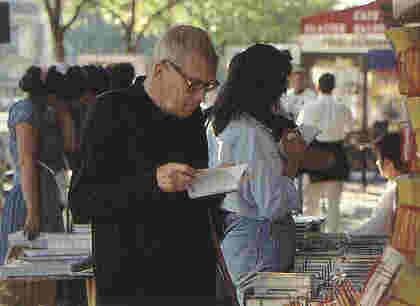
Co”. Loiter along the quays, leaf a book in one of the numerous
“bouquinistes”, waiting for clients in their green-painted stalls. You can
find anything, from an essay of Leibniz to a “Playboy” of a rare first
edition.
|
|
|
Open air bookstore along the
Seine |
THE
INSTITUT DU MONDE ARABE was opened at the quai Saint-Bernard, 23 in 1987 to give
people the opportunity to learn about Muslim culture and to facilitate the
cultural exchanges with the Occident. It is a really successful achievement all
that glass, aluminium and concrete, perfectly used. The northern building, sharp
as a blade, heads into a delicate curve. Between the two the junction is made
through a footbridge. A great concours (contest) had been launched in 1981 for
this incredible building, won by Jean Nouvel. It was not easy to find a modern
form, perfectly integrating in the curve of the quai Saint-Bernard... and
evoking the Arab world! Jean Nouvel integrated transparent ornaments at the
south side of the building that can be moved according to the position of the
sun. The different way of lighting changes the aspect of the wall permanently
all day! And it gives give an Arabic mark to the edifice.
It is in fact an assemblage of several hundred metallic blinds, which
openings are commanded by photoelectric cells in function of the light
intensity, remind us the "moucharabieh" (typical Arab window frame
art). The
inside, distributed around the elevators, houses a book shop, library in
the shape of a tower where a gigantic spirally ramp is plastered with thousands
of books, documentation center, mediatheque, audio-visual
space, auditorium and museum (starts at the 7th floor). Divided in
three sections, it is certainly worth a visit: pre-Islamic art, Arab-Islamic
art, Islamic art and Society (19th and 20th century).
The objects are very well displayed and valorized
by the lightings. For instance the superb enluminures (look that word up in your
dictionary) at the 6th floor), Koran title pages, geometric decorated
woodworks, religious books of the 12th and 14th century, carpets, coins
etc….On the 4th floor, little chests and encrusted wood sand in the gallery on
the left splendid collection of art objects: jewels, miniatures, very old
carpets, dervish axe, ceramics, etc.. In the big room: engraved water jar of the
12th, ravishing basins in chiseled brass and encrusted with gold and silver...
Don’t
forget to take the elevator to the top floor where a restaurant with a vast
terrace has one of the most beautiful views of the north and west of Paris and
of course, of Notre-Dame. Teatime is in the afternoon.
Bibliography:
Vie et histoire des arrondissements de Paris, ed.Hervas, 1985-1988, 20
volumes—Nouvelle Histoire de Paris, ed.Hachette (20 vol.since 1971), Le piéton
de Paris, by L.P. Fargue, ed.Gallimard 1997—Rive Gauche, une expérience
unique, by Cl.Evrard, ed.Albin 1991--- Guide du Routard Paris1998-99---Bords de
Seine, livres rares, by E.Goetgebuur
|
