|
Pantheon Sorbonne visits Site Home - What's New?-Feedback - About Jack-Travel/Art Links |
|
|
|
Paris main page
Arenes deLutece Contrescarpe-rue Mouffetard Rue de la Huchette Saint Severin-Saint Julien le Pauvre Musee de Cluny A
walk through the old quartier Latin-Cour de Rohan-Commerce Booksellers along the Seine-Institut du Monde Arabe
|
Paris-5th arr-Pantheon-Sorbonne |
|||
|
“Gloire à notre France éternelle ! Gloire à ceux qui sont morts
pour elle!....C’est pour ces morts que dont l’ombre ici est bienvenue, que
le haut Panthéon s’élève dans la rue. » This poem of Victor Hugo out of “Chants du Crépuscule
III” is very appropriate to this monument to the glory of France’s great
personalities. Translated freely, it means:” Glory to eternal France! Glory
for those who died for their country!…It’s for those deaths that this
Pantheon is erected here”. When Hugo wrote this phrase in 1827, he didn’t
know that once he would be part of this shrine as one of the great figures of
France’s history.Let’s start our walk here, on the square in front
of the PANTHEON. If you have the time you could first go to the Musee National
du Moyen Age et des Thermes de Cluny (I will describe in another article) or the
courtyard of the Sorbonne. Anyway, the walk from the Sorbonne to the Pantheon is
quite short. Passing on your way, you will run along some famous high schools
like the lycee Louis le Grand where famous pupils went like Robespierre, Victor
Hugo, Moliere, Baudelaire (thrown out for bad behavior!) and even Pompidou.
The interior of the Pantheon is mainly impressive by
its extent. The floor outlay is 110 meters long and 85 meters wide in the form
of a cross. But it’s from a distance that the Pantheon looks the most
beautiful. The best perspective is from the rue Soufflot, when you arrive from
the boulevard Saint-Michel. Stroll along the streets lying in a circle around
the place du Pantheon. You will meet City hall of the 5th
arrondissement, the Faculté de Droit (Law school), and the BIBLIOTHEQUE
SAINTE-GENEVIEVE founded in 1624. This library has more than half a million
books and thousands of manuscripts. But you must have a library card to enter
this books shrine. A short walk will bring you now to the church of
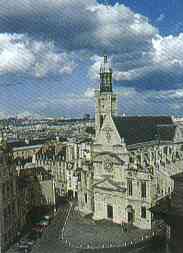
SAINT-ETIENNE DU MONT, facing the Pantheon.
This church is worth a visit especially because of
the very successful combination of different styles: the gabled roof above the
portal is classic, the rose window in the facade gothic and the cupola of the
bell tower shows Renaissance influences. Notice the remarkable choir gallery (16th
century), the only one in Paris not connected with the nave of the church. All
other similar galleries in Paris were destroyed during the 18th
century. The baroque organ and the wainscoting of the pulpit are outstanding,
and so is the stained glass window from the 16th and 17th
century in the “Galerie des Charniers”.
Going back through the rue Soufflot, take the rue
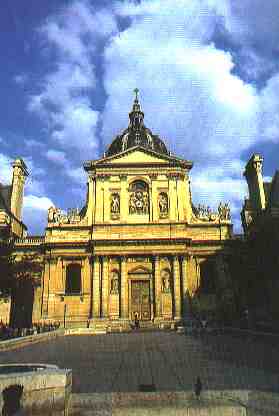
Victor Cousin to the right and you’ll walk straight into the SORBONNE, the
most famous symbol of French tradition. Its history goes back to the 12th
century when it was only a small theological faculty with some private homing.
The faculty was closed during the French revolution but Napoleon turned it into
the first French university. The present building you see dates from the 19th
century. If you manage to get inside (no problem, just act as a student or a
professor), you
will notice the sundial in the interior courtyard and the painted walls in the
reading rooms. The chapel of the Sorbonne, where Richelieu is buried, can only
be visited during special exhibitions or at special request. Bibliography:
Vie et histoire des arrondissments de Paris, ed.Hervas, 1985-1988, 20
volumes—Nouvelle Histoire de Paris, ed.Hachette (20 vol.since 1971), Le piéton
de Paris, by L.P. Fargue, ed.Gallimard 1997—Paris, 2000 ans d'histoire by
J.Favier ed.Fayard 1997---Guide du Routard 1998-99. |
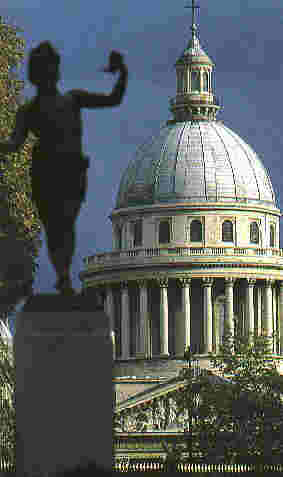 A little bit of history: we are in 1744 and Louis XV
is very ill during the siege of Metz. So he makes a vow, a promise that if he
gets better and regains his health, he will build an abbey church in honor of
Sainte-Genevieve, the patron of Paris. But he gets better much too fast…..! And
who pays for the costs? The citizens of Paris of course. The building starts in
1764 but is only finished in the middle of the French revolution, 1791. Very
bad timing ;-)! The revolutionaries decide to turn it into a mausoleum where
the great personalities of France would get their final resting place. The first
to be buried was Mirabeau, followed by Rousseau and Voltaire. But when the
shocking news came that Mirabeau had been a good pal of Louis XVI, he was pulled
out and had to give his place to Marat. The poor “Marat” would not be left
in peace for long since another problem came up! Indeed, a law of 1795 decreed
that you needed to be dead at least for 10 years before earning a spot in the
Pantheon. Out went Marat, finally buried at the cemetery of Saint-Etienne du
Mont. In 1885 Victor Hugo found hid way to the Pantheon. Since then, the purpose
of the Pantheon didn’t move an inch. Emile Zola, Jean Moulin, Louis Braille
(inventor of the Braille writing for the blind), Jean Jaures, Pierre and Marie
Curie were all buried with great pump. The great refurbishing of the Pantheon,
which is being on now, will last until 2010 at the least.
A little bit of history: we are in 1744 and Louis XV
is very ill during the siege of Metz. So he makes a vow, a promise that if he
gets better and regains his health, he will build an abbey church in honor of
Sainte-Genevieve, the patron of Paris. But he gets better much too fast…..! And
who pays for the costs? The citizens of Paris of course. The building starts in
1764 but is only finished in the middle of the French revolution, 1791. Very
bad timing ;-)! The revolutionaries decide to turn it into a mausoleum where
the great personalities of France would get their final resting place. The first
to be buried was Mirabeau, followed by Rousseau and Voltaire. But when the
shocking news came that Mirabeau had been a good pal of Louis XVI, he was pulled
out and had to give his place to Marat. The poor “Marat” would not be left
in peace for long since another problem came up! Indeed, a law of 1795 decreed
that you needed to be dead at least for 10 years before earning a spot in the
Pantheon. Out went Marat, finally buried at the cemetery of Saint-Etienne du
Mont. In 1885 Victor Hugo found hid way to the Pantheon. Since then, the purpose
of the Pantheon didn’t move an inch. Emile Zola, Jean Moulin, Louis Braille
(inventor of the Braille writing for the blind), Jean Jaures, Pierre and Marie
Curie were all buried with great pump. The great refurbishing of the Pantheon,
which is being on now, will last until 2010 at the least.