|
Rue de la Contrescarpe arenes de Lutece Rue Mouffetard Site Home - What's New?-Feedback - About Jack-Travel/Art Links |
|
|
|
Paris main page
Arenes de Lutece Place de la Contrescarpe-Rue Mouffetard Rue de la Huchette Saint Severin-Saint Julien le Pauvre Musee de Cluny A
walk through the old quartier Latin-Cour de Rohan-Commerce Booksellers along the Seine-Institut du Monde Arabe
|
Paris-5th arr-Arenes de Lutece-Place de la Contrescarpe-Rue Mouffetard |
|||
|
Leave the eglise St.Etienne du Mont and take the rue de Cujas eastwards,
make a left to the rue du Cardinal Lemoine and a right into the rue Monge. You
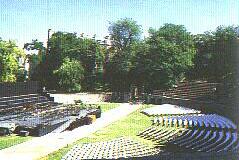
will arrive at a park where the ARENES DE LUTECE are waiting for you. The
“Arena Lutetia” are remains of a Roman arena destroyed in the 3rd
century. Completely forgotten during 1500 years they were rediscovered in 1869,
when new streets were planned and diggings ordered. Despite we cannot register
these arenas among the best-known Roman theatres, these ruins are one of the two
most important Gallo-Roman remains of Paris (the others being the Thermes de
Cluny, also in the 5th arrondissement). My sources inform me that it
was one of the largest amphitheatres of Gaul and that at least 15,000 spectators
could watch the gladiator fights or theatre performances. What you see now is
mostly a reconstruction and the arenas are a public garden now.
Return rue Monge and continue until you arrive at rue Lacepede. Make a
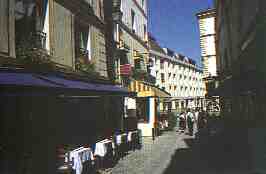
right and you’re heading to the PLACE DE LA CONTRESCARPE, bordered by ancient
houses, typical for the Parisian image book, with its pigeons and hobos, cafes
and restaurants. Have a look at no.1: this house used to be the “Cabaret de la
Pomme de Pin”, where Rabelais got drunk very often.
This is a street to walk, paying attention here to a dormer-window,
there to a beautiful door with its iron wrought decoration. You can discover old
signboards, small squares and passages, a little fountain of Marie de Medicis
(17th century) at the corner of the rue du Pot-de-Fer. Back yards are
to find (if still open) like the one at no.52, a bas-relief representing a
magnificent oak is to see at no.69, part of a 100 years old restaurant, “Le
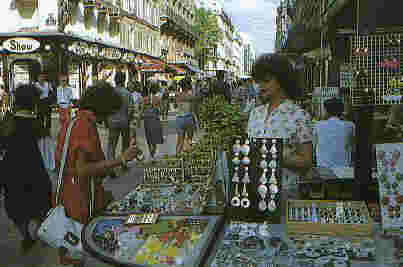
Vieux Chene”. The lower part of the Mouff’, with its permanent morning
market turns the street into a vibrant, coloured and vivid animation. If you
like this kind of food, delicatessen and some junk markets and you want to enjoy
it fully, come early in the morning, and preferably on Saturday. The market ends
around 1.30 pm. But, and there is unfortunately a “but”, the numerous
grocery shops are not more what they used to be. Quality is lowering, the
“clothing” business is setting in, and Greek restaurants are replacing the
traditional French bistros, leaving an odor of skewers behind. Bibliography:
Vie et histoire des arrondissements de Paris, ed.Hervas, 1985-1988, 20
volumes—Nouvelle Histoire de Paris, ed.Hachette (20 vol.since 1971), Le piéton
de Paris, by L.P. Fargue, ed.Gallimard 1997—Paris, 2000 ans d'histoire by
J.Favier ed.Fayard 1997---Le quartier de la Mouff"" by J.Hermelin,
brochure 1998, Guide du Routard 1998-99. |