|
Rue de la Huchette eglise saint severin Saint Julien le Pauvre Musee de Cluny Site Home - What's New?-Feedback - About Jack-Travel/Art Links |
|
|
|
Paris main page
Arenes de Lutece Contrescarpe-rue Mouffetard Rue de la Huchette-Eglise Saint-Severin-Julien le Pauvre-Musee de Cluny A
walk through the old quartier Latin-Cour de Rohan-Commerce Booksellers along the Seine-Institut du Monde Arabe
|
Paris-5th arrondissement-Rue de la Huchette-Eglise Saint Severin-Saint Julien le Pauvre-Musee de Cluny |
|
|
If the area of the Halles is called “Le Ventre de Paris” (belly of Paris), we must admit that the southeast is the head. This is the Paris of Abelard and Heloise, Thomas of Aquino, Erasmus and Ignatius di Loyola, Gertrude Stein, Ernest Hemingway, Jean-Paul Sartre and Simone de Beauvoir. Abelard, for those who ignore it, was
a 12th century dissident theologian who left the Ile de le Cite to
reflect with his students on the Montagne Sainte-Genevieve (still named like
that around the metro Maubert-Mutualite). This started a development that
brought a university, high school, faculty, college and laboratory in every
street and every alley where Latin
was the spoken language until the French revolution, even between the students
meeting in the cafes and street, hence the name “quartier Latin”. The area
was more less delimited by the boulevard Saint-Michel, boulevard Saint-Germain
and place de la Montagne Sainte-Genevieve, difficult to define their frontiers,
but it will not be the least of your fun to grab somewhere an unexpected place. Today the quartier Latin managed to keep its charm
despite all these years of changments. Small,
picturesque and lively streets bordered by old houses are still watching us. But
despite it is probably the area of Paris with the most traveling images, a
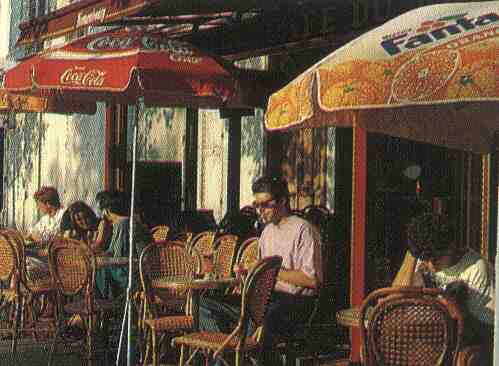
lot of streets are lined today with tourist restaurants, fast foods and cafes
more well known from the escalation of prices than the warmth of their
reception. Mostly between the Seine and the boulevard Saint-Germain a genuine
swindle and fake area grew where the inhabitants and other tourist catchers try
to make some money out of the credulity of the naive tourists. Bistros, snack
bars, grills and Chinese restaurants……name them, you have them, but all of a
VERY INFERIOR quality. They even hire “runners” to grab you by the arm and
drag you into their crummy place.
But something indefinable still fascinates:the atmosphere and the nightlife, a
spectacle and permanent agitation good to satisfy all visitors, attract young
people from the whole world. Finally, a stroll through this quarter can bring
you a great satisfaction as long as you stay away from the tourist traps. A walk
to the place de la Contrescarpe, descending the rue Mouffetard, a visit to the
Jardin des Plantes or a pilgrimage to the Pantheon to see the last resting place
of France’s many celebrities, these are the ways to visit this area. I will
make you some suggestions for a nice walk, but it is impossible to name all
worthy sites to see. Keep your eyes open and you will discover in Paris much
more then I can describe. Bibliography:
Vie et histoire des arrondissments de Paris, ed.Hervas, 1985-1988, 20
volumes—Nouvelle Histoire de Paris, ed.Hachette (20 vol.since 1971), Le piéton
de Paris, by L.P. Fargue, ed.Gallimard 1997—Guide du Routard 1998-99. |