|
Let’s proceed to the PLACE DE FURSTEMBERG, best by
taking the rue de l’Abbaye, behind the church. That’s how the Paris of the
great writers must have looked! One of the most beautiful squares in Paris,
especially in the spring when the trees show all their beautiful flowers. This idyllic square keeps the old spirit of Saint-Germain alive. And
in June it is the centre of the “Fete de la Musique”, music, music and music
again…. Benches were removed lately, to avoid a too large homeless
concentration. The MUSEE DELACROIX is located at no.6. He lived here
from 1857 until his death in 1863 in an apartment at the first floor of an old
house with atelier and garden.
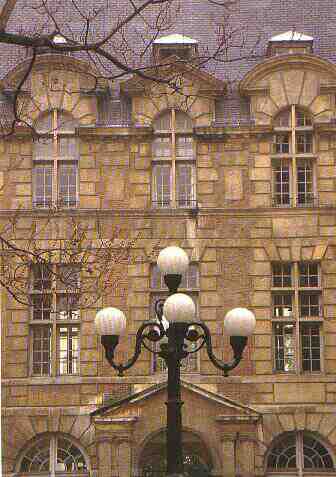 The museum keeps his souvenirs, sketches for his
large paintings, drawings of his journey to Morocco, photographies,
correspondence (documents evoke the contacts he had with Baudelaire, George
Sand, Theophile Gauthier), furnishing, aquarelles pastels of the master. The
most famous works are the frescoes he painted for the neighboring church of
Saint-Sulpice. The atelier is situated in a private garden inside. Stay in this neighborhood and loiter around. Not far from
the Ecole des Beaux Arts, at no.5 of rue Bonaparte you’ll see the house where
the impressionist painter Manet was born in 1823. In the rue Jacob you will find some chic antique shops, at no.7 the
writer Racine used to live, Wagner stayed
at no.14 and Colette at no. 28. Through the rue Visconti, one of the narrowest, the
oldest and most typical of the area, you arrive at the rue de Seine. Created in
1540, this street was a refuge for the protestants. The rue de
Seine with nice private hotels de maitre, sometimes with courtyards walls
covered with ivy and with its old facades, has changed drastically these last
years. Art galleries and specialized libraries replaced the old-fashioned and
stuffy commerces. The terrace of “La Palette”, well sheltered against cold
drafts, is very popular at the first days of spring. It is a pleasant tavern for
tourists, students and people calling themselves artists. Interior decoration is
from the thirties.
The museum keeps his souvenirs, sketches for his
large paintings, drawings of his journey to Morocco, photographies,
correspondence (documents evoke the contacts he had with Baudelaire, George
Sand, Theophile Gauthier), furnishing, aquarelles pastels of the master. The
most famous works are the frescoes he painted for the neighboring church of
Saint-Sulpice. The atelier is situated in a private garden inside. Stay in this neighborhood and loiter around. Not far from
the Ecole des Beaux Arts, at no.5 of rue Bonaparte you’ll see the house where
the impressionist painter Manet was born in 1823. In the rue Jacob you will find some chic antique shops, at no.7 the
writer Racine used to live, Wagner stayed
at no.14 and Colette at no. 28. Through the rue Visconti, one of the narrowest, the
oldest and most typical of the area, you arrive at the rue de Seine. Created in
1540, this street was a refuge for the protestants. The rue de
Seine with nice private hotels de maitre, sometimes with courtyards walls
covered with ivy and with its old facades, has changed drastically these last
years. Art galleries and specialized libraries replaced the old-fashioned and
stuffy commerces. The terrace of “La Palette”, well sheltered against cold
drafts, is very popular at the first days of spring. It is a pleasant tavern for
tourists, students and people calling themselves artists. Interior decoration is
from the thirties.
We arrive at the RUE DE
BUCI. This has always been an open air market, thus this buzzing
animation and popular character that disappeared from the neighboring streets.
Prices are the same as in other markets and don’t think
that you will find it cheaper at the next stall or even a few stalls further,
you will be the loser.....it's often the same owner!! On sunny days, terraces on
the rue de Buci are stormed and you will have to be very lucky to get a table. Times of students riots of 1968 are long gone by. But it is a colorful
market and in front of some delicious pastry shops, luxe charcuteries and
bakeries people are queuing as if we were in Moscow. Another very practical fact
is that the market closes late. Moreover, not far from here stands one of the
rare covered markets of Paris: “Marché Saint-Germain” in the rue Mabillon.
Saint-Germain has also a lot of nightlife to offer for
those who are not tired after a long day of “Jack walking”. Bars of certain
hotels in this neighborhood present performances of jazz and blues groups like
“Les Latitudes”, rue Saint-Benoit 7-11, “La Montana” a few meters
further at no. 28 and “La Villa”, rue Jacob 29.
Bibliography:
Vie et histoire des arrondissements de Paris, ed.Hervas, 1985-1988, 20
volumes—Nouvelle Histoire de Paris, ed.Hachette (20 vol.since 1971), Le piéton
de Paris, by L.P. Fargue, ed.Gallimard 1997—Rive Gauche, une expérience
unique, by Cl.Evrard, ed.Albin 1991--- Guide du Routard
Paris1998-99—Dictionnaire historique des rues de Paris, by J.Hillairet,
ed.Minuit 1985.
|
