|
From the small rue Rotrou you can join that other oasis of peace and rest:
THE JARDIN DU LUXEMBOURG.
Right away, next to the entrance of the rue Vaugirard is the famous
“Fontaine de Médicis” (1624), THE favourite meeting place for lovers. The
jardin du Luxembourg, named so many times in numerous books that each blade of
grass can be counted to the French literary patrimony, is the ideal place to sit
on a bench and rest your sore feet after a Jack’s walk. Have a taste of the
“Parisian way of life”. A lot of students from the nearby Sorbonne are
walking the alleys, studying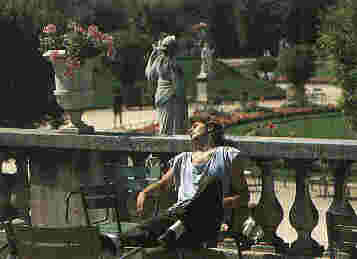 and mumbling their courses. Yes, once those
students were Baudelaire, Nerval, Verlaine, Rilke….. Seventy statues of
prominent French are enhancing the area and about lunchtime the “boule”
players have a game. At one of the ponds you can rent remote-controlled
toy-ships. Parisian mothers love to walk their kids in this park.There is even a gardening-school and amateurs of beehives who produce
several hundreds kilos honey a year.The famous “Guignol”
(puppet theatre) with performances every school holiday for the children is
still very popular (Wednesday, Saturday,
Sunday and holidays). And a final
curiosity: between the jardin and the Palais du Luxembourg (see later) adepts of
“tai chi chuan” move with slowness, with the typical ceremonial of this
martial art. and mumbling their courses. Yes, once those
students were Baudelaire, Nerval, Verlaine, Rilke….. Seventy statues of
prominent French are enhancing the area and about lunchtime the “boule”
players have a game. At one of the ponds you can rent remote-controlled
toy-ships. Parisian mothers love to walk their kids in this park.There is even a gardening-school and amateurs of beehives who produce
several hundreds kilos honey a year.The famous “Guignol”
(puppet theatre) with performances every school holiday for the children is
still very popular (Wednesday, Saturday,
Sunday and holidays). And a final
curiosity: between the jardin and the Palais du Luxembourg (see later) adepts of
“tai chi chuan” move with slowness, with the typical ceremonial of this
martial art.
 |
|
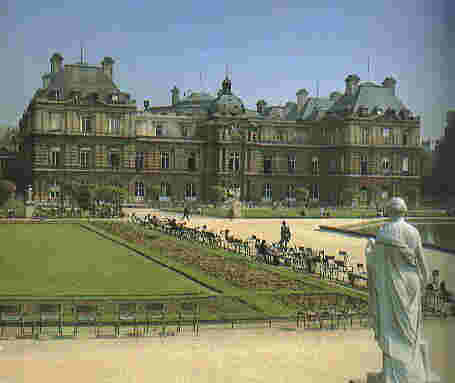
Palais du Luxembourg-French Senate |
I said “PALAIS DU LUXEMBOURG”!
Let’s
talk about it! Housing the
“Senate” (high chamber) it was built at the north side of the park in the 17th
century by Marie de Medicis, widow of Henri IV and mother of Louis XIII. This
palace was supposed to remind her of her Italian descent and shows therefore a
lot of Italian building style elements. Salomon de Brosse was appointed the
architect . Also the interior had to keep high
standards. Rubens was bribed to Paris to execute a series of paintings about the
life of the queen which are now all in a special room in the Louvre
museum. The library of the palace contains a few Delacroix. During the French
revolution the palace served some time as a prison, then the headquarters of the
“Directoire” and the Consulate of Napoleon.
Since then it is the home of the French Senate (except during WWII). You can
visit the palace only one day a month: the first Sunday of the month, and better
phone to be sure tel 0142342060
Getting out at the south side, take the rue d’Assas and let’s get on
to the MUSEE ZADKINE.
Unfortunately unknown to most tourists it is one of my favourite museums. Closed
Mondays and festive days it is a small museum but for real sculpture lovers.
Zadkine was a French sculptor of Jewish Russian origin, very famous in Rotterdam
where he sculpted the “symbol of a destroyed city (WWII)” called
“Verwoeste Stad”. He lived in this house almost his entire life, from 1928
to 1967. He was first influenced by Braque and Picasso in cubism but the
materials were different: iron, wood or bronze. Whatever
he twisted, contorted and worked on he could dramatize his subjects without ever
being abstract, always figurative. Go and see this museum if you like sculptures
out of someone’s guts! An
interesting novelty installed recently is that blind people can feel the
sculptures though a sort of “Braille” during special tours.
Bibliography:
Vie et histoire des arrondissements de Paris, ed.Hervas, 1985-1988, 20
volumes- Le piéton
de Paris, by L.P. Fargue, ed.Gallimard 1997—Rive Gauche, une expérience
unique, by Cl.Evrard, ed.Albin 1991--- Guide du Routard Paris 1998-99 -Dictionnaire historique des rues de Paris, by
J.Hillairet,
ed.Minuit 1985, Musées insolites, Jean Hermann ed.Lemaitre1995
|
