|
Exhausting pipes are without
mercy in the rue
Saint-Peres. A
traffic agent regulating traffic needs an "oxygen tent" after 2 hours
;-),
Coming out
of the rue Dauphine, turn left on the quai. The Impasse de Nevers, pierced in
the 13th century,leads you to a leftover of the
Philippe Auguste wall.
On the quai de Conti
stands the MUSEE DE LA MONNAIE (Mint museum). Here everything is about …money.
Mints, medals, press machines documents are presented in an educational way. The
francs made today are manufactured in Pessac near Bordeaux. Today only the
medals and special coins for special events are still manufactured. You can
visit the workshops on Tuesday and Friday at 2.30 PM. Closed in August.
Continuing on the same quai you meet the INSTITUT DE FRANCE,
recognizable by its cupola. Today it is the home of five different
institutions of which the Bibliotheque Mazarine and the ACADEMIE FRANCAISE,
created in 1635 by Richelieu to defend the French language. 40 members having
achieved celebrity in diplomacy, army or literature have since mankind can
remember constitute the Academie Francaise. Every Thursday they meet to
elaborate the perfect dictionary. Lately it seemed they were at letter " D
". Patience is a virtue ;-)
Return
direction boulevard Saint-Germain through one of the numerous streets like for
instance rue Bonaparte and rue Jacob, with a lot of galleries and antique shops.
You can find gothic sculptures as well as avant-garde paintings. You can buy for
a reasonable price some lithography at Gallerie Breheret quai Malacqais no.9.
And if you’re for in for the real shopping, the whole quarter, including the
boulevard Saint-Germain between the church and the boulevard Saint-Michel, rue
du Four, rue de Rennes, rue Bonaparte, rue du Cherche-Midi and rue de Sevres
will satisfy your rage.
Following the rue Bonaparte, arriving on the place Saint-Sulpice, make a stop
and take a rest. Cafes are everywhere at every corner (like the rue du
Vieux-Colombier). Admire the square. Opinions are divided, some like it, some
not. But like it or not the houses here are the most expensive in Paris. You can
easily imagine why: you’re just coming from of one of the noisiest and most
polluted areas of Paris. People like to live here between the soft spouting
fountains of 1844, the benches beneath the chestnut trees, the loitering
promeneurs eating a sandwich they bought at the “traiteur” in the rue du
Vieux-Colombier. Here the busy city people have the impression to get some extra
oxygen.
Above the
square the towers of the heavy looking, EGLISE SAINT SULPICE rise high above the neighbouring
roofs. See the Hebrew JAHWE on the left tower, curious..... . The ground map and the size are the same as
Notre-Dame. The first stone was laid in 1646 on the 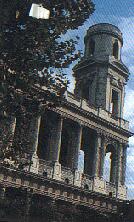 remains of an older and
smaller church. The building being interrupted several times, all styles and
epochs are mixed in the construction. One of the most interesting items inside
is the wall fresco (the fighting of Saul with the Angel) painted under the supervision of Delacroix, the Maria chapel and the
organ of 1781. A copper line in the middle of the choir symbolizes the zero
meridian of Paris. remains of an older and
smaller church. The building being interrupted several times, all styles and
epochs are mixed in the construction. One of the most interesting items inside
is the wall fresco (the fighting of Saul with the Angel) painted under the supervision of Delacroix, the Maria chapel and the
organ of 1781. A copper line in the middle of the choir symbolizes the zero
meridian of Paris.
A few anecdotes about the church. The ancestor of the
telegraph, the Chappe system (moving panel system set on heights) had a fixed
place on the roof until 1850. Baudelaire and the marquis de Sade were baptized
in this church. Victor Hugo got married here.
Bibliography:
Vie et histoire des arrondissements de Paris, ed.Hervas, 1985-1988, 20
volumes- Le piéton
de Paris, by L.P. Fargue, ed.Gallimard 1997—Rive Gauche, une expérience
unique, by Cl.Evrard, ed.Albin 1991--- Guide du Routard Paris 1998-99 -Dictionnaire historique des rues de Paris, by
J.Hillairet,
ed.Minuit 1985, Eglises de Paris, by J.Fournier ed. Art sacral.
|
