|
Back at our starting position in front of
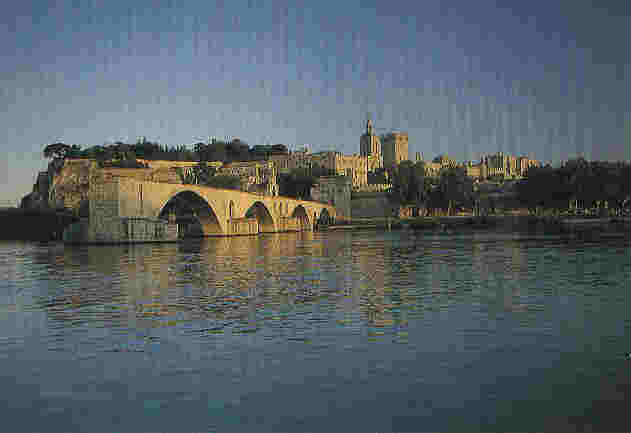
the palais des papes, let's pay a little visit to the pont Saint-Benezet, better
known by the name given by the French children song" Sous le pont
d'Avignon, on y danse...., on y danse..... We look first for the small area
behind the Petit Palais, closing the place des papes on the Northern side. A
mighty tower (Tour du Chatelet) is the entrance of the pont Saint-Benezet.
Paying access ( 15 FF) !! Alas!
|
 |
|
Pont d'Avignon |
There was never any dancing on the
bridge, but what is sure that it was destroyed in 1226 a first time by the
French king Louis VIII. . After reconstruction the bridge was used for transport
( no commerce without a bridge!) Only 4 arches remain and a small 2 stories
chapel and finally it tumbled down in 1669 when the river had a very high
tide. But what about that dancing? A legend says that on the island of
Barthelasse, that divides the Rhone in two parts , existed a tavern just
under one of the pillars. So they danced "under the pont d'Avignon!".
Let's start now a promenade in Avignon. It turns soon into a loitering between
confusing and entangling decors. Let's start from the place Crillon, walk
along the very busy rue Joseph Vernet with its attractive shops, his
majestic edifices the and the musee Calvet whose restoration was finally
completed after many years. (I will talk about it later). The first
side-street of the rue Vernet is the also very animated rue Saint-Agricol. At
no.19 an 1855 old library of Roumanille. I will not start to explain what
the "felibrige " movement was, I don't think that will interest much
readers. Let's cross now the main vein of Avignon: the cours Jean-Jaures and the
rue de la Republique to discover the other side of the city. A new maze of
tortuous streets await us where we will soon stumble upon a much older
thoroughfare: rue des Marchands continuing in the rue Carnot, rue Matheron and
rue Carreterie, finishing at the porte Saint-Lazare. This is a more popular part
of the city. Looking at the horizon, we are sometimes surprised by a
sudden view of the mont Ventoux with its shining white limestone summit . Our
route is interrupted agreeably halfway by the old remnants of the "cloitre
des Carmelites"at the quiet place des Carmes. The place where the rue de la
Carreterie joins the porte Saint-Lazare has something unreal. I can't explain
why, maybe the high walls of the hospital Saint-Bernard, founded in 1354 and
whose facade dates from the 17th century, gives me that awful feeling in the
stomach. The one who enters here, can forget all hope, that is the impression I
get from the dark building I see. Let's sit now at one of the terraces amidst
the "jeu de boules " players and let's say a few words about Napoleon
Bonaparte who was nearly stoned to death. He was never liked in Provence,
because the way he treated Pope Pius VII, who took prisoner and brought him to
Paris. The pope returned only in 1814 ( after Napoleons defeat) back to Rome,
via the Provence. The hatred of the emporium of Napoleon--a phenomenon as
far as a Paris metro strike for New-Yorkers --showed clearly when he had to join
the island of Elba, stopped in Avignon at this porte Saint-Lazare to change
horses. A mob tried to stone him to death and he escaped closely.
A quarter of an hour later we are again in the center, towards l'eglise
Saint-Pierre , the law-court, l'eglise Saint-Didier named for the first time in
1068 but built in it's present form in the 14th century. A beautiful "Cross
bearing" of Francesco Laurana, one of the most important Italian sculptors
in Provence during the reign of the good "roi Rene". If someone of you
knows the story of Petrarca and Laura, you can see at no. 14-20 of the rue du
Roi-Rene, the remains of the house where they met! Let's try now to find the rue
des Teinturiers, one of the most picturesque street of Avignon, with its famous,
well known paddle-wheel, and... restaurants. Just walk all the rue du Roi
Rene, the rue de la Masse, right in to the rue de la Bonneterie.
Bibliography:
Jean-Paul Clebert "Histoires et legendes de la Provence mysterieuse, ed.
Sand 1986)" --- Jean-Paul
Clebert "Guide de la Provence
mysterieuse," ed. Sand 1986---Jacques-Louis Delpal "Provence",
ed. Nathan, Paris 1987 very well written guide with a
personal view)
|