|
|
|
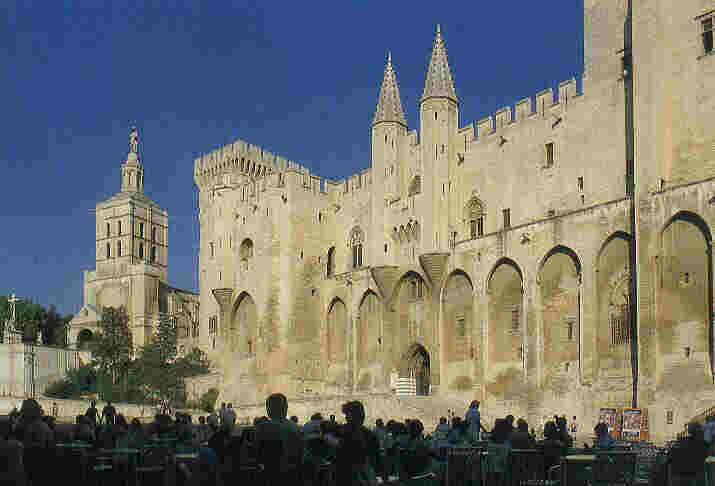
Palais des Papes |
Entering the city from the south through the Porte de la
Republique, we follow the cours Jean-Jaures and the rue de la Republique to the
place de l'Horloge and park our car in the underground garage of the place du
Palais des papes. As soon we are again at the surface, we are in the middle of
the history of the city.
Avignon's in its birth age was a rock and a river. The settlement was
called "Avennion" and later "Avennio". It is said it meant
"city along the river", or "city of the mighty wind". The
rock, the river and the wind are still there today. According to Plinius the Older (23-79), Avennio was not
more than a "oppidum" when the Romans arrived. The remains of the
Romans in Avennio are very meagre, a circumstance which confirms the low
interest the Romans had for this Avennio. The Roman forum was located exactly at
the actual place de l'Horloge with its Hotel de Ville and theatre. The famous
rock is practically invisible from the place du Palais because its view was
"stolen" by the gigantic Palais des Papes that was built later. This
Kremlin of medieval Catholicism diverts even our attention from the very first
Christian settlement in Avennio: Notre-Dame-des-Doms. It lost its architectonic
autonomy, when the papal fortress approached its towers and battlements to
almost glued to the fortress walls.
But let's now say a few words about this palais des Papes.
Seven popes ruled here from 1309 to 1377. Since the palace became property of
the city and the local civil servants didn't know what to do with the place ,
except to let it visit only by a guide, very long and boring, the interest of
the edifice diminished rapidly. So it
was leased to a private company , and everything seems suddenly brighter, in so
far the word "brought " can be said about this dark bunker. Bow you
can, all alone, walk all over the place without a guide and wonder about these impressive spaces, built in less then 30 years
from scratch. You get a very handy folder at the entrance with a clearly
indicated route to follow. I may sound negative about the building itself, but we must
not forget that you are going to visit one of the main sites of France's
history. One of the most evident examples of two different architectures :
Gothic and 16th century early Renaissance. So we have the old palace and the new
palace.
The " Cour
d'Honneur" ( honour courtyard) will be the first acquaintance you will make
with the palais. The past half century the greatest artists performed for the world
wide known summer Theatre festival.
Jean XXII was the second pope to come here in September
1316. . He was born in Cahors as Jacques Duèse. When he became pope he did like his predecessors, and couldn't care less than to be a "HOLY
FATHER" First of all he loved money. He invented a waterproof system to let
the clergy pay for every favour he granted them. The money poured in like water
but it was never enough! Anyway, he started to enlarge his ancient Episcopal
palace. Next pope, Benoit XII, born in 1285 as Jacques Fournier
settled definitely the popes in Avignon . He built the first part of the palais des papes. It was
so huge for those time that Prosper Merimee, a French writer and poet compared it to the palace of an
Asiatic tyrant more that to the home of a bishop. In "Decline and Fall of
the Roman Empire" by Gibbons Benoit XII (Benedictus XII) was characterised
as a "dumb peasant, crushed by scruples and far sunken away in laziness. He
was born not fit to be a priest,
let be a pope!".
But now comes the next pope: Clemens VI. He continued to
build the palace in a more cheerful way and soon the town became one of the wealthiest in Europe. The
architecture enriched considerably, but then comes the year 1348, and the black
plague! The death toll was 62.000 deaths in 4 months time. Clemens VI stayed in
his palace during that time, didn't flee Avignon and is still admired for its
courage.
|