Avignon a critical introduction Site Home - What's New? -Feedback - About Jack- Travel/Art Links

Provence
|
Avignon a critical introduction Site Home - What's New? -Feedback - About Jack- Travel/Art Links |
|
|
|
Provence |
|
Jack's Provence travels |
|
Avignon-Critical introduction |
|
Palais
des
|
hotel recommendations |
|
|
|
(Text correction by Mr.Rip Green) Avignon is the city of the dark "palais des papes", the summer Theatre Festival and the merry bridge where "on y danse tous en rond", a popular French children's song, I learned by the time I was three years old. The popes stayed in Avignon as the capital of Christianity during the whole 14th century, we will go into that history later on.
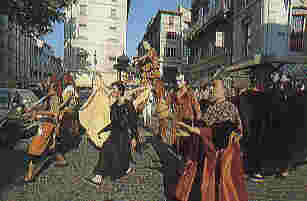
The best advice I can give to those who will stay in Avignon during the hot summer months, is to enjoy the whole scene, street jugglers, street plays from the "off" theatre young actors and actresses who are not allowed to figure in the official program) and everything else that's going on, from a terrace. Best place for that would be the place de l'Horloge and the place du Palais. We will loiter along an itinerary, that
looks more a labyrinth of medieval streets but we will visit at the same
time some monuments and sites ,labeled as a "must". Getting lost will
be difficult, because you finally always end up on the very busy cours
Jean-Jaures-rue de la Republique, cutting the city in two from north to south, or
the walls of the popes wall, still running all around Avignon. But now Victor Hugo changes its tone: """But getting closer to the city, the Greek and other antic figures of the old Avignon change to other forms and reveal and manifest itself to Catholicism. The palace of the popes turns into a gigantic -roman cathedral, while loop-holes appear at the upper side of the walls in the most remarkable shape: the loophole of the popes is the cross!"""" It's remarkable how Victor Hugo changes slowly his sentiments in this travel description of 1839, a initial feeling of enthusiasm moves over to a sense of abhorrence of the ubiquitous, overbearing presence of Catholicism of the worst kind and also about a fact that very few travellers at that time reported: the cruelty of its population. |
|||