Site Home - What's New? -Feedback - About Jack- Travel/Art Links

Provence
|
Site Home - What's New? -Feedback - About Jack- Travel/Art Links |
|
|
|
Provence |
|
Jack's Provence travels |
|
Ungrateful area at first sight, but......
|
Provence-Camargue-Horses and bulls |
|
|
Shortly
before arriving in Saintes Maries de la Mer we find again a Centre
d’Information du Parc National Naturel in GINES. It was created with the
intention to let tourists not too much in a hurry to learn and deepen their
knowledge of Camargue. Just next to the center is the Bird park of Pont de Grau.
Take your time here. If you’re on a Guinness book record trip to visit
Provence, Camargue and Cote d’Azur in two days, forget it. Here you find indicated and marked paths over terrains of 12 and 50
hectares giving us the opportunity to watch birds, horses and bulls in all
tranquility in their natural environment. If we are looking for the “unspoiled
and free nature” in Camargue we cannot allow to ignore such opportunities,
especially since the nature is screened always everywhere against invading
visitors. Bibliography James Henry, “A little tour in Provence”(Strauss and Giroux, New York 1983), Klingshirn, William E., “Caesarius of Arles” (Cambridge University Press, 1994), Lenthéric, Charles, “Les villes mortes du Golfe de Lyon” (Plon, Paris 1876), Maurras Charles “L’Etang de Berre” (ed. Champion, Paris 1924) Picon Bernard, “l’Espace et le temps en Camargue »(Actes Sud, Arles 1988)-Guides du Routard 1999 (ed.Hachette), « Animaux de Camargue », by P. Perez (ed. Pershing , Perpignan 1996) |
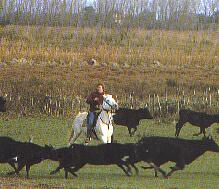 Meanwhile
we have seen the first white horses and black bulls behind dirty fences. Little
is known about their history. The theory that the short and small Camargue horse
would originate from the Arabian horses on which the Saracens terrorized the
south of France in the 8th century is being rejected. Its build has
nothing of an Arabian horse (don’t be surprised, I didn’t become suddenly a
horse expert, I read this in my bibliography;-)) but everything like the magic
horses which lived about a million years and of which a mass grave was
discovered in 1866 at the foot of the Solutré rock in Burgundy. A dubious
opinion is that these horses, chased by hunters, jumped in panic of the rock.
Meanwhile
we have seen the first white horses and black bulls behind dirty fences. Little
is known about their history. The theory that the short and small Camargue horse
would originate from the Arabian horses on which the Saracens terrorized the
south of France in the 8th century is being rejected. Its build has
nothing of an Arabian horse (don’t be surprised, I didn’t become suddenly a
horse expert, I read this in my bibliography;-)) but everything like the magic
horses which lived about a million years and of which a mass grave was
discovered in 1866 at the foot of the Solutré rock in Burgundy. A dubious
opinion is that these horses, chased by hunters, jumped in panic of the rock.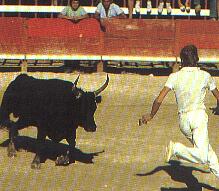 them alone.