|
We leave Arles taking the D
570 direction Saintes-Maries-de-la Mer. Soon you will have an exit direction
SALINS-DE-GIRAUD. If you have some time over on your journey, go for it. This
road leads you along the Rhone for 30 km through a strongly cultivated part of
the Camargue.
Salins-de-Giraud is a village full of plane trees and acacias. With its 3.000
inhabitants it has a surprising particular architecture: you could picture
yourself in the north of France amidst a group of coal minors dwellings. Indeed, not
only is the village’s industry salt and other developed chemistry but a plant
manufactures the famous "savon de marseille". Agricultural products
like asparagus and rice are also important trade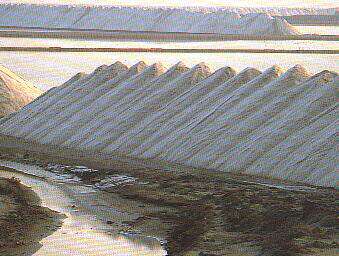 items. But salt is exploited here since antiquity and these salt fields are
today the most extended of Europe.
items. But salt is exploited here since antiquity and these salt fields are
today the most extended of Europe.
Half over the country's supplies come right from here. The harvested salt
is piled
up in pyramids called "camelles". It’s precisely on such
“camelles” south of Salins-de-Giraud that the pink flamingos settle down.
Now if you want to see a very large concentration 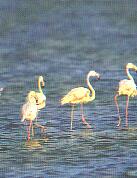 of these flamingos live in
nature head for La Pointe
de Beaded is 17 km away from Salins-de-Giraud. A haven of beauty awaits you at
the etang du Fangassier, just behind the "cabane des gardes flamants".
From April to mid-July these guards watch 10.000 couples of pink flamingos live
in this vast water outspread. Don't hesitate to question the guards who are a
mine of information about the Camargue and its mysterious long-legged
wading-birds. of these flamingos live in
nature head for La Pointe
de Beaded is 17 km away from Salins-de-Giraud. A haven of beauty awaits you at
the etang du Fangassier, just behind the "cabane des gardes flamants".
From April to mid-July these guards watch 10.000 couples of pink flamingos live
in this vast water outspread. Don't hesitate to question the guards who are a
mine of information about the Camargue and its mysterious long-legged
wading-birds.
To visit a “salines” call the tourist office or call 0490184120
The MUSEE DU RIZ (rice) at le Sambuc is all about you want to know about...rice
:-). Since the region of Salins-de-Giraud
is the symbol today of the revival of rice
culture reservations required.
Try now to find the D 21 to drive on to ALBARON drainage and desalinisation
station,
which is here very important for the struggle of man against water and salt.
From Albaron drive towards Saintes-Maries-de-la-Mer. After 10 km we can enter
the Chateau d’Avignon. While pastis-king Paul Ricard bought his “domaine”
in 1939 a little further, wine king Noilly-Prat, more famous because of the
liquor he produced, acquired this old “chateau” that he restored to receive
his business relations. The Regional Board of Camargue got it in 1985; furnished
it again with the originals and opened it for the public. The complex shows care
and style, a neat maintained park around but is in fact misplaced in this area
where salt, water and drought is more characteristic for Camargue. Or is it just
an oasis?
Bibliography
James Henry, “A little
tour in Provence”(Strauss and Giroux, New York 1983), Klingshirn, William E.,
“Caesarius of Arles” (Cambridge University Press, 1994), Lenthéric,
Charles, “Les villes mortes du Golfe de Lyon” (Plon, Paris 1876), Maurras
Charles “L’Etang de Berre” (ed. Champion,
Paris 1924) Picon Bernard, “l’Espace et le temps en Camargue »(Actes
Sud, Arles 1988)-Guides du Routard 1999 (ed.Hachette)
|