|
Let’s leave
Saintes-Maries-de-la-Mer by the main route D 570. Avoid the very deceiving musee
Boumian, really not worth a stop and we continue north on the D 58. The immense
plain we see now is the plain of AIGUES-MORTES. This part stayed like you see it
now for centuries, immobile, sweating under the implacable sun. From time to
time you will spot an authentic “mas”; single storey cabins with thatched
roofs. This area is a rich agricultural area producing grapes and cereals. Pay
attention towards the end of the D 58, to the right a small road will lead you
to the TOUR CARBONNIERE which allows you to look out over these fields, to the
foothills of the Cevennes in the north west, the petite Camargue in the east and
across the salt flats of Aigues-Mortes to the south.
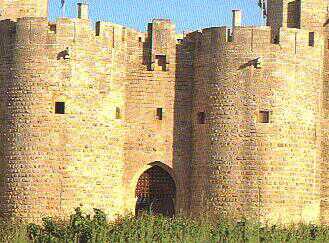 Indeed,
the area around Aigues Mortes is made up of salty lagoons and water channels
where the Rhone meets the sea. The town of Aigues Mortes was built amidst these
lagoons in 1241. Aigues-Mortes means “dead waters”. This location prevented
the a too big growth of the city and what stands now is a good-preserved
medieval town with intact remained ramparts built by Philippe le Hardi. You can
visit them with a tour starting at the PORTE DE LA GARDETTE Indeed,
the area around Aigues Mortes is made up of salty lagoons and water channels
where the Rhone meets the sea. The town of Aigues Mortes was built amidst these
lagoons in 1241. Aigues-Mortes means “dead waters”. This location prevented
the a too big growth of the city and what stands now is a good-preserved
medieval town with intact remained ramparts built by Philippe le Hardi. You can
visit them with a tour starting at the PORTE DE LA GARDETTE
Use you imagination, not too hard please ;-) and you can see how this town was
the springboard from which Saint-Louis departed for two crusades (1254 and 1270
where he died almost instantly). The access to the port silted up already in the
14th century.
Once you’ve passed through the gateway, you’ll find (in high season) very
crowded, narrow picturesque medieval patterned streets and cute squares, like
the place Saint-Louis with a statue of the king and the sober small church of
NOTRE DAME DES SABLONS. Notice that the roof has a wooden (thus cheap) roof,
which proves that the silting was catastrophic for the financing. You will find
the square lined by cafes and restaurants but
better wander around the adjacent and more secluded side streets.
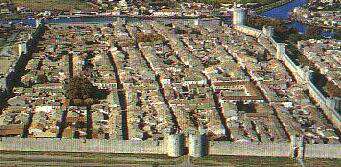 |
|
Aigues-Mortes (postcard scan) |
Specialty of
Aigues-Mortes is “Gardiane de Taureaux”, a type of beef stew cooked with
olives, or local seafood dishes.
Today Aigues Mortes has to make his living out of salt, tourists, wine and
….asparagus.
----SALT: to look how salt is being treated and retrieved in Salins - du-Midi there are
visits in July and August every Wednesday and Friday afternoon starting at the
tourist office.
---TOURISTS: that’s you and me ;-)
---WINE:,that's the “Listel” and is grown commercially, known for being
a “vin de sable”. This means it is made from vines that grow directly out of
the sand. White wine is called “gris de gris” and the red “rubis”.
To finish this article about Aigues-Mortes here is a legend that is told to
young children. If they misbehave they will be dragged off by “Lou Drape”, a
horse that is supposed to hover over the ramparts at night. It is said that its
body can lengthen to carry away as many as 100 naughty children on its back into
the marsh, where it will then devour them. Even today, myths, legends and
popular superstitions are an integral part of life in the Camargue.
Bibliography
James Henry, “A little
tour in Provence”(Strauss and Giroux, New York 1983), Klingshirn, William E.,
“Caesarius of Arles” (Cambridge University Press, 1994), Lenthéric,
Charles, “Les villes mortes du Golfe de Lyon” (Plon, Paris 1876), Maurras
Charles “L’Etang de Berre” (ed. Champion,
Paris 1924) Picon Bernard, “l’Espace et le temps en Camargue »(Actes
Sud, Arles 1988)-« Entrees dans le Languedoc » by Marie de Kermt
(ed. Beaujour-Marseille 1996)
|