|
 The Camargue looks probably
disappointing at first view. Let’s keep that in mind at the beginning of our
journey. At a first too quick overview the famous delta of the Rhone can be as
disappointing as Arles. And if our whole visit to Camargue would be reduced to a
ride to the coast over one of the two asphalted roads to lie down on a beach in The Camargue looks probably
disappointing at first view. Let’s keep that in mind at the beginning of our
journey. At a first too quick overview the famous delta of the Rhone can be as
disappointing as Arles. And if our whole visit to Camargue would be reduced to a
ride to the coast over one of the two asphalted roads to lie down on a beach in Saintes-Marie de la Mer or Salin-de-Giraud and returning over the other road,
throwing a quick glance at the Etang de Vaccares, we will feel very little
enthusiasm for this flat, bold, muddy and murderous hot region, plagued by
mosquitoes and which is ravaged regularly by screaming, ice cold mistral.
Saintes-Marie de la Mer or Salin-de-Giraud and returning over the other road,
throwing a quick glance at the Etang de Vaccares, we will feel very little
enthusiasm for this flat, bold, muddy and murderous hot region, plagued by
mosquitoes and which is ravaged regularly by screaming, ice cold mistral.
Despite of that, Camargue was declared Parc Naturel Regional in 1970, which
obliges the villages and cities, like in the Luberon, to protect their habitat.
And above all that the Etang de Vaccares with its dunes and lakes until the
coast (85,000 hectares) was declared “Reserve Naturelle” which is an elegant
formula to say that it is closed to the public for its greatest part. Finally
the UNESCO, the E.U., and the Council of Europe named Camargue very officially
“ an exceptional natural region”, a title that brings nothing to anybody.
To understand all that ecological enthusiasm for the Camargue, you, readers,
should not skip what I 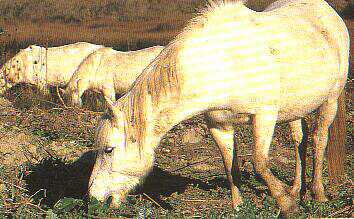 have to tell: just like in Arles there is more to know
than to see in this not very inspiring delta. have to tell: just like in Arles there is more to know
than to see in this not very inspiring delta.
It’s true: Camargue has the stereotype image of pink flamingos, white horses
and black bulls. These images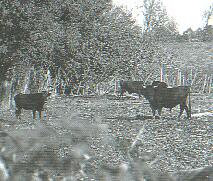 are
correct because the flamingos, horses and bulls
don’t make a mystery about
their presence. Much less visible are the 337 signalled bird species, of which
more than 200 different sorts of migrating birds making of Camargue the most
busy airport of the world in spring and fall. 32 different kinds of mammals, 15
frog species, six sorts of snakes, and 39 fish species live practically totally
hidden and unseen. And let’s not forget the numerous insects, where I even
don’t count the damn mosquitoes.
are
correct because the flamingos, horses and bulls
don’t make a mystery about
their presence. Much less visible are the 337 signalled bird species, of which
more than 200 different sorts of migrating birds making of Camargue the most
busy airport of the world in spring and fall. 32 different kinds of mammals, 15
frog species, six sorts of snakes, and 39 fish species live practically totally
hidden and unseen. And let’s not forget the numerous insects, where I even
don’t count the damn mosquitoes.
Bibliography
James Henry, “A little
tour in Provence”(Strauss and Giroux, New York 1983), Klingshirn, William E.,
“Caesarius of Arles” (Cambridge University Press, 1994), Lenthéric,
Charles, “Les villes mortes du Golfe de Lyon” (Plon, Paris 1876), Maurras
Charles “L’Etang de Berre” (ed. Champion,
Paris 1924) Picon Bernard, “l’Espace et le temps en Camargue »(Actes
Sud, Arles 1988)-Guides du Routard 1999 (ed.Hachette)
|