|
The new settlements of
SAINTES-MARIES-DE-LA-MER rise on the horizon toppled by the mighty Notre
Dame-de-la-Mer. Of the 85,000 ha of Camargue, there is 38,000 attributed to
Arles, therefore the largest “commune “ of France. Arles is also the
“brain centre” of Camargue: Farmers meet for their business in the cafes
along boulevard des Lices.
Everything that is repulsive about the degenerate delta is in Saintes - Maries -
de-la-Mer during the summer, but in the winter and early spring I
was stunned about the silence and peace around Notre Dame and the generosity of
the way the 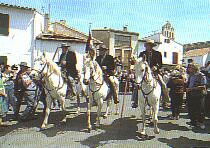 sea caresses endless beaches. And during winter this wonderful
village doesn’t count more than 25,000 inhabitants, while it
is flooded during
the summer by 80,000 vacationers. Wild camping along the beaches, liked it was
permitted all along the years, is forbidden today. The adventurous seafront walk
--dream route for all those wanting to see Camargue—is prohibited
for motorised vehicles. My friends drivers, leave your car at the
parking and loiter. It’s only on foot, horseback or bicycle that you can walk
the 15km, an experience not to miss! This sea embankment was built in 1857. Along
15 km, this dike will take you to the phare de Gacholle. Take your time to take
a glimpse of the sea birds, like the yellow-legged gulls, slender-billed gulls,
or the tern as it dives into the water for fish. A fine breeze blows across
these waters making them particularly good for wind-surfing. You could suddenly
stand eye in eye with a sand-lizard, a grey-purple
heron, a white stilt-walker, grass snakes and a lot more of these cute little
things...... sea caresses endless beaches. And during winter this wonderful
village doesn’t count more than 25,000 inhabitants, while it
is flooded during
the summer by 80,000 vacationers. Wild camping along the beaches, liked it was
permitted all along the years, is forbidden today. The adventurous seafront walk
--dream route for all those wanting to see Camargue—is prohibited
for motorised vehicles. My friends drivers, leave your car at the
parking and loiter. It’s only on foot, horseback or bicycle that you can walk
the 15km, an experience not to miss! This sea embankment was built in 1857. Along
15 km, this dike will take you to the phare de Gacholle. Take your time to take
a glimpse of the sea birds, like the yellow-legged gulls, slender-billed gulls,
or the tern as it dives into the water for fish. A fine breeze blows across
these waters making them particularly good for wind-surfing. You could suddenly
stand eye in eye with a sand-lizard, a grey-purple
heron, a white stilt-walker, grass snakes and a lot more of these cute little
things......
Saintes-Maries didn't wait for my self-guides to invent tourism!! Since 19
centuries pilgrims have found the way to this (for the gypsies) holy place.
Today, every year, 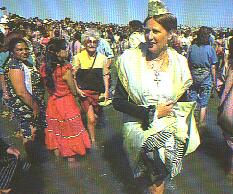 pilgrimages
happen on May 24 and 25 to honour different saints like Saint-Jacoba and Saint-Maria
Salomé on Sundays
approaching October 22. Considerable crowd converges to Saintes-Maries
and the city takes the more authentic aspect at these periods than the rest of
the year!! A huge procession take the reliquaries of saint Sara (the black maids
servant of Marie) out of the chapel of Notre Dame and bring them to the sea,
where the bishop blesses the water that allegedly brought them to Saintes
Maries. pilgrimages
happen on May 24 and 25 to honour different saints like Saint-Jacoba and Saint-Maria
Salomé on Sundays
approaching October 22. Considerable crowd converges to Saintes-Maries
and the city takes the more authentic aspect at these periods than the rest of
the year!! A huge procession take the reliquaries of saint Sara (the black maids
servant of Marie) out of the chapel of Notre Dame and bring them to the sea,
where the bishop blesses the water that allegedly brought them to Saintes
Maries.
What can you do in Saintes Maries?
 |
|
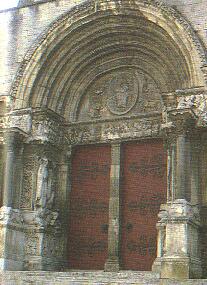
Portal Notre Dame |
The church of Saintes-Maries
, Notre Dame de la Mer is impressive. It has the typical exterior of a fortified
church. And you must imagine that the spot where you stand used to be many
kilometres from the sea in Middle ages. The church, build in the 12th
century, contains the alleged remains of saint Sarah and the two Marias. In
French they call this kind of finding “une invention” (an invention), not to
call it “a made-up story”. The bodies are said to have
rested on stones that are kept below in the crypt and have become "miracle
" stones. They are said to heal painful eyes and to have the power to cure
sterility in women. The high chapel of Saint-Michel, houses their tombs.
Don't fall into the Tiki tour tourist trap!! A wheel-boat ascendsthe Petit Rhone
to show you....nothing. Except a few birds, there is
nothing to see! You are being warned.
A word about the restaurant choice in Saintes-Maries. The number of restaurants
per square meter is impressive! There is even a square where you can find 14!!
Globally, the menus are the same everywhere. The appetizer gives you the choice
between the "tellines" (small shells, flat, oval and purplish-blue),
mussels and soupe au poisson. The entree goes between
"limandes"(dabs), the inevitable boeuf gardian or daurade. Desolate!
Bibliography
James Henry, “A little
tour in Provence”(Strauss and Giroux, New York 1983), Klingshirn, William E.,
“Caesarius of Arles” (Cambridge University Press, 1994), Lenthéric,
Charles, “Les villes mortes du Golfe de Lyon” (Plon, Paris 1876), Maurras
Charles “L’Etang de Berre” (ed. Champion,
Paris 1924) Picon Bernard, “l’Espace et le temps en Camargue »(Actes
Sud, Arles 1988)-Guides du Routard 1999 (ed.Hachette)
|