|
Nice
main page
History
and anecdotes
A view
from the Chateau
Cemetery
to old town
Old
town
|
Let's start
with Nice.
Much bad has
already been said about Nice. The British bestseller Graham Greene--who used to
live in Nice--noticed already in 1982: " Avoid the region of Nice, because
it is the domain of one of the biggest crime organizations in France".
 |
|
Jacques Medecin and friends |
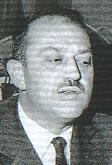
The mayor at that time was Jacques
Medecin, who was the real reason of this pamphlet, and very soon he was accused and charged with gigantic
fraud and embezzlement . When he fled to South-America in 1990. The Nicois were
flabbergasted, since the illegal and Mafia like behavior of Medecin, that made
him very rich, had done the city, surprisingly, a lot of good.
 |
|
Jacques Medecin |
The clever city potentate and dictator had manipulated as a "grand
maitre" of the Mafia underworld and his money-adoring companions, to make
huge sacrifices to enhance the city with a lot of expensive projects, of which
of course they had the charge to build them. After Medecin's escape , the city
council fell back to a low provincial level, which gave the Nicois new worries.
But still,
if we loiter around as tourists a few days in Nice, walk along the boulevards,
go and dine in the old Nice, not intend to settle down to live there permanently
and don't want to be aggravated by the underlying sociology, Nice can be a
highlight of a French Riviera trip.
Just let me
quote Patrick Modiano, a French writer which view on Nice I finally agree
totally :
" Nice
is not a harbor as Marseille, there is no transit. It's part of the world where
time has almost stopped. The city is marked by his past splendor, it was before
the war, it was still the luxury, it was still the Cote d'Azur of which Scott
Fitzgerald dreamed, the villas on Cimiez, the casinos, the grand hotels today
transformed in condominiums or garages. Nice is a precarious city."
Unquote.
There is a hill with a chateau
that you can see almost from any point in Nice. It’s there that the history of
Nice began. After the Greek sailors who came from Phocaea around 600 BC and
founded “Massilia”, the contemporary Marseille, they expanded their trading
posts all along the coast of which Nice, “Nikaia” (the triumphant) was the
most important. The Greeks left the natives in peace since they had no intention
of submitting them, just to do business. But during the 2nd century
the native Ligurians became so pushy that the Greeks asked the Romans for help.
They came and…stayed. The Romans continued to build Nice, but not along the
sea, no no sir! Building inland was the message and they had several reasons for
it: at this level of the coast they didn’t need a harbour and wished to stay
outside the influence zone of Massilia. They choose the hill most inland and
baptised it “Cemenelum” (now Cimiez). It became an important agglomeration
with an amphitheatre, thermal baths and even a network of central heating by hot
air...you see we invented nothing!!
After the decline of the Roman
Empire, population moved again seaward because it was easier to defend. The 10th
century saw the building of the chateau and soon a “walled city” developed
at the foot of the hill, the actual “old Nice”. It didn’t last very long
to see the population exploding and spreading outside the walls, left and right
of the river Paillon, still ignoring the hill of the old Cemenelum. After
several wars Nice fell into possession of the house of Savoia in 1388. From
Provencal, Nice becomes Savoyarde and weaves a strong bond with Italy. A new
province is created " le Comte de Nice". Except a few incidents with
France, during the reign of Louis XIV, Nice became only French again under
Napoleon III, when he saw the opportunity to seize Nice back in 1860, in full
Italian Independence war, to the great disappointment of the Italian freedom
fighter Garribaldi, who was born in Nice.
But before that, when Nice was still Italian,
the first British arrived, like I pointed out in my previous articles, in 1763
with Tobias Smollet. His wife, servant and two adopted daughters accompanied
him. He was a sick man, had severe cough attacks and probably suffered
tuberculosis. His enthusiasm launched a massive move amongst his countrymen and
from 1780 on Nice was swarming with British and Russians. From time to time this
“beau monde” took some risks and made a promenade along the “dangerous and
hazardous” sea.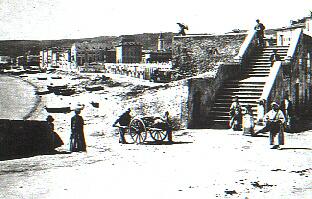 Middle 19th century, an English reverend, Lewis
Way, made two observations: Middle 19th century, an English reverend, Lewis
Way, made two observations:
1. The road along the sea was full of holes and ditches and the important
ladies who walked could break a leg or their neck
2. It was crawling with beggars.
He had then the genial idea to
hire these beggars to make a short coast road from the river Paillon to the
actual rue Meyerbeer. The reverend and his brother paid it from their own
pocket. In Nice they called Way’s road “lou camin dei Angles” (the road of
the English) later turning into “Promenade des Anglais”. Now
anyone who wished could make a stroll along the sea. On top of that, the train
arrives in 1864, which increases the number of arrivals. The first luxury hotels
are built along the seaside, like the Westminster and the hotel des Anglais.
But
they were discreet if you compare them with the sugar pastries built 70 years
ago in the hills of Cimiez, like the boulevard Carabacel.
From now on the city will have
an extraordinary soar. 22,000 in 1890 and 150,000 in 1910.Guest who stay a few
months attract financial real estate investment. More hotels are built and
Cimiez becomes a trendy place to stay, like Queen Victoria, but also the
imperial Russian family, the queen of Portugal and other crowned heads. The fame
of Nice is exceptional and overshadows cities like Cannes, Monaco, and Menton
who will mainly develop in the 20th century. All this of course needs workmen
and labourers and the Italians, fleeing poverty in their own land are a welcome
manpower. Slowly but surely, the fame and
glitter moves away to other bath resorts like Cannes and Monaco. It becomes less
wealthy and charm fades a bit. In 1925, Jean
Medecin becomes mayor of Nice. He will stay in power until his death in 1965 and
will be followed by his turbulent son, Jacques. He was re-elected five times but
had to flee to South-America in 1990 charged with embezzlements of all sorts.
But I told you that story already.
 |
|
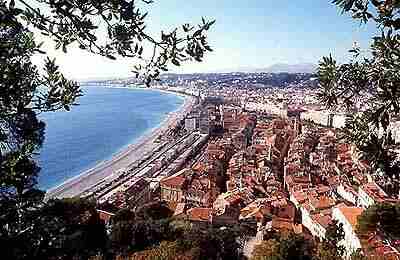
Baie des Anges-Nice |
Bibliography:
Tobias
Smollet,
"Travels through France and Italy", (Oxford University Press, Oxford,
New-York in the series World Classics), John Pemble, "the Mediterranean
Passion, Victorians and Edwardians in the South", (Oxford University Press
1988), Mary Blume, "Cote d'Azur. Inventing the French Riviera" (Thames
and Hudson, London 1982), Hannibal's footsteps by Bernard Levin(Sceptre
paperback 1987)
|
Cote
d'Azur main page
Promenade des Anglais
Cimiez
walk - Musee Matisse
Musee
Chagall - Museum
of Contemporary Art
|