|
Nice
main page
History
and anecdotes
A view
from the Chateau
Cemetery
to old town
Old
town
|
An excellent
way to see Nice is to take a ride in the "Petit train" and to drivearound in town. It starts at the foot of the Jardin Albert I and climbs all the
way to the chateau, a spot, where each visit to Nice should (in fact) begin!
 |
|
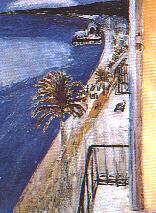
Baie de Nice by Matisse |
If you ever were in Rome and
stayed on the "Pincio", you can compare: hightrees, small rock
sections and waterfalls, stone benches under the greenery and the reward at the
top with its dressed tables and a cool and fresh glass of white wine. A lot of
mothers come here to see their children try their first steps and large
families, who queue, chatting under
the trees, for lunch. In the summer, when it's very hot, the heat is much more
bearable up here than in town, during the springtime, the birds sing until
exhaustion and in the winter, it is serene and quiet. Nice
is at our feet. This is the right place to observe some particularities about
this extrovert and so secretive Paris-at-the Cote-d'Azur.
From here
you see clearly that Nice airport is totally built on the sea. Who remembers the
collapse of a part of the runway in 1980 ?? The Dutch contractor (Boskalis),
hired by Jacques Medecin had warned that the project was not safe since the
bottom of the sea at that place was too weak and disapproved the plans. But they
didn't know the typical brutal ways of Mayor Jacques Medecin, who, once he had
his idea, never changed his mind. The investigations for the people responsible
for the catastrophe disappeared of course in a forgotten drawer. From
our viewing spot we see also the hilltops at the horizon, who protects the city
of the northern winds, we see how old town, with its medieval street layout, is
separated from new town by a green boulevard with the Congress Palace
"Acropolis" and the Musee d'Art Contemporain. All this is also the
initiative of Jacques Medecin.
From our hilltop we recognize the Italian
style of the city, which lasted for
five centuries, in the street plan of Nice. Typical example is the Place Massena
at the border of the boulevards, built over the river Paillon. The place Massena
is surrounded by magnificent red ocher facades, and looks like a northern
Italian city. But
people who know Nice very well, swear solemnly that Nice is in fact much less
"Italian" as you it looks visually. After all, they speak the
"langue d'oc" and marriages are much more celebrated in the Provencal
back country than in Italy. Nevertheless, the popular admiration of local people
is indestructible in front of an 'Italianizing" gentleman crook like
Jacques Medecin. The reason? Because Nice, like we see it today, in all its
progressive cheerfulness, is the work of Medecin. Take
now only the old Nice, magically transformed from a maze of slovenly alleys to a
feast of cool ocher streets, full of shops and restaurants. A part of this
miracle is the restoration of the old flower market, the COURS SALEYA, now
totally surrounded by restaurants and terraces.
The fact
that Nice looks today as a perfect running " housing machine", is
thanks to Jacques Medecin's father, Jean . The extreme right wing "Front
National" takes now slowly the power after the fall of the Medecins as if
it were a normal thing to do, while the Nice inhabitants still cry over their
lost mayor. Despite Medecin called himself " partyless", he was also
extreme right. For the 200th anniversary of the French revolution, Nice didn't
participate to the festivities. Medecin, spokesman for his city, said:
"During the revolution we were not part of France. So this anniversary
doesn't concern us at all."
Bibliography:
John
Pemble, "the Mediterranean
Passion, Victorians and Edwardians in the South", (Oxford University Press
1988), Mary Blume, "Cote d'Azur. Inventing the French Riviera" (Thames
and Hudson, London 1982) Stephen
Liegeard, "La Cote d'Azur (Ed.Serre, Nice 1988), Georges
Poujouly,"Nice, une ville méconnue" (ed.Frontieres, Grasse)
|
Cote
d'Azur main page
Promenade des Anglais
Cimiez
walk - Musee Matisse
Musee
Chagall - Museum
of Contemporary Art
|