|
Nice
main page
History
and anecdotes
A view
from the Chateau
Cemetery
to old town
Old
town
|
At the
exact place where the promenade des Anglais changes into the quai des Etats-Unis,
near the Casino Ruhl, now a simple building, lays the Jardin Albert 1er. It’s
a nice park, used to be a swamp and has a statue symbolizing the incorporation
of Nice (then Nizza) to France in 1860. Near the jardin Albert 1er, let’s
enter the rue Francois-de-Paul. You are in old Nice. It’s an ideal place to
loiter, taste, smell and look around. A typical Italian market area. It is a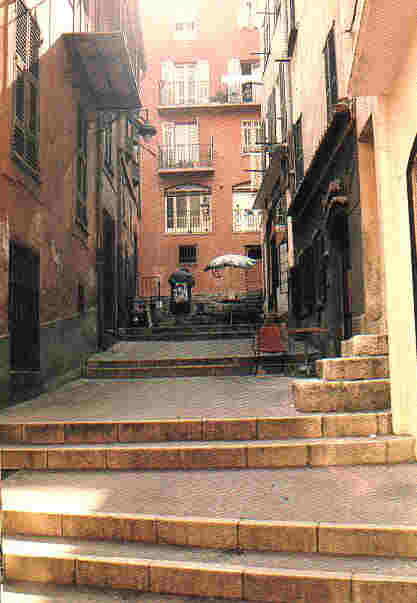 genuine walk ad, climb domain, a maze of winding alleys and very small streets
with stairs covered by hanging laundry. A lot of small restaurants, exotic
shops, cafes, open air stalls wits sausages, cheese, pizzas, fruits confits and
broiled sucking pigs. Look up and admire facades adorned with "trompe
l'oeuil" and frescoes . High maison de maitre and picturesque squares with strange
odours. The rue
Pairoliere gives access to the adorable place Saint-Francois. Every day a
picturesque morning fish market is held. From there take the rue Droite. At the angle of
the rue Droite and the place Jesus,
the bakery "ESPUNO" ( closed on Mondays, Tuesdays and end of June) has
a great variety in breads ( aux olives, with fennel, au roquefort, a l'anis !!,
(anise) ) and a special bread for the bouillabaisse. A hint: the excellent Auberge des Arts in the
rue Pairoliere at no. 9. We soon arrive at the
PALAIS LASCARIS, a 17t century mansion now completely restored as an elegant
museum, complete with pharmacy and a splendid open staircase in the Genoese
style. House of the noble family Lascaris-Ventimiglia, the city of Nice bought it in 1942 and restored it thoroughly
twenty years later. As soon as you enter you notice the vast hall with open
staircase and the family shield on the ceiling. Several museums house on the
floors. The first with a Gobelin and a wall painting from Carlone and styles
furniture. The third is a folkloristic museum. Continuing the rue Droite, next
important church, CATHEDRALE SAINTE-REPARATE on Place Rossetti. Built in 1650, a
clock tower was added in the 18th century. Look at the roof, special
design and material!. The interior of the church shows the exuberant manner of
the almighty baroque style in the 17th century Nice. Follow now rue
Sainte Reparate until the rue de la Prefecture, and make a right. Pass the
Palais de Justice, cross the place du Palais and enter the rue Gassin, leading
you to the church SAINT-FRANCOIS-DE-PAUL. Typical baroque church of the 18th
century (1736) with neo-classic influences. Inside the columns are gilded.
Across the street lies the Nice Opera House with a monumental façade with
columns and sculptures.
genuine walk ad, climb domain, a maze of winding alleys and very small streets
with stairs covered by hanging laundry. A lot of small restaurants, exotic
shops, cafes, open air stalls wits sausages, cheese, pizzas, fruits confits and
broiled sucking pigs. Look up and admire facades adorned with "trompe
l'oeuil" and frescoes . High maison de maitre and picturesque squares with strange
odours. The rue
Pairoliere gives access to the adorable place Saint-Francois. Every day a
picturesque morning fish market is held. From there take the rue Droite. At the angle of
the rue Droite and the place Jesus,
the bakery "ESPUNO" ( closed on Mondays, Tuesdays and end of June) has
a great variety in breads ( aux olives, with fennel, au roquefort, a l'anis !!,
(anise) ) and a special bread for the bouillabaisse. A hint: the excellent Auberge des Arts in the
rue Pairoliere at no. 9. We soon arrive at the
PALAIS LASCARIS, a 17t century mansion now completely restored as an elegant
museum, complete with pharmacy and a splendid open staircase in the Genoese
style. House of the noble family Lascaris-Ventimiglia, the city of Nice bought it in 1942 and restored it thoroughly
twenty years later. As soon as you enter you notice the vast hall with open
staircase and the family shield on the ceiling. Several museums house on the
floors. The first with a Gobelin and a wall painting from Carlone and styles
furniture. The third is a folkloristic museum. Continuing the rue Droite, next
important church, CATHEDRALE SAINTE-REPARATE on Place Rossetti. Built in 1650, a
clock tower was added in the 18th century. Look at the roof, special
design and material!. The interior of the church shows the exuberant manner of
the almighty baroque style in the 17th century Nice. Follow now rue
Sainte Reparate until the rue de la Prefecture, and make a right. Pass the
Palais de Justice, cross the place du Palais and enter the rue Gassin, leading
you to the church SAINT-FRANCOIS-DE-PAUL. Typical baroque church of the 18th
century (1736) with neo-classic influences. Inside the columns are gilded.
Across the street lies the Nice Opera House with a monumental façade with
columns and sculptures.
 |
|
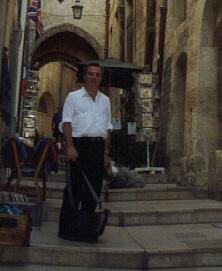
Old Nice and Jack |
If you
care to look and find the rue Rossetti, the square for ice-cream and coffee, make a stop at the rue Benoit-Benico and
imagine the area a few centuries ago. Just a little effort of your imagination
;-). You are standing in the middle of the ancient Jewish ghetto. The street,
former rue Guidaria (Jews street) used to be closed at sunset by a chain and
iron fences. . The law, dating from 1430 said it was to protect the Jews, but of course
a disciplinary measure and vexation as there were so many in the middle ages.
But Jews are not so easily taken off guard. A maze of cellars, caves and sewers
gave the population the opportunity to get outside and do their business as
usual. We had during WWII the still vivid example of the Warsaw ghetto and their
ways of surviving thanks to the same kind of contact with the outside world. In
the 18th century, the king of Sardinia, more open (but ugly) minded,
ordered the Jews to wear a yellow star. Adolf invented nothing! This measure was
only abolished during the French revolution.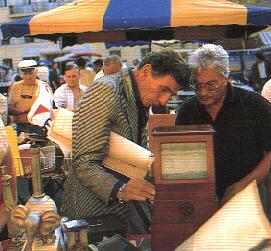
 Go now to
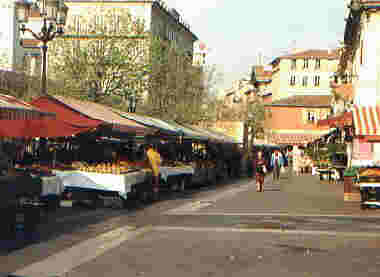
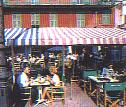
the famous PLACE SALEYA, the famous flower market (flea market on Mondays) where all tourists visiting
the old town meet and take a rest at one of the numerous terraces. the fruit and
vegetabel market vanishes at noon . A
lot of French like to come here, the atmosphere being fresh and special. Just
sit down to take a coffee, beer or glass of wine. Or eat a quick pizza at one of
the Go now to
the famous PLACE SALEYA, the famous flower market (flea market on Mondays) where all tourists visiting
the old town meet and take a rest at one of the numerous terraces. the fruit and
vegetabel market vanishes at noon . A
lot of French like to come here, the atmosphere being fresh and special. Just
sit down to take a coffee, beer or glass of wine. Or eat a quick pizza at one of
the
 numerous stalls outside shops, selling also sausages, numerous stalls outside shops, selling also sausages,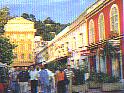 cheese and fruit. The
show is permanent. Maybe you could try the only decent place around here: the
Mille Pates, or else go in the narrow rue de l’Abbaye in the very animated
“Ville de Sienne” (Penne a l’arrabiata, followed by a saltimbocca a la
Romana with a cool and dry Orvieto Secco). cheese and fruit. The
show is permanent. Maybe you could try the only decent place around here: the
Mille Pates, or else go in the narrow rue de l’Abbaye in the very animated
“Ville de Sienne” (Penne a l’arrabiata, followed by a saltimbocca a la
Romana with a cool and dry Orvieto Secco).
Let’s
return to the place Massena to continue our walk in Nice.
Bibliography:
Mary Blume, "Cote d'Azur. Inventing the French Riviera" (Thames
and Hudson, London 1982) Stephen
Liegeard, "La Cote d'Azur (Ed.Serre, Nice 1988), Georges
Poujouly,"Nice, une ville méconnue" (ed.Frontieres, Grasse),
"Guides du routard 1998-99, ed.Hachette)
|
Cote
d'Azur main page
Promenade des Anglais
Cimiez
walk - Musee Matisse
Musee
Chagall - Museum
of Contemporary Art
|