|
Rouen curch and antique museum Normandy Site Home - What's New?-Feedback - About Jack-Travel/Art Links |

NORMANDY
Rouen-Church of Saint Ouen- Antiques museum
Gros Horloge and Place Vieux Marché
Palais de Justice Bourgtheroulde
Church Saint Ouen-Musée des Antiquités
Tour Jeanne-Musée Secq des Tournelles-musee des Beaux Arts
Musée de Faience-Musée Flaubert
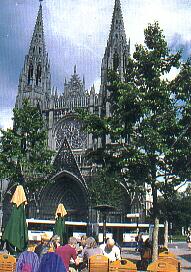
The ABBATIALE DE SAINT OUEN, dating 14th century is another marvel of gothic French architecture! My god, what this beautiful!! You may be Jewish or Muslim or even Buddhist, if you have some common sense about beauty, you must get goose pimples by looking at this! The view is a bit framed between the timbered houses of the rue Damiette, catching the breath of its lantern towers.
 |
|
Saint-Ouen |
Unlike the cathedral of
which this church is larger and higher (only a few metres), it is closely
confined in a protective huddle of streets and houses. Combining delicacy and
airiness to the extreme it has its arched vaults drawn like rainbows. Tow
splendid octagonal towers surmounted by a spire. Rouen’s second grand church
rises from lawns, trees and wide-open spaces of the place General de Gaulle.
Founded in 1318 it was not completed 200 years. Therefore you can notice a
lot of other influences in its architecture than the original Gothic style.
Inside, a forest of fine and elegant columns supports the long nave. Often
described as being of great unity, the interior impresses more by its great size
from end to end beneath an unbroken roof, and its great height (33 meters) Light
floods from the windows so 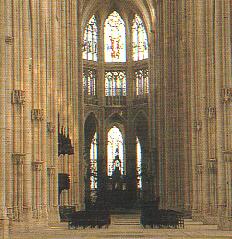 vast
that it seems impossible that these slender stone framed can support the
enormous weight of the roof. In fact, the walls are propped by the flying
buttresses outside. Superb 16th century stained windows, with soft
pink colours enhance the already stupendous place. In the choir we see a series
of one of the most beautiful stained-glass windows in France.
vast
that it seems impossible that these slender stone framed can support the
enormous weight of the roof. In fact, the walls are propped by the flying
buttresses outside. Superb 16th century stained windows, with soft
pink colours enhance the already stupendous place. In the choir we see a series
of one of the most beautiful stained-glass windows in France.
Just beyond the place du General is a former Jesuit college named Lycée
Corneille after its star pupil. But also other great names used their shorts on
the school benches: Flaubert, Maupassant, Delacroix, and later the modern writer
and critic André Maurois. No doubt they would have been fascinated by the
collections of the nearby MUSEE D’ANTIQUITES, rue Beauvoisine. This museum is
housed in a 17th century cloister. It is an exciting and thrilling
conserving a lot of testimonies about the history of Rouen from prehistory to
our present time. Don’t forget that Normandy was one part of the great Roman
Empire and daily artefacts are found in the city. Like that mosaic Orpheus
charming the animals and Apollo pursuing a reluctant Daphne, rescued from the
Roman baths in Lillebonne. The collections are of great valour.
The 16h century and up is also well represented by a series of admirable stained
glass windows, numerous, sculptures in polychrome wood, locks, chimney pieces,
tapestries, ivories and carved woodwork. A whole gallery is only decorated with
sculpted timber that ornated Norman houses. Nice tapestries room and another
room with ancient mosaics, found in the valley of the Seine.
Next the tour Jeanne d’Arc, Musee Seq des Tournelles, the musée des
Beaux-Arts and musée de la Ceramique.
Bibliography
A holiday history of France, by Ronald Hamilton (London-Hogarth press), Region Normandie, ses merveilles, ses cicatrices, by Louis Letellier (ed. Cloison, Rouen 1995), Routard 1998 (Hachette, Paris), Rouen, ville martyr, by Patrick Deware (Ed. Dargelle, 1998)-France today, by John Ardagh (Secker and Warburgh, London) The Identity of Normandy, by Fernand Braudel (Fontana Press, London)