|
Rouen Saint Maclou in Normandy Site Home - What's New?-Feedback - About Jack-Travel/Art Links |

NORMANDY
Rouen-Saint Maclou-Aitre Saint Maclou
Gros Horloge and Place Vieux Marché
Palais de Justice Bourgtheroulde
St.Maclou-Aitre St.Maclou
Church Saint Ouen-Musée des Antiquités
Tour Jeanne-Musée Secq des Tournelles-musee des Beaux Arts
Musée de Faience-Musée Flaubert
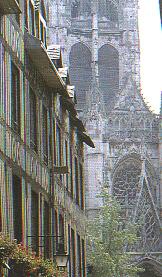 It
is an immense delight to come on SAINT-MACLOU (open 10.00-12.00, 14.00-18.00 in
the week, 15.00-17.30 Sunday and festive days), opposite the Archbishop’s
palace on the far side of the rue de la Republique. Late gothic, end 15th
flamboyant architecture at his best! And with a unique uniform style since the
church was built in a rather quick tempo (about ten years). The church gives
such a formidable impression of airiness and grace that I stood and watched for
long minutes!
It
is an immense delight to come on SAINT-MACLOU (open 10.00-12.00, 14.00-18.00 in
the week, 15.00-17.30 Sunday and festive days), opposite the Archbishop’s
palace on the far side of the rue de la Republique. Late gothic, end 15th
flamboyant architecture at his best! And with a unique uniform style since the
church was built in a rather quick tempo (about ten years). The church gives
such a formidable impression of airiness and grace that I stood and watched for
long minutes!
I have seen many but it is for me one of the finest pure gothic edifices in
France. Damaged during last war it was restored and entirely renovated. Large
porch with five great arches, superb Renaissance folding doors and gables
carried up against flying buttresses “crowned by fretted niches and fair
pediment—meshed like gossamer with inextricable tracery”. You think I made
up this perfect English text? No way, it’s from the English critic John
Ruskin.
 |
|
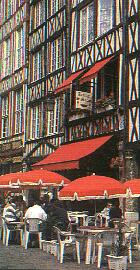
Dining near St.Maclou |
Anyway the round façade adds to the homogeneity of the building. Medallions representing the Good Pastor and two other medallions with the circumcision and baptism of Christ. Absolutely remarkable. Raise your head: somewhere in the forest of pinnacles are two oil jars in stone. The 6th century saint to whom the church was dedicated was a Scotsman who seems to have been canny enough to win the concession to supply holy oil to the diocese. Clever boy! Inside, a magnificent organ of 1521 with delicate Renaissance wainscoting (summer concerts) and an elegant sculpted spiral staircase of the 16th century.The rue Martainville on the left of Saint-Maclou is anattractive half-timberedstreet of old print and book shops which hides a ghost train funfair ride of indescribable horror: the AITRE SAINT-MACLOU.
 |
|
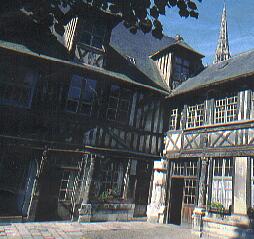
Ecole Beaux-Arts |
Enter its passage and push
open the door. There is a quadrangle surrounded by two-storied buildings being
the studios of the “Ecole Regionale des Beaux-Arts”. Look at the carved
wooden frieze above the ground floor on the timberwork gallery. Gruesome
paraphernalia of death are there, skulls, coffins, crossbones, numerous macabre
figures that give us a clue what this used to be:
a former cemetery and
ossuary of the Black plague epidemics, a plague pit with bones heaped in the
centre. The ossuary was at the first floor. The pillars are all decorated with
very sympathetic and rhythmic sculptures representing figures of crossed
shinbones, shovels digging a tomb, axes to dissect the dead bodies,
crosses…amazing!Rouen’s victims of the
Black Death, who are believed to have numbered 100,000 in the 14th
century alone, must be buried here. I figure that the students of the Art School
must be inspired by this very peculiar place J.
There are often very interesting contemporary art exhibitions.
Bibliography
A holiday history of France, by Ronald Hamilton (London-Hogarth press), Region Normandie, ses merveilles, ses cicatrices, by Louis Letellier (ed. Cloison, Rouen 1995), Routard 1998 (Hachette, Paris), Rouen, ville martyr, by Patrick Deware (Ed. Dargelle, 1998)-France today, by John Ardagh (Secker and Warburgh, London)The Identity of Normandy, by Fernand Braudel (Fontana Press, London)