|
Rouen Tour Jeanne Secq des Tournelles-Musee des Beaux Arts Normandy Site Home - What's New?-Feedback - About Jack-Travel/Art Links |

NORMANDY
Rouen-Tour Jeanne d'Arc-Musee Secq des Tournelles-Musée des Beaux-Arts
Gros Horloge and Place Vieux Marché
Palais de Justice Bourgtheroulde
Church Saint Ouen-Musée des Antiquités
Tour Jeanne-Musée Secq des Tournelles-Musée des Beaux Arts
Musée de Faience-Musée Flaubert
Philippe Auguste, king of
France, built a castle in the 13th century with seven towers. Only
one tower remains and is piously called “TOUR JEANNE D’ARC” since legend
assures it is here that she was brought from her prison cell in the Tour de la
Pucelle and, in a scene reminiscent of early cinema melo-drama, she was
confronted wit her instruments of torture. In fact it’s untrue, she was held prisoner in another tower. (The
Jeanne d’Arc adulators should go to 102, rue Jeanne d’Arc to fondle the
basements of the tower with devotion.) The Tour is located rue du Donjon, it’s
conical roof thrusts like a rocket’s nose cone above the surrounding modern
buildings. Stones hurdled from the wooden hoarding of the top of the tower today
would make holes in the roof. Used a long time as a stone quarry, it became a
convent and then a cotton mill. Now
nuns run a girl’s school after making more demolitions to make a garden.
In 1920 a man named Henri Le Secq bequeathed his entire blacksmith art and iron
wrought collection to the city of Rouen. Being a clerk he dedicate all his
leisure hours to the iron, which entered really his soul, and he conceived a
passion for blacksmith’s art. The collection found a home in the redundant
church of Saint-Laurent in the rue Jacques Villon, now the MUSEE LE SECQ DES
TOURNELLES. More than 20,000 pieces: from keys to corkscrews, flatirons to
jewellery, locks from all eras to utensils of daily life. Decorative ironwork
from forgotten buildings, even a chastity belt.
Opposite the church is the MUSEE DES BEAUX ARTS, one of the most impressive in
France. The MUST of the region. Vast, airy, luminous, well organized this
stunning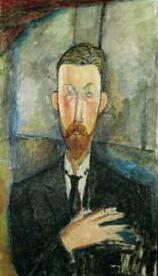 museum offers us a perfect example of European painting from the 14th
centuryto nowadays.
museum offers us a perfect example of European painting from the 14th
centuryto nowadays.
 |
|
Velazques |
It thinks of itself as a new
inviting and fresh look at the work of the great and famous artists from the
Spanish, Italian, French and Flemish schools like Caravaggio, Veronese,
Velasquez, Rubens Ruysdael, Ingres, Gericault, Delacroix.. Closer to us you can
renew acquaintance with Sisley, Monet, Dufy, Modigliani, Duchamp. In the
sculpture garden, classic figures pose, in a frozen immobility under a glass
roof. If you’re interested to see how Pierre Corneille looked like there he is
in terracotta, and looking rather fierce, in oils.
A curiosity signalled by one of my guides figuring in the bibliography:
an anamorphosis realized in the 16th century from an “Elevation to
the Cross” by Rubens, which means that the painting is only visible on a
cylindrical mirror on which it is projected! Don’t miss this museum!!
Bibliography
A holiday history of France, by Ronald Hamilton (London-Hogarth press), Region Normandie, ses merveilles, ses cicatrices, by Louis Letellier (ed. Cloison, Rouen 1995), Routard 1998 (Hachette, Paris), Rouen, ville martyr, by Patrick Deware (Ed. Dargelle, 1998)-France today, by John Ardagh (Secker and Warburgh, London)The Identity of Normandy, by Fernand Braudel (Fontana Press, London)