|
Rouen cathedral in Normandy Site Home - What's New?-Feedback - About Jack-Travel/Art Links |

NORMANDY
Rouen Cathedral
Cathedral
Gros Horloge and Place Vieux Marché
Palais de Justice Bourgtheroulde
Church Saint Ouen-Musée des Antiquités
Tour Jeanne-Musée Secq des Tournelles-musee des Beaux Arts
Musée de Faience-Musée Flaubert
Why is Rouen an unavoidable
attractive city? An extraordinary cathedral, three essential museums and an old
quarter to loiter, just like that, without any reason, raising you nose and eyes.
Much
of Rouen’s history is in the open book of the CATHEDRAL. Stand where Claude
Monet put up his easel before these great towers of the west front for his
series of paintings in 1894 and have a closer look. An elegant lacework of
stones, majestic and refined. You are standing in front of one of the most
beautiful master works of French gothic. First a cathedral was built by William
the Conqueror, just three years before his forces invaded England. You can see
that from the brutalism of the lower stages of the TOUR ST.ROMAIN, from the 12th
century, Gothic arches soar to the extravagances of the flamboyant style that
sets the character for the remainder of the west front. To your right, the TOUR DU BEURRE, 15th century, 75 m height
in the most genuine flamboyant gothic it is named like that because a popular
belief says that it has been with the taxes perceived on people who ate butter
and drank milk during Lent. Another proof that you can do anything with money
!!! Even eat on Lent. So far for equality in treatment ;-). Anyway, soon after
construction the tower started to lean, but the cracks were filed and building
went on its exquisite conclusion in 1517.
In the centre, three porches, chisel masterworks, a fairytale of stones,
presenting all aspects of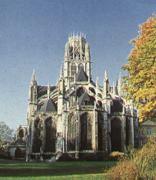 Gothic art. Even if sometimes it gives
away to Renaissance. Portail St.
Jean, St. Etienne are from the 12th century.
Gothic art. Even if sometimes it gives
away to Renaissance. Portail St.
Jean, St. Etienne are from the 12th century.
The central tower and the spire, of an extreme refinement, is already visible
from the rue du Change, completes and unites the composition rising through the
13th to 16th centuries to the lantern which so
dramatically lights the space below and supports the tapering spire. The spire
is 151 m high, the highest in France. Step back to admire it better. Love it or
hate it, but admire the innovative skill of the architect who substituted the
wood and lead with, of all things, cast-iron.
|
|
|
Porte des Libraires |
Take now the rue Saint-Romain on the other side, and see a stone flamboyant
gothic portal, on the transept side, called “La Cour des Libraires”, once
filled with booksellers stalls and beyond it the entrance to the north transept
through the portail des Libraires. Angels and monsters crowd the pages of this
“encyclopaedia of the Middle Ages”. You get the same kind of door at the
south side: Porte des Calendes.
Let’s enter and get only to the essentials, even if a bit of culture won’t
hurt us. After the rich display of the exterior, first steps inside bring
something of anticlimax, of chill even. The very high nave, naked, of an early
primitive gothic and the central tower are supported by slim, elegant and
clustered columns, never looking massive.
Indeed, the soaring heights,
the sheer magnificence of enclosed space and absence of decoration reveal the
builders solemn intention.
At the crossing of the transept look up: 51 m separate you from the ceiling. In
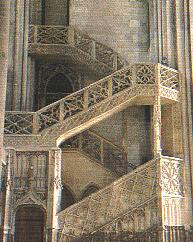
the left transept an elegant staircase leads you to the library. Very sober 13th
century choir? Behind the choir, “the deambulatoire” to see different
chapels like the Virgin’s chapel, one of the highlights of the cathedral.
Amongst other tombs of the great and the formidable are those of William I? Duke
of Normandy, Richard Lionheart’s brother Henry, the effigy of Richard himself,
his heart in a casket in the stone beneath, Cardinal Georges d’Amboise, Louis
XII’s minister and virtual ruler of France who gave Rouen fresh water supply
and sanitation. Another figure is his nephew, Louis de Brézé, seneschal of
Normandy, died 1544, a knight above, a naked corpse below, mourned by a kneeling
Diane de Poitiers.
Before leaving look at the Saint-Julien windows in the north choir aisle:
admirable stained windows, where Flaubert found inspiration to write a novel of
a man destined to kill his parents.
Bibliography
A holiday history of France, by Ronald Hamilton (London-Hogarth press), Region Normandie, ses merveilles, ses cicatrices, by Louis Letellier (ed. Cloison, Rouen 1995), Routard 1998 (Hachette, Paris), France today, by John Ardagh (London, Secker and Warburgh), Writer’s France, by John Ardagh (London, Hamish Hamilton)