|
Rouen Normandy the whole city review Site Home - What's New?-Feedback - About Jack-Travel/Art Links |

NORMANDY
Rouen-Gros Horloge and Place du Vieux Marché
Gros Horloge and Place du Vieux Marché
Palais de Justice Bourgtheroulde
Church Saint Ouen-Musée des Antiquités
Tour Jeanne-Musée Secq des Tournelles-musee des Beaux Arts
Musée de Faience-Musée Flaubert
Leaving the cathedral, cross
the Place Notre Dame, and enter the RUE DU GROS HORLOGE,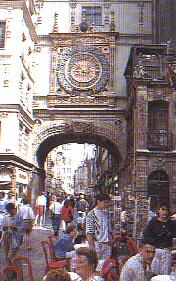 evidently the most popular street in town. Tall, timber-framed mansions backed
by the belfry ornate the street with the charms of the past. When offices close
it is very, very animated and on Saturday afternoon impossible to circulate,
absolutely packed. Once a main artery leading to the Vieux-Marché, it is now
bisected by a modern boulevard, but still rich in Renaissance buildings. But it
seems that the rue du Gros-Horloge has lost some of the favour of Rouennais
shoppers for the commercial centre “Saint-Sever” which resulted in the
migration of luxury boutiques to this center. The level of shops on the old
centre fell dramatically.
evidently the most popular street in town. Tall, timber-framed mansions backed
by the belfry ornate the street with the charms of the past. When offices close
it is very, very animated and on Saturday afternoon impossible to circulate,
absolutely packed. Once a main artery leading to the Vieux-Marché, it is now
bisected by a modern boulevard, but still rich in Renaissance buildings. But it
seems that the rue du Gros-Horloge has lost some of the favour of Rouennais
shoppers for the commercial centre “Saint-Sever” which resulted in the
migration of luxury boutiques to this center. The level of shops on the old
centre fell dramatically.
Spanning the
street ahead is the GROS-HORLOGE, a delightful Renaissance pavilion set on a
sculpted arch with the most splendidly embellished clock. Probably the most send
postcard from Rouen. The gilded lead clock used to inside the belfry in the 14th
century, when it was decided it should be showed. That’s why the arch was
built in the 16th and the clock given its present richly gilded
setting. Have a look under the arch: a sculpted scene of the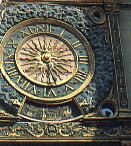 Good Pastor and his lambs. On the side of the clock, nice romantic fountain of
the 18th century, full of elegance, with an appearing nymph.
Good Pastor and his lambs. On the side of the clock, nice romantic fountain of
the 18th century, full of elegance, with an appearing nymph.
The clock tells the hour, week and moon phases through a bull’s eye above. The
curfew was rung at 9 o’ clock each evening. The bells rang for the people,
calling them when decisions had to be made, when their rights were threatened,
or revolt was the only way to resist oppressive rule.
The clock being in renovation last time I visited it I hope it is ready now, at
least half the year 2000. In the mean time you can still climb the 163 stairs of
the belfry.Continue to the end of the
street towards the PLACE DU VIEUX MARCHE. Jeanne d’Arc was burned alive here
on 30 May 1431, here ashes thrown in the river Seine. It was the place where all
condemned were executed in the Middle Ages. Surrounded by tall, timber-framed
houses, the square is the most popular and vivid of the city thanks to the
gaiety that restaurants, cafés, shops, market stalls and visitors contribute to
the market place today.
|
|
|
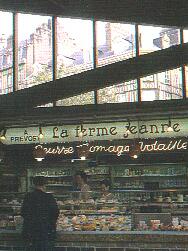
Shop on Vieux Marché |
Near the spot where the
flames were lit, traced out in stones and marked by a 20 meters cross, is the
CHURCH OF SAINT SAUVEUR mute witness to the scene. Next to it, the EGLISE JEANNE
D’ARC (open 10.00-12.30 14.00-18.00, closed Friday and Sunday morning) is
decorated by beautiful stained glass windows recuperated from a church razed in
1944. The interior is very successfully arranged, warmly glowing with the
brilliant lustre of the stained glass. In fact it is the exterior architecture
that is heavily criticized: it sits uneasily under a kind of ski slope roof and
pyramid gables.
On the south side of the square, you can hear voices in the MUSEE JEANNE D’ARC
(open 9.30-18.0 summer; off season 10.00-12.00 14.00-18.00). About fifteen
scenarios with wax figures and taped commentary in four languages that bring
nearly to life the characters in her story, from her birth to her dramatic death.
Collection of documents, small scale models that children will like.
Bibliography
A holiday history of France, by Ronald Hamilton (London-Hogarth press), Region Normandie, ses merveilles, ses cicatrices, by Louis Letellier (ed. Cloison, Rouen 1995), Routard 1998 (Hachette, Paris), Rouen, ville martyr, by Patrick Deware (Ed. Dargelle, 1998)-France today, by John Ardagh (Secker and Warburgh, London)The Identity of Normandy, by Fernand Braudel (Fontana Press, London)