|
Rouen Normandy Hotel de Bourgtheroulde Palais de Justice Site Home - What's New?-Feedback - About Jack-Travel/Art Links |

NORMANDY
Rouen-Hotel de Bourgtheroulde-Palais de Justice
Gros Horloge and Place Vieux Marché
Palais de Justice Bourgtheroulde
Church Saint Ouen-Musée des Antiquités
Tour Jeanne-Musée Secq des Tournelles-musee des Beaux Arts
Musée de Faience-Musée Flaubert
Turn
right into the market into the rue de la Pucelle and discover the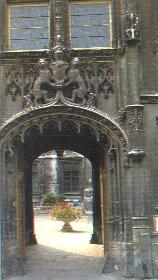 HOTEL
DEBOURGTHEROULDE, (call it Boortrood), a jewel of a Renaissance building,
undoubtedly the most beautiful Renaissance edifice of Rouen. Built in the 16th
century by Guillaume II Le Roux, counsellor of parliament. It’s private but as
the porch is often open try to peek inside. It is owned by a bank now who
let’s us sometimes enter the courtyard and admire the octagonal staircase
tower, a surviving Gothic flamboyant end building and a fine gallery around the
side. Friezes and wall sculptures are beautiful but a bit tarnished by
weathering. But look at the majestic facades and chiselled turrets.
HOTEL
DEBOURGTHEROULDE, (call it Boortrood), a jewel of a Renaissance building,
undoubtedly the most beautiful Renaissance edifice of Rouen. Built in the 16th
century by Guillaume II Le Roux, counsellor of parliament. It’s private but as
the porch is often open try to peek inside. It is owned by a bank now who
let’s us sometimes enter the courtyard and admire the octagonal staircase
tower, a surviving Gothic flamboyant end building and a fine gallery around the
side. Friezes and wall sculptures are beautiful but a bit tarnished by
weathering. But look at the majestic facades and chiselled turrets.
Glimpsed up a side street in the rue des Juifs, is the PALAIS DE JUSTICE,
obviously the most beautiful non-religious building of the city. Another gothic
masterpiece, begin 16th century, by the same Le Roux, also architect
of the cathedral considered by most as one of the world’s richest examples of
Gothic architecture. But if you are a bit architecturally minded you can notice
the slow conversion from later Gothic to Renaissance. And it has not only 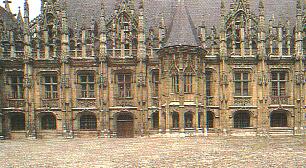 survived
restorers (often incompetent idiots) war and desecration, but also the
restorer’s restoring the work of restorers. I hope you can follow me! :-)
survived
restorers (often incompetent idiots) war and desecration, but also the
restorer’s restoring the work of restorers. I hope you can follow me! :-)
The Norman parliament had its quarters here in the 16th
century. An it is not surprising that during later restoration works the
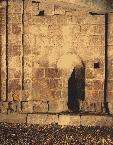
foundations of a Jewish building (12th century) in the Romanesque
style was discovered, probably a synagogue, since this area was the Jewish
quarter in Middle Ages.
|
|
|
Ancient synagogue |
As parliament it as a private place, hidden behind towering walls, its beauty not for the public eye. Now you can admire the façade in the large interior courtyard with its central turret of a great decorative wealth. Notice how decoration increases the higher the wall is. Downstairs the windows are quite simple and sober, the first floor is already more sculpted, and the superior level is an orgy and glorious profusion of turrets, pinnacles, flying buttresses, lantern widows, arches, tracery and crockets rising like champagne bubbles against the steeply sloping roof. Superb!!
|
|
|
Rue St.Romain |
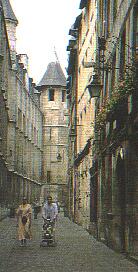
The great Corneille, Rouen’s dramatist son, must often have thumped the inside of the Justice palace when addressing the court as a lawyer.
To the left of the cathedral
is the RUE SAINT ROMAIN, skirting the Archbishop’s palace. At no.70 an elegant
façade abundantly chiselled with iron works. No.74 a gothic house with sculpted
capitals of the 15th century. And discover the CHAPELLE -D’ORDRES
where unfortunately only the ruined windows survive. It is here that the final
act of the trial of Joan of Arc took place. The next day she would be burned at
the stake. In some of the houses opposite lodged the canons that condemned her
to death. In this street, as elsewhere in the city, the old wooden houses
attract sympathetic businesses, and the displays of dealers in antique furniture,
books and prints put a welcome brake on “progress”.
Next, the church of Saint-Maclou.
Bibliography
A holiday history of France, by Ronald Hamilton (London-Hogarth press), Region Normandie, ses merveilles, ses cicatrices, by Louis Letellier (ed. Cloison, Rouen 1995), Routard 1998 (Hachette, Paris), Rouen, ville martyr, by Patrick Deware (Ed. Dargelle, 1998)-France today, by John Ardagh (Secker and Warburgh, London)The Identity of Normandy, by Fernand Braudel (Fontana Press, London)