|
Rouen Normandy history and world war 2 Site Home - What's New?-Feedback - About Jack-Travel/Art Links |

NORMANDY
Rouen in history and WWII
History and WWII
Gros Horloge and Place Vieux Marché
Palais de Justice Bourgtheroulde
Church Saint Ouen-Musée des Antiquités
Tour Jeanne-Musée Secq des Tournelles-musee des Beaux Arts
Musée de Faience-Musée Flaubert
Capital of Haute-Normandie, prefecture of Seine-Maritime, and one of the most important French harbours, Rouen is the region’s largest city with a population of 386,000. Pierre Corneille and Gustave Flaubert would not recognize THEIR city, the city of their childhood, but despite the war destructions, industrial development, the old city where Jeanne d’Arc was burned alive, stayed one of the most beautiful in France.
|
|
|
William invading England |
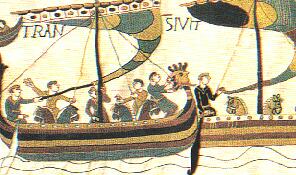
Probably created by the
Gaulish it was conquered by the Romans and Christianised in the third century.
Normans looted the city several times from 9th century up. Finally there is nothing left of the old Roman trading place to be seen
above the ground except in the Museum of Antiquities.
One of these plundering Norsemen, Rollon, received a part of the region from
Charles le Simple, king of France. He becomes the first duke of Normandy and
recognizes Rouen as his capital. We talk the year 911. Rollo changed his name to
Robert and married the king’s daughter, inaugurating three centuries of rule
by Norman dukes with Rouen as their power base.
Begin XIII th century, Normandy is reattached to France. The cathedral is
rebuilt, symbol of the “Rouennais” power, flanked by two totally different
towers.
The boom of the city, thanks to its drape industry and harbour attracts more and
more people. Rouen becomes the second city in France! But soon problems begin: bubonic plague, floods and other epidemics
decimate the people. Revolts follow and to punish the city Charles VI abolishes
the title of “city”. Rouen will have no mayor during ….310 years!
To put a crown on all this, the Hundred Years war starts and the English besiege
the city in 1419. Famished, the population surrenders after six months.
The English settled down for 30 years.
|
|
|
Joan of Arc |
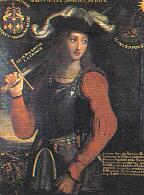
The episode with
Jeanne d’Arc is known to everybody. She was captured by the Burgundians,
enemies of the king of France and brought to justice by a certain “eveque
Cauchon” in March 1431, condemned for heresy and …improper behaviour (she
dressed like a man) to a lifetime in jail. This didn’t please the English who
urged Cauchon to change the sentence. On the 29 she is again condemned for
heresy and to be burned at the stake as a witch.
This little ceremony took place on the place du Vieux-Marché, next morning. To
avoid all adoration, her ashes are thrown in the river.
During the following
centuries Rouen had moments of glory and decaybut it’s always the fact that it
had a port that brought her wealth. It was and is still the main pass through to
Paris.
The last catastrophe that touched Rouen was WWII. When the Germans arrive,
hundreds of explosions welcome them. The port, then all bridges were blown up.
The old city burns like a torch and even comes near the cathedral. It’s an
architectural disaster. Dozens of wooden panelled houses collapse but the gentle
German soldiers and officers forbid the firemen to approach. It’s Hitler, the
good man himself, who orders the cathedral to be spared. We are all very
grateful! But during the 10 days fire did its job, 900 houses were totally lost.
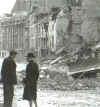 In 1941 and 42 the English bombs add a little to the destructions killing
several citizens, like on the night of 18 to 19 April 1944 when 345 bombs fall
in the city, provoking a new fire. 900 victims and 500 building destroyed of
which hotels particuliers of the 14th and15th century.
In 1941 and 42 the English bombs add a little to the destructions killing
several citizens, like on the night of 18 to 19 April 1944 when 345 bombs fall
in the city, provoking a new fire. 900 victims and 500 building destroyed of
which hotels particuliers of the 14th and15th century.
The sumptuous Palais de
Justice leaves only a façade blackened by fire.
Rouen thought the worse had happened. Wrong!!! On May 30, 160 bombs eviscerate
the areas around the Seine. On the 31st, 140 torpedoes explode and on
June 1st the fire sets in the old quarters. At 19.00 someone shouts:
”The cathedral is burning!!!”. Indeed, the tour Saint-Romain collapses, with
its bell towers and soon the fire threatens the spire, pride of the city! A
dozen of young Rouennais fight all night against the fire, high perched in the
towers, throwing sand and water. On June 2, the cathedral is saved. But two days
later the church Saint-Maclou collapses under a new bombing.
After D-day, the allied chased the Germans with great difficulties. During three
months, the Rouennais will be under more attacks, bombings, raids, and
sabotages. The German tanks decide finally to evacuate but they are blocked
since the bridges hadn’t been rebuilt. The R.A.F. bombs them heavily and
finally on August 26 and 27 the bombs finally chase the enemy, 4 explosions a
minute! Before leaving the Germans arson the harbour. The allies enter a city in
ruins, which had lots 3,000 of its children and 10,000 houses during this war.
Bibliography
A holiday history of France, by Ronald Hamilton (London-Hogarth press), Region Normandie, ses merveilles, ses cicatrices, by Louis Letellier (ed. Cloison, Rouen 1995), Holt’s battle field guides, Normandy Overlord by Holt, Tonie and Valmai (Sandwich, Kent), Routard 1998 (Hachette, Paris), Rouen, ville martyr, by Patrick Deware (Ed. Dargelle, 1998), Six armies in Normandy, by John Keegan, (paperback ed. Pimlico)- La Journée fut longue, by Patrick Dewaere (ed.Robin, Paris 1988)