|
The ILE DE LA CITE, which was for a long
time the center of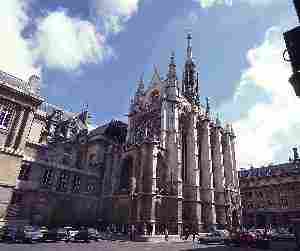 the capital was also the earliest inhabited part of it. It is
commonlyaccepted that the tribe "Parisii" established their home here
in the 3rd century BC and lived peacefully on that island, where the arms of the Seine offered them protective frontier. In 52 BC it
was conquered by the Romans. The first must we have to visit is the
SAINTE-CHAPELLE, 4 Boulevard du Palais. the capital was also the earliest inhabited part of it. It is
commonlyaccepted that the tribe "Parisii" established their home here
in the 3rd century BC and lived peacefully on that island, where the arms of the Seine offered them protective frontier. In 52 BC it
was conquered by the Romans. The first must we have to visit is the
SAINTE-CHAPELLE, 4 Boulevard du Palais.
The most beautiful religious achievement
ever anywhere, a masterpiece, a jewel of gothic architecture. We can consider it as
the most perfect creation of the Middle Ages. The proportions, wonderful of
accuracy, give her an incredible harmony. Built by Saint Louis between 1242-1248
it was destined to house two reliquaries: the thorn crown and a piece of the
original Cross. Today those reliquaries are displayed in the cathedrale
Notre-Dame (4th arrondissement).
|
|
|
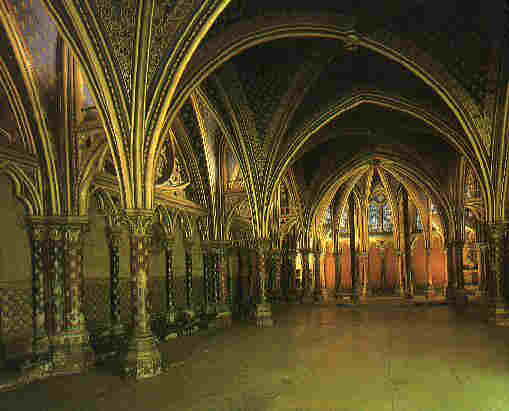
Chapelle Basse
|
This Chapel escaped from disaster during the
French revolution, being used as a loft to store corn! But only the storage
space and archives were badly damaged. The edifice was sold and served as a
club, an archive depot and was finally restored by Duban, Lassus and the
inevitable Viollet-le-Duc (1837-1867). It escaped also by miracle from a fire in
1871.This jewel of gothic architecture seizes
us by its unity, synthesis between the technical constraints and artistic
exigencies. This royal court chapel was built on two
levels of which the superior part has a direct entry to the Palais de Justice. The lower floor was reserved for ordinary people, soldiers and poor craftsmen
(no unions in those times);-)) but the most impressive is the upper floor, the
chapel, you can accede by a spiral staircase and where the Royal Family and its
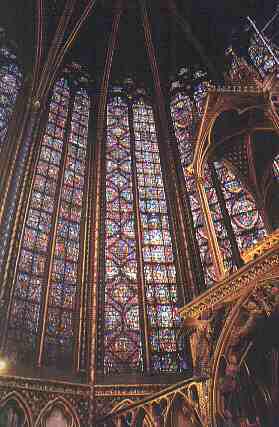
courtesans were present for the religious celebrations. As soon you step in this upper hall your
breath sticks in your throat! The light oozes through the 15 stained-glass
windows in an extraordinary panorama. Exactly 1134 biblical illustrations
ornate a huge glass-frame,
sublimated by the slightest touch of light. The tonality of the colors and the
delicacy of the stroke make it the oldest and most beautiful cartoon in history
of mankind. If you have the impression that the whole Chapelle seems to float in
the air, it's thanks to the architect Pierre de Montreuil, who, simply said,
placed the roof on supporting pillars.e
|
|
|
Chapelle haute
|
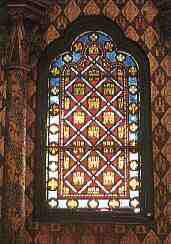
Stained glass window
|
As long as we are here, why not say a
few words about the PALAIS DE
JUSTICE?
Since centuries it is the center of
Parisian administration of justice. It's here that the Roman stadtholder had its
siege, as well as the first French kings (until the 13th century). The
parliament and city council had also their sessions here until the French
revolution put an and to it. The building survived quite a few fires over the
centuries. ( in 1618 and a very bad one in 1776 where a great part of the
archives disappeared) . During the Revolution, the revolutionary court held its
trials in the Chambre Doree. How many famous princes, princesses and other
nobility were sent to the scaffold from here!
Today, you can watch trials going on by
pushing any court door.The Palais de Justice forms an
architectural unity with the Sainte-Chapelle and the Conciergerie.
Exit and go to the Conciergerie. Passing the corner of the quay, look up to the
"Tour de l'Horloge"
(1370),
still functioning.
THE CONCIERGERIE
These sinister, gothic walls ( north
side of Palais de Justice), angle of boulevard du Palais and quai de l'Horloge, represent exactly what has been the most notorious prison of Paris. The
Conciergerie was built during the period of 1298-1353. It housed many famous
prisoners.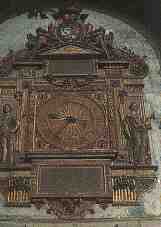 Marie-Antoinette, Mme du Barry, Danton and Robespierre together with
1200 other victims. Only between January 1793 and January 1994 we can say that
2600 were sent to execution from here.
Marie-Antoinette, Mme du Barry, Danton and Robespierre together with
1200 other victims. Only between January 1793 and January 1994 we can say that
2600 were sent to execution from here.
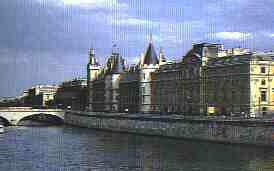
The tower at the right (reference point:
the Seine river) is called "Tour Bonbec" and that's where the
prisoners were questioned and tortured. The two middle towers are the "Tour de Cesar" and "Tour d'Argent". It's in the last
one that the crown treasures were kept. You enter the Conciergerie via the old
"salle des gardes", where the guards had an eye on what was going on.
At the left you see the "Salle des Gens d'Armes" (hall of the weapon
holders) and a kitchen with large ovens. Exterior and interior description can be found in all guides and
brochures, I'm not going to repeat the same as everybody. Just let your
imagination loose and imagine the condemned crossing the prisoners gallery, have
a last haircut before taking the cart for the BIG voyage. End of the road for a
lot of aristocrats or revolutionaries who didn’t fit the ideas of Danton and
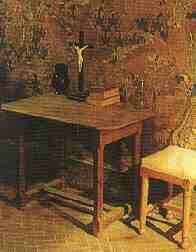
Robespierre during the Terreur period of 1993. You can visit the dungeon (with
only a chair, a table and a bed) where Marie-Antoinette spent her last weeks.
For those who want to have a good idea
of that terrible epoch, I would advise to read the (French or English
translated) novel by Victor Hugo” 1793”. It is a unique book that evokes the
cruelty and brutality of the rulers of that time.
|
|
|
|
Replica of Marie-Antoinette cell |
Conciergerie view from Seine
|
|

