|
Paris main page
Louvre museum Tuileries Jeu de Paume
Jardins du Palais Royal
Place
Vendome Place des Victoires
Les Halles
Ile
de la Cité Sainte-Chapelle
Conciergerie
Pont Neuf-Saint Germain l'Auxerrois
Quai
de la Megisserie
Chatelet
|
Paris 1st arr-Jeu de Paume-Jardins du Palais Royal
|
Paris main page
1st arr
2nd arr
3rd arr
4th arr
5th arr
6th arr
7th arr
8th arr
9th arr
10th arr
11th arr
Bastille and area
Rue de Charonne
Faubourg St. Honore
12th arr
Opera Bastille
Marche Aligre
Train Bleu
Promenade Plantee
Picpus
Bercy-Vincennes
Musee Africain
13th arr
Gobelins
Chinatown
14th arr
Montparnasse
Cemetery
Musee Bourdelle
Catacombs
Vanves
15th arr
Parc Citroen
Parc Brassens
Ruche-Pasteur
16th arr
Musee Vin
Maison Balzac
Guimard-Castel Beranger
Sewer-Modern Art
Dapper museum
New Guimet museum
Marmottan
Bois Boulogne
Defense
17th arr
Parc Monceau
18th arr
Montmartre walk
Fleamarket St.Ouen
19th arr
La Vilette
Cite Musique
Cite Sciences
20th arr
Cemetery Pere Lachaise
|
|
Let's have a look at other building at
the exit of the jardin des Tuileries, to the right, bordering the rue de Rivoli:
the musee du Jeu de Paume also called GALERIES NATIONALES DU JEU DE PAUME. Before it turned to a center of
contemporary art, this museum housed principally the Impressionist and 19th
century paintings. The museum became too small, dusty and badly maintained, so
they decided to move everything to the musee d’Orsay, closed down in 1986 was
renovated and reopened to become what you see now. A superb facade, the original
entrance and a glass-stand looking out on the gardens and a cozy cafeteria. Avant-garde and very contemporary exhibitions take place here all year.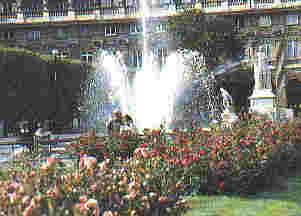 Walk back the rue de Rivoli towards the
Louvre and make a left at the place du Palais Royal. Enter the jardins through any entrance at the other side of
the square. This place, dating probably from the Roman period and was the first
thermal station of Paris. In 1786 the famous Comedie Francaise was built and
around the square under the vaulted arcades a lot of small specialty shops
opened. But it's in this very
poplar and poor neighborhood behind the Comedie Francaise at that time that the
French revolution had its most bloody days. Quoting the Routard 1998: “It's in
one of these shops that Charlotte Cordier bought the knife that stabbed Marat.
Even after the Revolution it stayed a "hot " quarter, had very bad
reputation. Everybody who wanted to
fornicate, gamble and feast came to this quarter. Under the open galleries
(still visible today) cafes and gambling places attracted the crowd.”(unquote)
Take now the very serious looking building at no. 6 rue des Moulins (metro: Pyramide) being a brothel until 1946 and where Toulouse-Lautrec painted his
famous "Au Salon de la rue des Moulins "in 1894. On the second floor
to be more precise.
Walk back the rue de Rivoli towards the
Louvre and make a left at the place du Palais Royal. Enter the jardins through any entrance at the other side of
the square. This place, dating probably from the Roman period and was the first
thermal station of Paris. In 1786 the famous Comedie Francaise was built and
around the square under the vaulted arcades a lot of small specialty shops
opened. But it's in this very
poplar and poor neighborhood behind the Comedie Francaise at that time that the
French revolution had its most bloody days. Quoting the Routard 1998: “It's in
one of these shops that Charlotte Cordier bought the knife that stabbed Marat.
Even after the Revolution it stayed a "hot " quarter, had very bad
reputation. Everybody who wanted to
fornicate, gamble and feast came to this quarter. Under the open galleries
(still visible today) cafes and gambling places attracted the crowd.”(unquote)
Take now the very serious looking building at no. 6 rue des Moulins (metro: Pyramide) being a brothel until 1946 and where Toulouse-Lautrec painted his
famous "Au Salon de la rue des Moulins "in 1894. On the second floor
to be more precise. 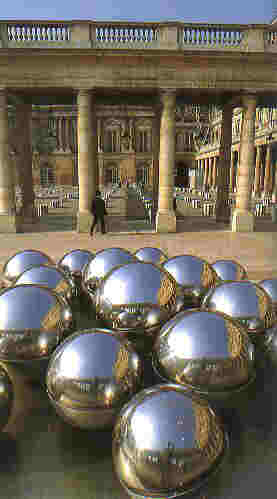 The atmosphere in this house was a popular literary subject:
"La Maison Tellier" by Guy de Maupassant or "Nana" by Emile
Zola. Here erotic and revolutionary plays were
performed, there a group of intellectuals had a discussion on Voltaire or Victor
Hugo. It was really the place to gather, meet people and ...play money games. But times changed. The atmosphere in this house was a popular literary subject:
"La Maison Tellier" by Guy de Maupassant or "Nana" by Emile
Zola. Here erotic and revolutionary plays were
performed, there a group of intellectuals had a discussion on Voltaire or Victor
Hugo. It was really the place to gather, meet people and ...play money games. But times changed.
The jardins du palais-Royal
turned finally into a quiet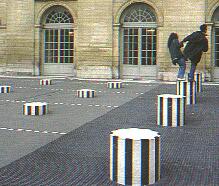 city garden where the wealthy could sit very near to
the buzzing rue de Rivoli and still feel as in a village. Children at play, accompanied by their nannies or old "retired
" men trying to catch some sun ray in the nice season and office clerks
eating their home made lunch.
A very controversial project is to see
at the south side of the garden: the
colonnes de Buren, a modern feature or sculpture (just pillars). Sticking out of
the ground in different heights they make by passers and tourist wonder what
this is all about. I reserve my opinion, you all know what that means. city garden where the wealthy could sit very near to
the buzzing rue de Rivoli and still feel as in a village. Children at play, accompanied by their nannies or old "retired
" men trying to catch some sun ray in the nice season and office clerks
eating their home made lunch.
A very controversial project is to see
at the south side of the garden: the
colonnes de Buren, a modern feature or sculpture (just pillars). Sticking out of
the ground in different heights they make by passers and tourist wonder what
this is all about. I reserve my opinion, you all know what that means.
In front of the Theatre
Francais, rue
St.Honore 157, the cigar amateurs will find happiness in one of the oldest
tobacco shops of town, " La Civette" (address also gracefully
indicated by the Routard). And another attraction may be to have a look at the
"Grand Vefour", beacon restaurant of the 18th century where Voltaire
was a regular customer.
Another attraction is still worth
staying and waiting a bit at the Jardins du Palais-Royal:
THE CANON OF THE PALAIS-ROYAL
At noon, the exact time to go to the
Palais-Royal (on the central lawn, on the side of the Buren columns) a guard
fires every day a small canon.....originating from the first canon-chronometer
installed here for the first time in 1786 by a certain Rousseau, on the meridian
of Paris. Through an ingenious ignition system,
the sun played artificer from May to October and provoked the firing through a
magnifying glass connected to a fuse. It’s only since a few years that a
guard ignites manually the small canon every day. The abbe Delille, reminding when the
Palais-Royal was very dedicated to the selling of female charms had these
delicious little rimes in accordance to the daily canon firing:
"Dans ce
jardin on ne rencontre
Ni
champs, ni pres, ni bois, ni fleurs.
Et
si l'on y deregle ses moeurs,
Au
moins on y regle sa montre."
Which is in good English (by courtesy of
Mrs.Anne Forrest):
No fields, no meadows and no flowers
In this garden, no shady bowers,
And if your morals you forget,
At least your watch can be re-set.
Just a reminder for the unconcerned
walkers: two other meridians in Paris will indicate you the hour at noon: the
obelisk of Saint-Sulpice and the pyramid of the hotel des Monnaies.
|
