|
 500
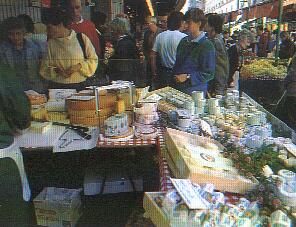
meters below the Opera Bastille lies one of the most dense, animated and lively
Paris markets: the MARCHE D’ALIGRE, metro Ledru-Rollin. Open every day
except Monday from 8h30 to 13h, but Saturdays and Sundays are the most interesting.
Located between its place
and the covered market housing 22 commerces, and is one of the most inexpensive markets in Paris. Some
clients, as if they were going to Fauchon, cross whole Paris to do their
shopping there. 500
meters below the Opera Bastille lies one of the most dense, animated and lively
Paris markets: the MARCHE D’ALIGRE, metro Ledru-Rollin. Open every day
except Monday from 8h30 to 13h, but Saturdays and Sundays are the most interesting.
Located between its place
and the covered market housing 22 commerces, and is one of the most inexpensive markets in Paris. Some
clients, as if they were going to Fauchon, cross whole Paris to do their
shopping there.
It’s really a reference when you talk about markets. Something magic suddenly
operates, you are not in Paris anymore but in a small village. You discover a
boiling, buzzing, lively place with its fruit market, vegetable stalls and
especially its junk and collectibles market. In fact, this is not a traditional
market, you can find here products from North Africa, India or others in Asia.
You can travel through time by browsing amidst the "puces" or at the
furniture or through countries with the unusual African objects. Take a
drink in one of the cafes when weather permits,
terraces are packed, and nothing equals " Le Baron Rouge", rue
Theophile Roussel!! Be careful when you leave that café. There is a lot of
chance you’re drunk and tipsy from the good wine that is coming out directly
from the barrel!
Or sit down in the street on one of the wine
barrels or car hoods serving as bars. It's so much more convivial! Maybe some
musicians will play for you their melancholic music. It has also a section of old books, clothes, glassware, lace and
jewelry.
This marché d’Aligre is not so renowned but once you discovered it, you
definitely return! Once they only sold straw and horse food
and up to 1914, you could dress and eat second hand! The spirit remains today.
Via the rue Hector Malot you come on the boulevard Diderot. Here is the GARE DE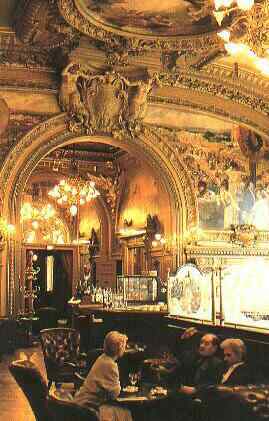 LYON, from where all trains going to the Mediterranean, leave. The station was
built in 1889 entirely following the architectural trend of that time.
LYON, from where all trains going to the Mediterranean, leave. The station was
built in 1889 entirely following the architectural trend of that time.
Not only the Jugendstil faced is worth a look but the extravaganza restaurant
“Le Train Bleu”
on the first floor. Opened in 1901 by the president of the French republic, it
is now "monument classé". Let's admit that entering this
place the whole beauty and magnificence of the “Belle Epoque “ is crushing.
You can enjoy wealthy gold leafs, heavy curtains, magnificent chandeliers and
frescos representing Paris, Lyon and Marseille (and their stations), but also
very pretty views of the Alps, the Midi, Tunisia and Algeria. Notice also a nice
painting of the Orange amphitheatre. Funny is that Sarah Bernhardt with umbrella
and Edmond Rostand are in the background. The ceilings and walls are decorated buy 41 paintings of the most famous artists
of that time. You can stay for lunch or dinner but it is expensive and the
quality not equalling the beauty of the place. A la carte 250 to 400 FF.
Bibliography
--Vie et histoire des arrondissements de Paris, ed.Hervas
(1985-1988--Nouvelle Histoire de Paris, ed.Hachette--Le Pieton de Paris, by
L.P.Fargue, ed.Gallimard 1997--Dictionnaire historique des rues de Paris, by
J.Hillairet, ed.Minuit --Guide du Routard 1998-1999 (Ed.Hachette)--Paris, 2000
d'histoire, by J.Favier, ed.Fayard 1997 --Paris 19eme siecle, l'immeuble et la
rue, by F.Loyer, ed.Hazan, 1994-
Le 12eme et ses secrets, J.Favier( ed.Natah 1996)
|
