|
Viaduc des Arts Promenade plantee Paris gare de Lyon La Coulee verte Site Home - What's New?-Feedback - About Jack-Travel/Art Links |
Opera Bastille, a TV soap history Marche-Aligre- Gare de Lyon- Train Bleu Promenade Plantée
Chateau
Vincennes
|
Paris-12th arr-Viaduc des Arts-Promenade Plantée-Picpus cemetery |
|
||||
Getting
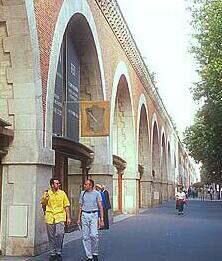
out of the gare de Lyon look up the avenue Daumesnil, it is very near. You’ll
see a long and large viaduct in front of you. You’re in front of the famous
“viaduct des Arts “ with a lot of specialty shops in arts, craftsmanship and
culture. Fifty six boutiques and
art galleries, lodged in ancient vaults with elegant window displays: vast bays
and structures of curved wood. Sculptors, " luthiers" ( musical string
instruments makers), cabinet-makers and tailors succeed each other....Now if you
walk along the viaduct corner Av.Daumesnil-Boulevard Diderot you will soon
notice that stairways go up on the viaduct every 100-150 meter. Take the first
stairway you see and you will not believe your eyes when you’ll stand on top
of the viaduct. It’s a long, long and thrilling pedestrian promenade (best to
do from spring to fall) all on the viaduct, called “La
Built on 6 levels, with large bays , it are
especially the two last terraced floors that are worth the attention. 14
identical resin, replicas of the "Dying Slave" by Michelangelo
scan the regular window intervals. The effect is spectacular. The promenade is adorned with
bushes, cherry-trees, flowered clumps and flirting young lovers on park benches.
Passing over the rue de Charenton we arrive at the jardin de
Reuilly . A giant sun dial on the ground marks the entrance of this garden.
Notice at the right, small terraces with al the green nuances. Standing on
the grand footbridge, you can clearly see the structure of the garden,
articulated around a vast circular lawn, with free access.
If
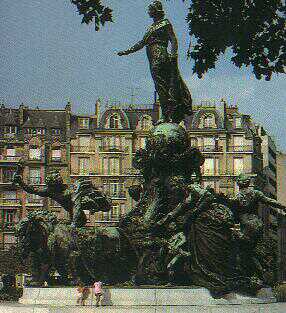
you continue like I said to the place de la Nation, have in mind that a
guillotine was placed here. This now very busy traffic knot was called place du
Trone . 1300 executions
were performed in 43 days!! Bibliography --Vie et histoire des arrondissements de Paris, ed.Hervas
(1985-1988--Nouvelle Histoire de Paris, ed.Hachette--Le Pieton de Paris, by
L.P.Fargue, ed.Gallimard 1997--Dictionnaire historique des rues de Paris, by
J.Hillairet, ed.Minuit --Guide du Routard 1998-1999 (Ed.Hachette)--Paris, 2000
d'histoire, by J.Favier, ed.Fayard 1997 --Paris 19eme siecle, l'immeuble et la
rue, by F.Loyer, ed.Hazan, 1994- |
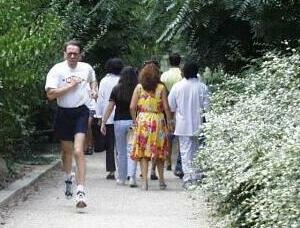 Promenade Plantee” or
“Coulee Verte”. It is mentioned nowhere in any guide and a real special to
do in Paris. It uses the ancient railway track that stopped to function in 1969.
The terminus was the Bastille where the Opera stands now. Take with you
a Michelin map, they are the best.
Promenade Plantee” or
“Coulee Verte”. It is mentioned nowhere in any guide and a real special to
do in Paris. It uses the ancient railway track that stopped to function in 1969.
The terminus was the Bastille where the Opera stands now. Take with you
a Michelin map, they are the best. 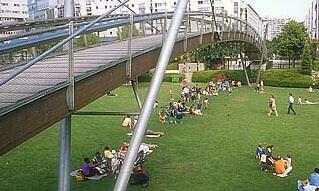
 document.
In summer 1794 the authorities gave the order to dif three big holes: two of
them will be used as mass graves for the guillotined people. It's the cemetery of the “nobles”.
The mass graves marked and honored by a sanctuary, the names, ages, date of execution, and profession of their
victims inscribed on the chapel wall, and the continuing 24-hour vigil of the
Sisters of the Sacred
Heart. This
cemetery is very unknown even by the Parisians. 1306 guillotine
victims of the place du Trone, now called place de la Nation (you can visit the
place by continuing later avenue de Saint-Mandé and avenue du Bel Air) are
buried (with a famous French poet Andre Chenier). In 6 weeks
time 2765 heads rolled on that place. On June 1794, the executioner Sanson was
in great shape! He executed 54 people in 24 min (could be in the Guinness record
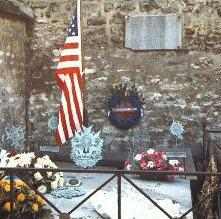
book). LAFAYETTE
is also buried at Picpus and every day his
tomb adorned by an American flag
as a reminder of his achievements and help in the American War of Independence.
Despite he was not beheaded, he benefited from the honor since his parents in
law are among the victims of the guillotine.
document.
In summer 1794 the authorities gave the order to dif three big holes: two of
them will be used as mass graves for the guillotined people. It's the cemetery of the “nobles”.
The mass graves marked and honored by a sanctuary, the names, ages, date of execution, and profession of their
victims inscribed on the chapel wall, and the continuing 24-hour vigil of the
Sisters of the Sacred
Heart. This
cemetery is very unknown even by the Parisians. 1306 guillotine
victims of the place du Trone, now called place de la Nation (you can visit the
place by continuing later avenue de Saint-Mandé and avenue du Bel Air) are
buried (with a famous French poet Andre Chenier). In 6 weeks
time 2765 heads rolled on that place. On June 1794, the executioner Sanson was
in great shape! He executed 54 people in 24 min (could be in the Guinness record
book). LAFAYETTE
is also buried at Picpus and every day his
tomb adorned by an American flag
as a reminder of his achievements and help in the American War of Independence.
Despite he was not beheaded, he benefited from the honor since his parents in
law are among the victims of the guillotine.