|
The area of the gare de
Lyon, with its clock of a high of 60 meters that got competition at the
other side of the rue de Bercy by the Gamma towers, releasing unquestionably an
immense vertical boredom. The cubes and parallelepipeds of the HLM cite next
door, are a typical proof of the lack of imagination of the architects in the
60's. Leaving the gare de Lyon, turn left around the corner and via the
pedestrian passage of the rue de Bercy you will arrive at the main attraction
pole: the new building of the Finance department that used to occupy a wing of
the Louvre but moved in 1989 because of the extension of the museum. It is a
futuristic palace in the Bercy area with a helicopter platform. An ensemble
completely in glass, presenting a dented, cornered, multiple projected facade
breaking the impression of uniformity. Reasonable architecture, making for
one an effort to integrate intelligently with the environment . Mitterand
declared in 1981, when the Treasure department occupied a wing of the Louvre:
“we must return the Louvre to the history of France" and announced the 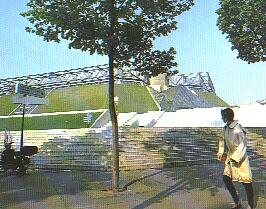 transfer
of the department who housed there since 110 years! transfer
of the department who housed there since 110 years!
The Treasury Department is placed on the quai de Bercy with a motorboat always
ready to bring the Finance minister quickly to the centre. There are 65,000
employees working in the department!
In front of the department stands the PALAIS OMNISPORTS DE BERCY, with a blue
steel roof and covered with grass. The facade of the building recaptures the
architectural rhythm of the aerial metro. And more, all these big arches create
a certain effect of transparency. Inside a gigantic hall, proper to be used for
a lot of purposes and 17,000 spectators. Events taking place there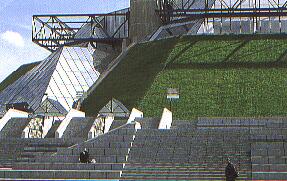 vary from
rock concerts to ice hockey games. When you walk around the building you can see
a fountain at the east side built like a staircase. vary from
rock concerts to ice hockey games. When you walk around the building you can see
a fountain at the east side built like a staircase.
During centuries, this area (located east of the palais Omnisports and extending
on both sides of the rue de Dijon) was devoted to the wine trade. It was the
wine village Bercy. Take now 1930. The wine activities were booming in wooden
barracks where 380 wine merchants had their trade office. The wine was delivered
by horse carriages and during the weekends barbecues were often held in front of
the warehouses.
The workmen, played “boules” under the high chestnut trees and dancers jived
on music. The Bourgogne wines arrived by barges descending on the Seine, Port
wine came up the river. But today the area became now a vast park of 800 meters
long (near to 13 ha) baptized " Jardin de la Memoire".The old houses,
covered with ivy and having that charming romantic touch disappeared and became
enormous holes in the ground for the excavating machines. The New Bercy has to
become a large living complex with a lot of greenery, a warehouse for wine,
excusive food. It houses the Museum of Circus Arts, a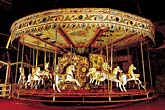 carrousel-salon, errant monument of the Belle Epoque. It's one of the most
important collection of fair material of the world (attractions, swings,
maneges). Lotteries, wooden horses centennial bikes become the privileges
amusement for adults. The museum announced it will open a wine bar and
restaurants, proposing international exhibitions connected to the good wine and
food.
carrousel-salon, errant monument of the Belle Epoque. It's one of the most
important collection of fair material of the world (attractions, swings,
maneges). Lotteries, wooden horses centennial bikes become the privileges
amusement for adults. The museum announced it will open a wine bar and
restaurants, proposing international exhibitions connected to the good wine and
food.
Notice the crazy façade of the American Center signed Frank Gehry)
unfortunately closed after only one and half years of activity in February 1996.
Bibliography
--Vie et histoire des
arrondissements de Paris, ed.Hervas (1985-1988--Nouvelle Histoire de Paris,
ed.Hachette--Le Pieton de Paris, by L.P.Fargue, ed.Gallimard 1997--Dictionnaire
historique des rues de Paris, by J.Hillairet, ed.Minuit --Guide du Routard
1998-1999 (Ed.Hachette)--Paris, 2000 d'histoire, by J.Favier, ed.Fayard 1997
--Paris 19eme siecle, l'immeuble et la rue, by F.Loyer, ed.Hazan, 1994-
Le 12eme et ses secrets, J.Favier( ed.Natah 1996)—Les Travaux Mitterand, by
J.Firmin (Figaro Magazine, 12/9/94)
|
