|
The
12th arrondissement is a discrete part of town. Maybe the most
discrete
of them all. The attractions of this arrondissement are the
opera Bastille and the restaurant “Le Train Bleu “in the gare de Lyon. But
there are other poles of interest that I will point out during my walks.
The 12th was not
always such a discrete neighbourhood. It’s in the 12th century that
it was first named in scriptures on the right bank of the Seine under the Roman
name “Insula Bercilis” The Romans were gone since a long time when they
invaded Lutetia in 52 B.C. They arrived through the via Carentonis, the actual
rue de Charenton. In the 17th century the chairman of the French
parliament has himself a castle build: the chateau de Bercy, after a design of
Lenotre. The chateau was destroyed during the revolution but the citizens of
Bercy stayed. Bercy, not yet a part of Paris didn’t have to pay wine taxes and
that’s why it became a sort of free zone and a lot of cafes, dancing places at
the stream were created and are still called “guinguettes”. It’s only in
1860 that Bercy was incorporated in Paris and fun was out :-)
Before starting with the opera
Bastille it is interesting to have a look at the “Bassin de l’Arsenal”,
the yacht harbour of Paris, all along the boulevard de la Bastille. There is
room for 200 to 300 boats.
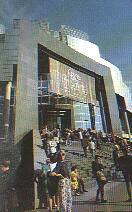 But let’s attack the OPERA BASTILLE. A few days before the inauguration of the
Opera-Bastille, " Le Canard Enchaine" (the gagged duck), a satiric
French weekly paper that fears nobody and has a very sharp tongue wrote ( freely translated !)
: " It's amazing how a heavy,
creamy wedding cake of which you can not eat enough and will always ask for
more. And WE WILL ask for more, even after the divorce, only to shake with
laughter. One must admit that today we don't have so many opportunities to have
fun and that such a loony adventure will maybe not occur for the next century.
“ Not a very good opinion, I would say ;-). And still today, ask a waiter, a
kiosk owner or a taxi driver what he thinks about the Bastille, take care, he
could lose control of his temper.
But let’s attack the OPERA BASTILLE. A few days before the inauguration of the
Opera-Bastille, " Le Canard Enchaine" (the gagged duck), a satiric
French weekly paper that fears nobody and has a very sharp tongue wrote ( freely translated !)
: " It's amazing how a heavy,
creamy wedding cake of which you can not eat enough and will always ask for
more. And WE WILL ask for more, even after the divorce, only to shake with
laughter. One must admit that today we don't have so many opportunities to have
fun and that such a loony adventure will maybe not occur for the next century.
“ Not a very good opinion, I would say ;-). And still today, ask a waiter, a
kiosk owner or a taxi driver what he thinks about the Bastille, take care, he
could lose control of his temper.
Francois Mitterand
had the idea to build an opera house for the "common people",
accessible to everyone, and the will to realize it. Even the old station de Vincennes had to disappear.
Several projects were selected and finally the project of an almost unknown
Canadian, Carlos Ott was finally chosen. In any case he delighted the ones who
feared something too bold and daring.
Being an international architect, it wouldn't be something gigantic or exaggerated,
but just a simple building!
The building of the opera was like a soap on TV. Several incidents having
apparently nothing in common with the building of an opera, stopped, delayed and
were a real pain in the ass for those who wanted this project to be finished.
First, the works were
almost stopped in 1986, due to political changes. After that, it was a constant ballet of stage directors,
administration and management jobs, music directors, dance choreographers….
etc…. I will spare you the details about the
different changments operated during several years at the top of this house. For
example since 1985 resigned or were dismissed: the director of the modulative
hall, the director of the Bastille project, the president and director of the
Association of prefiguration of the opera, the director of the Paris Operas, the
technical director of the Opera Bastille. the
different changments operated during several years at the top of this house. For
example since 1985 resigned or were dismissed: the director of the modulative
hall, the director of the Bastille project, the president and director of the
Association of prefiguration of the opera, the director of the Paris Operas, the
technical director of the Opera Bastille.
Tension came to its breaking point when Pierre Berge, general manager of the
fashion house Yves Saint-Laurent, was appointed general director of the Opera
Bastille, after the socialist election victory in 1988. The new government
forgot that it had taken some engagements with some staff members of the opera.
Pierre Bergé decided that Daniel Barenboim, the musical director had a much too
high paid salary considering the poor amount of time he would lead the orchestra
per year (5 millions FF a year for 4 months of work). Bernboim, flashing his
contract wouldn't move an inch , and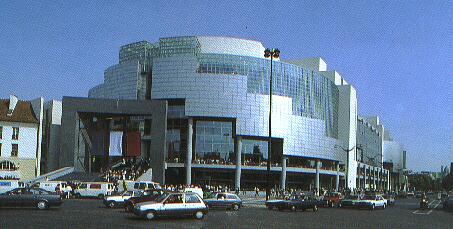 finally resigned resigned (with a diamond handshake :-)) together with
two other great names in French music and opera directing: Pierre
Boulez and Patrice Chereau .
Barenboim went to Chicago and became the chief conductor of the Chicago Symphony
Orchestra.
Dogged by eight years of controversy over its
design and by political infighting, the ultramodern building opened in 1990 at a
cost of $400 million. finally resigned resigned (with a diamond handshake :-)) together with
two other great names in French music and opera directing: Pierre
Boulez and Patrice Chereau .
Barenboim went to Chicago and became the chief conductor of the Chicago Symphony
Orchestra.
Dogged by eight years of controversy over its
design and by political infighting, the ultramodern building opened in 1990 at a
cost of $400 million.
The Corean Myung Whun
Chung was nominated as musical director and opened officially the first
performance of the new Bastille Opera.
Let’s have a few figures: its auditorium is very large (2,700 seats) and has been hailed as the hall to bring opera to the masses.
It has a very homogenous acoustics , unique stage equipments , integrated decor,
costumes and accessories ateliers, work and rehearsal rooms. All a modern
theatre is supposed to have today. The opera house includes a library, discotheque, videotheque etc..
You can visit
the opera every day backstage at 12.30. Tickets inside next to the box office.
Bibliography
--Vie et histoire des arrondissements de
Paris, ed.Hervas (1985-1988--Nouvelle Histoire de Paris, ed.Hachette--Le Pieton
de Paris, by L.P.Fargue, ed.Gallimard 1997--Dictionnaire historique des rues de
Paris, by J.Hillairet, ed.Minuit --Guide du Routard 1998-1999 (Ed.Hachette)--Paris,
2000 d'histoire, by J.Favier, ed.Fayard 1997 --Paris 19eme siecle, l'immeuble et
la rue, by F.Loyer, ed.Hazan, 1994-
Opera Bastille, feuilleton et passion, by
J.D’Ormessaie—Brochure of the Opera Bastille
|