|
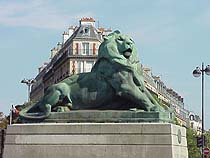 Return place Denfert Rochereau. It owns its
celebrity to the statue of the “Lion de Belfort”, bronze reduction of the
statue Bartholdi sculpted in the rock at Belfort in the Vosges (1880) in
souvenir of the heroic resistance of general Denfert-Rochereau and his soldiers.
On this place, at no.1 you find the famous “Catacombes”. They from the end
of the 18th century! The Paris subsoil being in the course of centuries
exploited for construction materials and gyps quarries, it resulted that after a
few centuries the Paris subsoil counted 160 km of galleries. A real Swiss Return place Denfert Rochereau. It owns its
celebrity to the statue of the “Lion de Belfort”, bronze reduction of the
statue Bartholdi sculpted in the rock at Belfort in the Vosges (1880) in
souvenir of the heroic resistance of general Denfert-Rochereau and his soldiers.
On this place, at no.1 you find the famous “Catacombes”. They from the end
of the 18th century! The Paris subsoil being in the course of centuries
exploited for construction materials and gyps quarries, it resulted that after a
few centuries the Paris subsoil counted 160 km of galleries. A real Swiss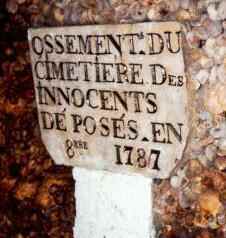 gruyere cheese! At the same time, since the cemeteries were overflowed with
bodies and corpses. Stench, horrible odours, accidents and diverse nuisances
pushed the Parisians to claim the moving of the biggest cemetery of them all,
“cimetiere des Innocents”. Voltaire was the leader of that campaign and in
1780, the king prohibited any further burial in that cemetery. In 1785 he
ordered the sanitation of the place by moving all bones to the quarries of Tombe
Issoire. The operation was stretched from 1785 to 1914. An evaluation of the
number of skeletons stored in the catacombs is about 5 to 6 million!!
gruyere cheese! At the same time, since the cemeteries were overflowed with
bodies and corpses. Stench, horrible odours, accidents and diverse nuisances
pushed the Parisians to claim the moving of the biggest cemetery of them all,
“cimetiere des Innocents”. Voltaire was the leader of that campaign and in
1780, the king prohibited any further burial in that cemetery. In 1785 he
ordered the sanitation of the place by moving all bones to the quarries of Tombe
Issoire. The operation was stretched from 1785 to 1914. An evaluation of the
number of skeletons stored in the catacombs is about 5 to 6 million!!
Today the catacombs only occupy 65 km of galleries in a space of 11 hectares.
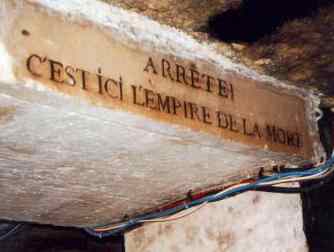
Take a torch, and perferably someone to hold your hand , but you have been
warned by the inscription on the
lintel of the door to the ossuary, :" Arrete, ici c'est
l'empire de la mort" (Stop, here begins empire of death).
 Descend, coming from Denfert-Rochereau, the avenue du General Leclerc, on the
left sidewalk. When a big iron wrought gate will announce "Villa Adrienne" enter the alley. You could imagine you’re in
Chelsea, London. Large open garden
in the middle and a few brick houses around, two or three stories high. Most of
them disappear under the ivy, with little savage gardens! Pass quickly by the
concierge's window, she is sometimes very war-like! Better she doesn't see you.
Descend, coming from Denfert-Rochereau, the avenue du General Leclerc, on the
left sidewalk. When a big iron wrought gate will announce "Villa Adrienne" enter the alley. You could imagine you’re in
Chelsea, London. Large open garden
in the middle and a few brick houses around, two or three stories high. Most of
them disappear under the ivy, with little savage gardens! Pass quickly by the
concierge's window, she is sometimes very war-like! Better she doesn't see you. 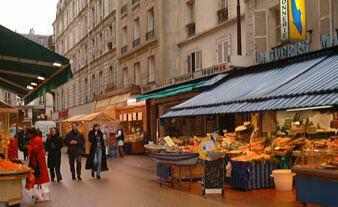
Return to rue du general Leclerc and return direction place Denfert. At the
other side of the street take the rue Daguerre, the best-known market-street of
the 14th arr.
The looks have changed since a few years, the street was renovated, not
always for the best (sidewalks disappeared). But is still very lively and
sympathetic. Framers, different kind of craftsmen still work in the
street. Calder had his first workshop at no.22 (now Hotel Le Lionceau) and
at no.63 a craftsmen village assembles printers, decorators, architects,
graphists, cabinet-makers.
Make a right at the rue Fermat and walk into the rue Froidevaux. Bordering the
cemetery of Montparnasse, it has numerous courtyards and ateliers and large
bourgeois buildings.
Bibliography
--Vie
et histoire des arrondissements de Paris, ed.Hervas (1985-1988--Nouvelle
Histoire de Paris, ed.Hachette--Le Pieton de Paris, by L.P.Fargue,
ed.Gallimard 1997--Histoire et dictionnaire de Paris, by A.Fierro, ed.Laffont,
1996--Dictionnaire historique des rues de Paris, by J.Hillairet, ed.Minuit
--Guide du Routard 1998-1999 (Ed.Hachette)--Paris, 2000 d'histoire, by J.Favier,
ed.Fayard 1997--Naissance de Paris, by M.Fleury, ed.Imprimerie Nationale
1997—Guide des cimetieres de Paris, by Marcel Le Clere, Hachette 1990
|
