|
Let’s return to
boulevard Raspail, make a right and a left into boulevard Edgard Quinet, another
into the avenue Emile Richard and enter the cemetery of Montparnasse to your
left.
After Pere Lachaise this is the most visited cemetery of Paris. Very easy to
walk if you want just to have a promenade, no hills or slopes but good flat
terrain. Besides the usual customers part of local retired people, loners,
nostalgic or grieving, this cemetery receives also the visit of the more
intellectual or artistic elite of the capital. That’s because the buried are
not part of the most famous persons of cultural cavalry. It is evident that
Chopin, Edith Piaf or Sacha Guitry are celebrities attracting a much larger
population as Saint-Saens, Tristan Tzara or Serge Gainsbourg.
 |
|
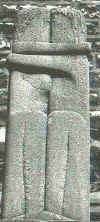
Le Baiser by Brancusi |
Go to your left and at the
end you’ll see on your the famous sculpture “Le Baiser” by Brancusi he
sculpted for a couple of artists who committed suicide. Come back to avenue du
Nord, then the avenue Thierry to the tomb of Bartholdi, famous sculptor who
realized the statue of Liberty at the entry of New-York harbour. Continue on and
on your right: grave of Cesar Franck. Return to the avenue Transversale, make a
left and at the corner of the avenue du Nord see the tomb of Dreyfus.
 |
|
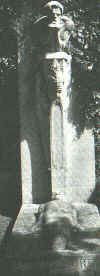
Hommage a Baudelaire |
Return avenue
Transversale, get out and in the cemetery on the other side. Here is the
monument erected in homage to Charles Baudelaire. The bust of the poet
contemplates his corpse. It’s only a cenotaph, the corpse is buried in
the 6th division with the family Aupick.
Loitering around try to find the graves of Henri Laurens (a friend of Braque),
Bourdelle, Soutine, Sartre, Camille Saint-Saens and Brancusi.
Be sure to leave the cemetery through the exit avenue Emile Richard and into the
rue Froidevaux where you make a left. Admire an apartment building at 21-23,
which has a large glass case in the middle, remarkable by its mosaic décor
of stylish flower motives.
Turning left in rue Schoelcher admire the beautiful façade at no.5, where
every balcony and window shows a different design. Now place Denfert-Rochereau,
a small walk along boulevard Arago to the Observatoire (Observatory). Make a
right at the avenue de l’Observatoire and a left into the boulevard du
Montparnasse where you walk trough (quote guide du Routard 1998)-a monumental
porch at no.126. At fundum of the second courtyard, splendid house with artist
ateliers. At 120bis, flower mosaic decor on the front facade-(unquote).
Continue boulevard du Montparnasse, cross the boulevard Raspail and make a right
into the rue Vavin. At no.26 a fascinating building from 1912 of the
architect Henri Sauvage. Very special: look at the ceramic layers. Notice that
this architect was the founder of a housing project for the homeless far before
our time.
 Coming back to 216 boulevard Raspail, see cubist Studio Raspail built in
1932,with a lot of artist ateliers.
Coming back to 216 boulevard Raspail, see cubist Studio Raspail built in
1932,with a lot of artist ateliers.
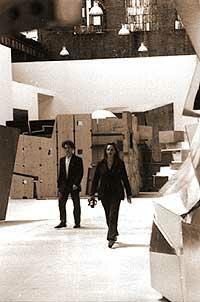
At no.251, today the Fondation Cartier pour l'Art Contemporain, built by Jean
Nouvel, has a tree planted in the middle of its lobby. It’s
Chateaubriand who planted a Lebanese cedar here in 1823. Created en 1984,
located in this building since1994, built of glass and steel building, designed
by Jean Nouvel, it's purpose is to present the works, in any form, of living
contemporary artists from all over the world. Many thematic exhibitions are
shown all over the year, not only painting but also dance, music, theatre.
Bibliography
The pictures are scans of
old postcards.
--Vie et histoire des
arrondissements de Paris, ed.Hervas (1985-1988--Nouvelle Histoire de Paris,
ed.Hachette--Le Pieton de Paris, by L.P.Fargue, ed.Gallimard 1997--Histoire et
dictionnaire de Paris, by A.Fierro, ed.Laffont, 1996--Dictionnaire historique
des rues de Paris, by J.Hillairet, ed.Minuit --Guide du Routard 1998-1999
(Ed.Hachette)--Paris, 2000 d'histoire, by J.Favier, ed.Fayard 1997--Naissance de
Paris, by M.Fleury, ed.Imprimerie Nationale 1997—Guide des cimetieres de
Paris, by Marcel Le Clere, Hachette 1990
|


