|
It is useless to look for a mount Parnassus in the 14th
arrondissement like in Montmartre or the buttes Chaumont. The hillock that
existed (made out of scrap from the neighbouring stone quarries) and that gave
its name to the area, disappeared a long time ago. It is true that Montparnasse,
in those times, was just a village. The golden age of the Montparnasse area
starts in 1900. The poet Alfred Jarry and the painter Rousseau “Le Douanier”
built their nest here. If we can believe Louis Paul-Fargue, only “artists”
were allowed to enter the Montparnasse territory from beginning of the 20th
century. This small world of “tangos”, terraces, peanuts and highly NOT
recommendable drinks” was gathered around its “popes”: Picasso, Derain,
Hemingway, Ezra Pound. Painters settled down who fled out of Montmartre in 1910
as a reaction to the fake rarities of Place du Tertre and around. Foreign
sculptors, painters and artists like Hemingway, Foujita,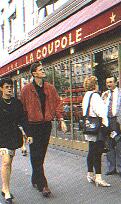 Soutine, Zadkine,
Braque, Chagall, Picasso, Rouault, Klee, even Lenine and Trotsky joined them and
soon it became a sort of closed ”colony” camping continuously around the
tables of the “Dome”, the “Rotonde” and the enormous “Coupole”,
historic establishments still very active after 100 years. Artist ateliers
nestled in flowery dead end alleys and Paris could be considered as the
intellectual capital of the world. In the empty rooms of the “Ruche”, a
former pavilion of the 1900 exhibition, Soutine, Chagall, Zadkine, Leger and
Modigliani made their home and atelier. The later art historians named them the
“Ecole de Paris”. Supporters of this movement were politicians, musicians,
novel writers, movie directors and all pioneers of avant-garde art: Stravinsky,
Satie, Eisenstein, Ibanez, Cocteau…
Soutine, Zadkine,
Braque, Chagall, Picasso, Rouault, Klee, even Lenine and Trotsky joined them and
soon it became a sort of closed ”colony” camping continuously around the
tables of the “Dome”, the “Rotonde” and the enormous “Coupole”,
historic establishments still very active after 100 years. Artist ateliers
nestled in flowery dead end alleys and Paris could be considered as the
intellectual capital of the world. In the empty rooms of the “Ruche”, a
former pavilion of the 1900 exhibition, Soutine, Chagall, Zadkine, Leger and
Modigliani made their home and atelier. The later art historians named them the
“Ecole de Paris”. Supporters of this movement were politicians, musicians,
novel writers, movie directors and all pioneers of avant-garde art: Stravinsky,
Satie, Eisenstein, Ibanez, Cocteau…
This could maybe have continued until today if the kings of concrete
hadn’t decided otherwise.
Apollinaire wrote in 1914: (quote)“Even if the actual Montparnasse has other
characteristics as Montmartre, it is the same fun, nonchalance and simplicity. I
bet, but I don’t wish, that soon there will be nightclubs opening in
Montparnasse, and that painters and poets will have the company of chansonniers.
The day that Bruant will sing about the diverse spots of this picturesque area,
is the day that Montparnasse will have its full life. But the Cook agency will
provide the import of tourists and other travel companions”(unquote).
How right he was, Apollinaire! The rue de la Gaité is packed with cafés
and restaurants, bistros, theatres and music halls.
And if you know also that the heart of the Montparnasse-Maine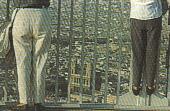 complex is overwhelmed by a tower of steel and glass since 1974, you will
understand that the “Montparnos” era of which Blaise Cendrars, Francis Carco,
Max Jacob, Apollinaire, Modigliani and others were the main actors is only a
souvenir today. Everywhere on the globe you can find this sort of showy, gaudy
shopping centre and a new railway station with a very common architectural
concept. What a horrifying lack of taste. And
the Tower? Tower Montparnasse? With its head in the clouds, 210 meters high, you can
have a fantastic panorama on Paris. Maybe they made it so high to hide the nasty
thrash in the snack bars and bus stations down below. Let’s talk about
something else….
complex is overwhelmed by a tower of steel and glass since 1974, you will
understand that the “Montparnos” era of which Blaise Cendrars, Francis Carco,
Max Jacob, Apollinaire, Modigliani and others were the main actors is only a
souvenir today. Everywhere on the globe you can find this sort of showy, gaudy
shopping centre and a new railway station with a very common architectural
concept. What a horrifying lack of taste. And
the Tower? Tower Montparnasse? With its head in the clouds, 210 meters high, you can
have a fantastic panorama on Paris. Maybe they made it so high to hide the nasty
thrash in the snack bars and bus stations down below. Let’s talk about
something else….
Bibliography
--Vie et histoire des arrondissements de Paris, ed.Hervas
(1985-1988--Nouvelle Histoire de Paris, ed.Hachette--Le
Pieton de Paris, by L.P.Fargue, ed.Gallimard 1997--Histoire et dictionnaire de
Paris, by A.Fierro, ed.Laffont, 1996--Dictionnaire historique des rues de Paris,
by J.Hillairet, ed.Minuit --Guide du Routard 1998-1999 (Ed.Hachette)--Paris,
2000 d'histoire, by J.Favier, ed.Fayard 1997--Naissance de Paris, by M.Fleury,
ed.Imprimerie Nationale 1997
|