|
Via the rue Jean Zay enter the rue Vercingetorix. On no.59, a curious
church Notre-Dame-du-Travail (1898-1902). The
metallic structures were probably used because of the lack of money that was
also responsible for the numerous kinds of material used. It’s here that the
church bell Sebastopol was brought by Napoleon III in 1854. Interior decoration is very poor.
The rue Vercingetorix lost almost all his
houses but is bordered by recent buildings and was the core of renovation in
this area. It gained a nice square lined with artist ateliers. For bread
connoisseurs, stop at no.105, a beautiful old fashioned bakery to buy their
specialty: "fougasse aux anchois
et olives" (Mediterranean type of bread with anchovy and olives). A
delicacy.
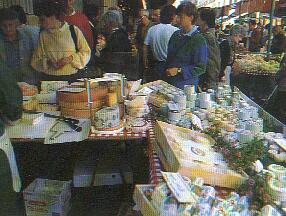 You can visit the flea market “Puces de Vanves” ", avenue
Georges-Lafenestre and avenue Marc-Sangnier. French call it “brocante “
(junk objects). Open from Saturday and Sunday, from dawn until 7
pm. It's an unauthorized flee market, but plenty of people come here. A funny
impression I had was the number of men enjoying cans of strong lager , but
then I realized that some of the clochards seemed to have emptied their pockets onto the sidewalk - in an attempt to play at being
junkseller? Less touristy as the other markets, the puces de Vanves reveal
sometimes nice antiquities, Indian and Asiatic furniture and a few booths with
luxury brands like Chanel. But once more, don’t come her to make a bargain,
prices are carefully studied. A myriad of small
You can visit the flea market “Puces de Vanves” ", avenue
Georges-Lafenestre and avenue Marc-Sangnier. French call it “brocante “
(junk objects). Open from Saturday and Sunday, from dawn until 7
pm. It's an unauthorized flee market, but plenty of people come here. A funny
impression I had was the number of men enjoying cans of strong lager , but
then I realized that some of the clochards seemed to have emptied their pockets onto the sidewalk - in an attempt to play at being
junkseller? Less touristy as the other markets, the puces de Vanves reveal
sometimes nice antiquities, Indian and Asiatic furniture and a few booths with
luxury brands like Chanel. But once more, don’t come her to make a bargain,
prices are carefully studied. A myriad of small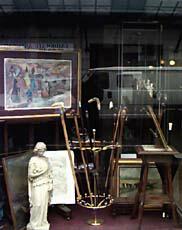 vendors, selling the bric a brac
from the capital. Complaints from locals have led to strong police presence,
checking the illegal stallholders. Don't be dissuaded, they often offer the best
bargains. But no problem for the "savage"
and "unauthorized" junk dealers. They disappear as soon they smell the
slightest alert and reappear as soon as the police car vanishes. I saw that in
all Italian cities before :-). Less colorful, but just as bric-a-brac, just as kitsch. vendors, selling the bric a brac
from the capital. Complaints from locals have led to strong police presence,
checking the illegal stallholders. Don't be dissuaded, they often offer the best
bargains. But no problem for the "savage"
and "unauthorized" junk dealers. They disappear as soon they smell the
slightest alert and reappear as soon as the police car vanishes. I saw that in
all Italian cities before :-). Less colorful, but just as bric-a-brac, just as kitsch.
And the diverse crowd here also buzzes from stall to stall, primped and painted Parisians rub shoulders with the men I mistakenly took for
clochards. Locals have laid out goodies right on the sidewalk as if they couldn't be bothered to set up a portable table or overhead tarp. The constant murmur of 'jolie, ça,' 'mignon!' and 'trés, trés belles' hang in the air, along with nonplussed bargaining.
Continue down the avenue Marc-Sangnier to avenue Georges Lafenestre. A couple are cooing over vintage fans; a stallholder is trading the metal bits found on top of champagne corks with another; several tables - the most popular - display 'Tout à
20 FF' signs. Down at the intersection of the two avenues, a 'Grand Déballage: 200 Brocanteurs' banner waves over a crépes-frites van and a jolly little group of families out for a promenade. A man plays a portable piano, belting out chansons with people up and down the streets warbling or whistling along with the familiar tunes.
Bibliography
--Vie
et histoire des arrondissements de Paris, ed.Hervas (1985-1988--Nouvelle
Histoire de Paris, ed.Hachette--Le Pieton de Paris, by L.P.Fargue,
ed.Gallimard 1997--Histoire et dictionnaire de Paris, by A.Fierro, ed.Laffont,
1996--Dictionnaire historique des rues de Paris, by J.Hillairet, ed.Minuit
--Guide du Routard 1998-1999 (Ed.Hachette)--Paris, 2000 d'histoire, by J.Favier,
ed.Fayard 1997--Naissance de Paris, by M.Fleury, ed.Imprimerie Nationale 1997
|
