|
Take the rue Raymond-Losserand towards the metro Pernety. The area Pernety used
to be a very popular area with a lot of impoverished people. A lot of immigrants had and still have their shops and business here. As certain neighbourhoods were quite insalubrious in the period 1900-1950, life conditions were very hard. In the sixties bid plans were drawn to erase the whole area and build megalomaniac projects like a highway connecting Montparnasse with the Peripherique. Imagine! Luckily all these plans failed but... the Tour Montparnasse came instead......
It's in rue Raymond-Losserand that animation is crystallized today. A very special atmosphere of the 19th century with its popular animation, a lot of passages and artists concentrations, courtyards and back-yards where ateliers continue to function. At no. 45 the bakery kept its painted rings, charming low houses. At no.28 the passage de Vanves, bordered by poor houses, where the reflection of life in the 19th century was replaced by a harmonious and modern building. There still remain a few bistros and popular restaurants with picturesque characteristics. Useless to name them here, it is a question of personal sensibility to find them. And I'm not taking any risk to send hordes of tourists, longing for exotic shots with their Nikons to disturb the peace and quiet of the local cafes.
Go and discover the area on foot. With a little feeling, you still discover plenty of things, unusual streets and houses, an accumulation of little details and always warm, welcoming smiles. And
then, south of the rue d'Alesia, you have the " villas", these incredible oasis of the 14th.arr, last witnesses of the village Plaisance, privileged zones out of the " city", out of time.........
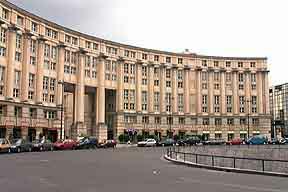
Come back along the rue de l'Ouest and at the corner of the rue du Chateau here is a Greek temple, solemnly called " Les Colonnes", build by Ricardo
Bofill, world renowned architect and urbanist. What you see are mostly social condominiums. Six hundred of them articulate around three squares.
The round square is inspired by baroque Italian architecture. The semi-circular
facade connects and articulates two interior squares of which one is a public
garden . By the way, this whole area was completely restructured, acquired a new face. Drastic revision of the past architectural aberrations and compromises, the form of the buildings become more human, the height becomes reasonable. Place de Catalogne, still a part of the
restructuration has an admirable view on the Eiffel tower. In the middle a strange fountain (doesn't work often) by Shamai Haber.
 |
|
Place de Catalogne |
Bibliography
--Vie et histoire des arrondissements de Paris, ed.Hervas (1985-1988--Nouvelle Histoire de Paris, ed.Hachette--Le Pieton de Paris, by L.P.Fargue, ed.Gallimard 1997--Histoire et dictionnaire de Paris, by A.Fierro, ed.Laffont, 1996--Dictionnaire historique des rues de Paris, by J.Hillairet, ed.Minuit --Guide du Routard 1998-1999 (Ed.Hachette)--Paris, 2000 d'histoire, by J.Favier, ed.Fayard 1997--Naissance de Paris, by M.Fleury, ed.Imprimerie Nationale 1997
|
