|
Place de la Concorde.
You cross the square and walk along the rue Royale.
Wherever you will stop and look around in this street, you have a splendid view
in each direction. To the north the Madeleine, an imposing game of horizontal
and vertical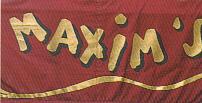 lines, to the south your regard reaches very far over the place de
la Concorde, the pont de la Concorde and the Palais Bourbon. The place Royale
was born together with the place Louis XV, now Concorde, built by architect
Gabriel amidst stinking swamps. At no.3 lived the famous Richelieu (see the 3
musketeers, by Alexandre Dumas), now the ex-glorious Maxim’s restaurant in a
Jugendstil style house. lines, to the south your regard reaches very far over the place de
la Concorde, the pont de la Concorde and the Palais Bourbon. The place Royale
was born together with the place Louis XV, now Concorde, built by architect
Gabriel amidst stinking swamps. At no.3 lived the famous Richelieu (see the 3
musketeers, by Alexandre Dumas), now the ex-glorious Maxim’s restaurant in a
Jugendstil style house.
Going to the Madeleine just have a peek (and walk later if you have the
time and envy) at your left side into the RUE DU FAUBOURG SAINT-HONORE. This is
the street of the REAL LUXURIOUS Paris.
|
|
|
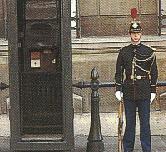
Guard at Elysee Palace |
Since Louis XIV only aristocrats lived
here in big mansions. Now it’s the street of power and money and every kind of
luxury you can imagine is to find in this street. Even the Palais de l’Elysée,
siege of the French president. Already since the 19th century fashion
houses had their shops here: Henri, Hermes, Jeanne Lanvin. Today the modern
grands couturiers joined them: Prada, Yves Saint-Laurent, Ungaro, Tarlazzi,
Thierry Mugler, Stephane Kelian, Sonia Rykiel and a lot of others.
But let’s return to our eglise de la Madeleine looking like a great gray Greek
temple. 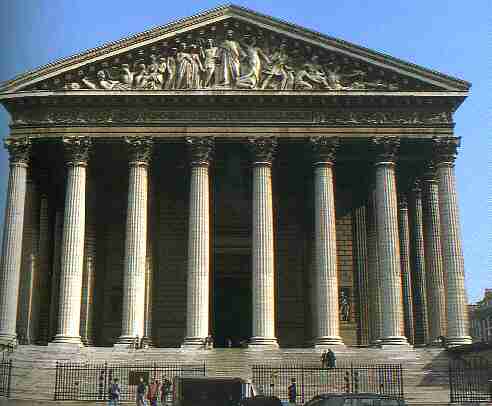 I’d swear an imitation of the Athena Parthenon with no cross. The building of the Madeleine,
decided already in 1757, lasted more than 80 years and was only done begin
1842. Started in 1764 it was built finally by
Constant d’Ivry. His follower wanted to make it a sort of Pantheon when the
revolution stopped the works. During the Revolution, nobody knew for what purpose this gigantic
building would serve. A library? An exchange hall? A ballroom? In 1806 Napoleon took the decision: it would become a temple to the glory
of the soldiers of his "Grande Armee". After 1814 Louis XVIII turned
it to a church again . Services were reestablished on 5th of February 1802. But
more adventures made that the parish could only enter the church in 1842.
I’d swear an imitation of the Athena Parthenon with no cross. The building of the Madeleine,
decided already in 1757, lasted more than 80 years and was only done begin
1842. Started in 1764 it was built finally by
Constant d’Ivry. His follower wanted to make it a sort of Pantheon when the
revolution stopped the works. During the Revolution, nobody knew for what purpose this gigantic
building would serve. A library? An exchange hall? A ballroom? In 1806 Napoleon took the decision: it would become a temple to the glory
of the soldiers of his "Grande Armee". After 1814 Louis XVIII turned
it to a church again . Services were reestablished on 5th of February 1802. But
more adventures made that the parish could only enter the church in 1842.
Inside the church it is very quiet with sculptures from classic masters like
Rude and Pradier but for the flashy and grandissimo style you can't beat it! And
the dome of 18-meter diameter, when it was first unveiled, had his admirers. The
music-lovers will be more sensible to the sound and accents of the organs, a
magnificent instrument of 1846.
The Madeleine church is not for everybody’s taste,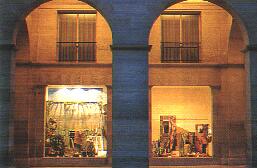 certainly not mine. I would
even say that the square looks more interesting to me than the temple itself.
It’s a haven for the gourmands and you start mouth watering when you see the
chocolates, strawberries in winter, rare wines and caviar in the display windows.
The delicatessen shop Fauchon, 26 place de la Madeleine, started a small grocery
shop in the 19th century and grew out to the imperium you all know
today. It’s the temple for the "grande bouffe" exquisite and
sophisticated. All year through you can buy cherries, apricots, peaches, exotic
fruits like granadillas of Brazil, litchis from Madagascar, passion fruit from
Kenya, papayas etc........ At the other side of the street, refined groceries:
perfumed teas in bulk (bilberries, mango, caramel), carrot preserve, black
olives, almonds from Provence, hazelnuts. There is even a patisserie next door:
pastries are delicious and just a little bit more expensive than in other areas.
You’ll meet Hediard, another delicatessen shop, his cooked dishes, his cakes,
confectionaries (the famous marzipans) and also his very rich grocery section.
The initiator of exotic fruits to France. La Maison de la Truffe sells
truffles, of course, the most expensive certainly and some even say the best
(because they are expensive?) All around in the area you have also "La Marquise
de Sevigne" and her renowned chocolates (mostly from Belgium). The risk is, that when you finish your tour of the area, you will not be hungry
enough to have a dinner at Lucas-Carton, one of the three starred restaurants of
Paris and the theatre kiosk where you can buy tickets for performances taking
place the same day for half the price.
At the right side of the Madeleine a flower market is held every day. The
camellias sold here were precious for Alphonsine Duplessis, hero of “La
Traviata”, dying of T.B.C. and written down for eternity by Alexandre Dumas
and Verdi. The public toilets just next to the market
are also worth a visit! I'm not joking, they are the nicest of Paris and maybe
of the world, and feeling perplexed, you should resolve to visit them as one of
the favorite 1900 Paris locales . On the Place de la Madeleine, take the spiraling staircase down to the subterranean art nouveau toilettes publiques, a cavern of carved wood, brass and mirrors, with floral frescoes and stained-glass windows in each cabinet.
Awake the maybe sleeping Madame Pipi (as bathroom attendants are still called).
Notice the imperial throne for shoe-shining !
certainly not mine. I would
even say that the square looks more interesting to me than the temple itself.
It’s a haven for the gourmands and you start mouth watering when you see the
chocolates, strawberries in winter, rare wines and caviar in the display windows.
The delicatessen shop Fauchon, 26 place de la Madeleine, started a small grocery
shop in the 19th century and grew out to the imperium you all know
today. It’s the temple for the "grande bouffe" exquisite and
sophisticated. All year through you can buy cherries, apricots, peaches, exotic
fruits like granadillas of Brazil, litchis from Madagascar, passion fruit from
Kenya, papayas etc........ At the other side of the street, refined groceries:
perfumed teas in bulk (bilberries, mango, caramel), carrot preserve, black
olives, almonds from Provence, hazelnuts. There is even a patisserie next door:
pastries are delicious and just a little bit more expensive than in other areas.
You’ll meet Hediard, another delicatessen shop, his cooked dishes, his cakes,
confectionaries (the famous marzipans) and also his very rich grocery section.
The initiator of exotic fruits to France. La Maison de la Truffe sells
truffles, of course, the most expensive certainly and some even say the best
(because they are expensive?) All around in the area you have also "La Marquise
de Sevigne" and her renowned chocolates (mostly from Belgium). The risk is, that when you finish your tour of the area, you will not be hungry
enough to have a dinner at Lucas-Carton, one of the three starred restaurants of
Paris and the theatre kiosk where you can buy tickets for performances taking
place the same day for half the price.
At the right side of the Madeleine a flower market is held every day. The
camellias sold here were precious for Alphonsine Duplessis, hero of “La
Traviata”, dying of T.B.C. and written down for eternity by Alexandre Dumas
and Verdi. The public toilets just next to the market
are also worth a visit! I'm not joking, they are the nicest of Paris and maybe
of the world, and feeling perplexed, you should resolve to visit them as one of
the favorite 1900 Paris locales . On the Place de la Madeleine, take the spiraling staircase down to the subterranean art nouveau toilettes publiques, a cavern of carved wood, brass and mirrors, with floral frescoes and stained-glass windows in each cabinet.
Awake the maybe sleeping Madame Pipi (as bathroom attendants are still called).
Notice the imperial throne for shoe-shining !
Bibliography:
--Vie et histoire des arrondissements de
Paris,ed.Hervas 1985-1988, 20 volumes- Le piéton de Paris, by L.P. Fargue,
ed.Gallimard 1997-Dictionnaire historique des rues de Paris, by J.Hillairet,
ed.Minuit 1985, Guides du Routard 1998, ed.Hachette, Parijs, een wereldstad, by
Hilaire Verbert, ed. Nelle 1996, Autour des Capucines , by J.Boucher, ed.
Presses Cité 1993, Les 20 arrondissements de Paris,by Martine Constans (Guide
le la Renaissance du livre 1999)
|
