|
Just before arriving at the place de la Concorde, turn around at the
« Marly horses » sculpted by Coysevox. These are only copies since
the originals are on display in the Louvre museum.
 |
|
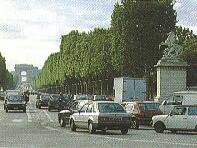
Champs Elysees from Concorde |
But turn around and look at the panorama of the Champs Elysees. It is difficult
to imagine that this boulevard was once an unhealthy swamp. In 1616, Marie de
Medicis designed the “Cours de la Reine”, three lanes that Lenotre prolonged
to the Jardin des Tuileries and the Duc d’Angouleme to the Butte Chaillot
(today Place de l’Etoile). It’s only in 1709 that the boulevard was named
Champs-Elysees.
It was the place where the kings showed themselves to the people. When they were
in a good mood they gave wine and bread to their humble subjects. It’s a
tradition that survived even the French revolution since the general mood in
Paris was very inflammable and distributing food calmed the people a bit. For a
long time the Champs-Elysees had a very bad reputation, especially at night. But
more and more bourgeois started to build hotels de maitre all along the
boulevard and the trend became to live here and to make promenades along the
road to show off. But at night it stayed dangerous: Napoleon’s soldiers
murdered Philippe Lebon, inventor of the gas lamp, who contributed a lot to
Paris safety.
1814 was a very bad year…The Prussians and English had their bivouac in the
Tuileries gardens and the place de la Concorde, the Russian had put up their
tents on the Champs Elysees. When in March 1814 winter had a very severe return,
mostly all the trees of the Champs were sacrificed. It lasted years to restore
the Champs like it was before!
But let’s now put our attention to the Place de la Concorde! As a pedestrian
you will feel lost in this immense square amidst crazy traffic trying to get you
killed. Beware when you cross to the centre!
Realized by architect Gabriel between 1753 and 1763 to the glory of Louis XV, to
receive his equestrian statue it was inaugurated in 1763 under the name “Place
Royale”. In 1792 rebaptized “Place de la Revolution” and “Place de la
Concorde” in 1795. Returned to her original name in 1814 it was upgraded in 1825 to Place
Louis XVI. It’s only since the July monarchy that –she was called definitely
Place de la Concorde.
A lot of celebrities lost their head (literally!) here. Mr. Guillotine worked
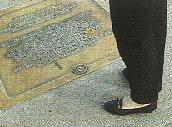
hard : Louis XVI and Marie-Antoinette in January 23 1793,then Robespierre.
|
|
Plaque to Louis XVI and
Marie-Antoinette |
In 1794, Charlotte Corday, Danton, Madame Du Barry, Madame
Roland, Fabre d’Eglantine, Camille Desmoulins……. and more than 1000 persons
lost their
heads on the same spot.
The obelisk of Luxor, a monolith 33
centuries old, decorated the centre of the square since 1833. Twenty three
meters high and weighing 23 tons this heavy monument of pink granite is
decorated by 3300 hieroglyphs praising the reign of Ramses II. Our very
intellectual tourist readers will have much fun to learn some rudiments of
Egyptian by deciphering the hieroglyphs narrating the stories of the reigns of
Ramses II and Ramses III. It was a gift of the vice-king of Egypt Mohammed Ali to
Charles X. In fact he offered three obelisks but there was only possibility to
transport one! The transportation of that obelisk was not a simple task! They
had to build a special ship to transport that cumbrous gift to France. The view
from here is phenomenal: you can see the Champs Elysees and the copies of the
“Chevaux de Marly”(copies), the Arc de Triomphe, southwards the Pont de la Concorde,
build with the stones of the Bastille prison , the Assemblee Nationale (Congress), at the east the
Tuileries gardens and the Louvre and the north shows the hotel Crillon, rue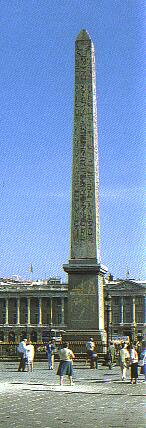 Royale and the Madeleine. On the northern side also two impressive buildings wit
arched galleries resembling to the Louvre. One used to be the ministry of
Royale and the Madeleine. On the northern side also two impressive buildings wit
arched galleries resembling to the Louvre. One used to be the ministry of 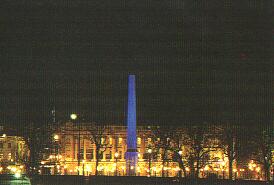 Defence, now the ministry of the Marine. In the 18th century it’s
there that Marie-Antoinette had her little sentimental adventures. The other is
the hotel “Crillon”, the bastion of Parisian snobs and billionaires, used to
be the luxurious winter residence for the Chateaubriand family. And notice all
over the square lampposts and sculpted groups of eight cities of France:
Bordeaux, Brest, Lyon, Marseille, Nantes, Lille, Rouen and Strasbourg.. I read
in my favorite guide (Guide du Routard) that these statues were covered with black veils
in March 1871, when the Kaiser marched into Paris after the signature of the
French capitulation in the French-Prussian war. It was not the only expression
of grief, all Parisian shops closed for a national mourning.
Defence, now the ministry of the Marine. In the 18th century it’s
there that Marie-Antoinette had her little sentimental adventures. The other is
the hotel “Crillon”, the bastion of Parisian snobs and billionaires, used to
be the luxurious winter residence for the Chateaubriand family. And notice all
over the square lampposts and sculpted groups of eight cities of France:
Bordeaux, Brest, Lyon, Marseille, Nantes, Lille, Rouen and Strasbourg.. I read
in my favorite guide (Guide du Routard) that these statues were covered with black veils
in March 1871, when the Kaiser marched into Paris after the signature of the
French capitulation in the French-Prussian war. It was not the only expression
of grief, all Parisian shops closed for a national mourning.
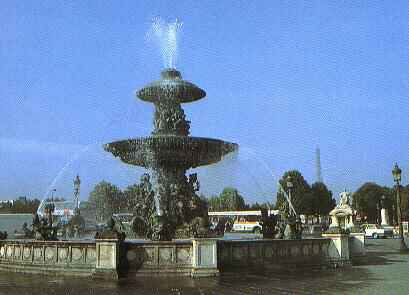
Another spot not to miss on this is the bronze fountain of Jacob Ignaz Hittorf
(1836).
In
1866 the de la Concorde was illuminated for the first time by electricity, at the
occasion of Napoleon III birthday. And today evening is for me the most magic
moment to admire the place de la Concorde: less traffic and the square is
fairy-like lit. Take a cab to make the our but beware to be there before
midnight, since at the exact time all light go out and you see only complete
darkness.
Bibliography:
--Vie et histoire des arrondissements de
Paris,ed.Hervas, 1985-1988, 20 volumes- Le piéton de Paris, by L.P. Fargue,
ed.Gallimard 1997-Dictionnaire historique des rues de Paris, by J.Hillairet,
ed.Minuit 1985, Guides du Routard 1998, ed.Hachette, Parijs, een wereldstad, by
Hilaire Verbert, ed. Nelle 1996, De l’Arc à Concorde, by J.Boucher, ed.
Presses Cité 1993, Les 20 arrondissements de Paris,by Martine Constans (Guide
le la Renaissance du livre 1999)
|