|
Royal road,
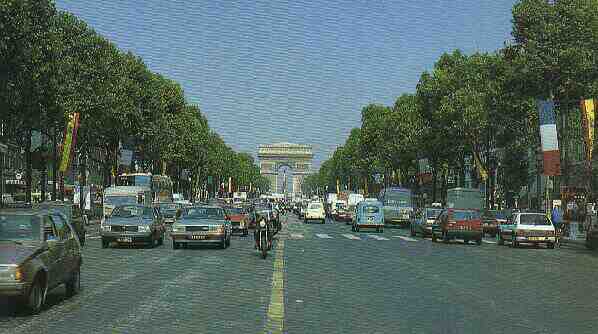
imperial road, triumphant road…..To name the CHAMPS-ELYSEES no words or
expressions are too superlative. It is the universal Paris, where luxurious
luxury plays the high notes, where stylish facades stuns your senses, large
boulevards, historical memorials and street cafes with elegant apron dressed
waiters. Some people even make a detour via the Porte Maillot to enter the Champs and
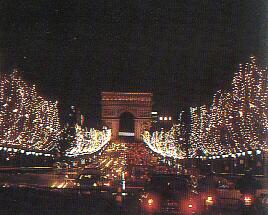
catch the atmosphere. At night this boulevard looks like a double light
stream, yellow left, red right, never extinguishing or fading. An important
face-lift in 1993-1994 improved enlarged the sidewalks a lot. Despite all
that, the Champs Elysees has a sad appearance lately. The ones who loiter now
over this avenue that so many chansons and songs praised, sees the Paris of
the clichés, the world of what I would call (north of the rond-point des
Champs Elysées), the “HIGH “part of the Champs with its too expensive
luxury boutiques,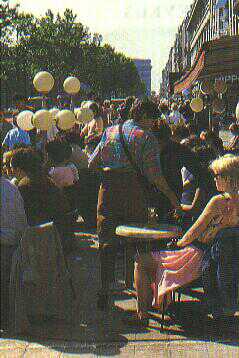 café-restaurants, snacks, Mac Dos, major airline anonyme bank offices, travel
agents and car show rooms. Not particularly the ideal place for the tourist
who came to smell Paris city climate. He will have some difficulty to move in
the stream of tourist and wildly parked. Then you have the “LOW “ part of
the Champs-Elysées where the timeless charm of nonchalant lanes and quiet
terraces didn’t completely disappear. On one side there is still the famous
stamp and old postcards market and a sympathetic stationery exchange.
The ones of you having a millionaire budget to spend, the avenue Montaigne
awaits you to have a regal in the luxurious world famous boutiques. Dior,
Prada, Montana, Chanel, Givenchy and others…the sort of commerce’s of
which Baudelaire wrote that they radiated “luxe, calme et volupté”
But let’s start our walk at the Place de l’Etoile called now place
Charles de Gaulle (the Parisians rarely name it that way). The famous ARC DE
TRIOMPHE is of course the main attraction here. Built for the glory of the
armies of Napoleon, it’s the typical image of the great imperial epic and
megalomania. The irony is that Napoleon never saw the arch completed. It’s
king Louis-Philippe who inaugurated the monument in 1836. 4 years later,
Napoleons ashes came back from Sainte-Helena through the arch and were exposed
before their transfer to the Invalides.
café-restaurants, snacks, Mac Dos, major airline anonyme bank offices, travel
agents and car show rooms. Not particularly the ideal place for the tourist
who came to smell Paris city climate. He will have some difficulty to move in
the stream of tourist and wildly parked. Then you have the “LOW “ part of
the Champs-Elysées where the timeless charm of nonchalant lanes and quiet
terraces didn’t completely disappear. On one side there is still the famous
stamp and old postcards market and a sympathetic stationery exchange.
The ones of you having a millionaire budget to spend, the avenue Montaigne
awaits you to have a regal in the luxurious world famous boutiques. Dior,
Prada, Montana, Chanel, Givenchy and others…the sort of commerce’s of
which Baudelaire wrote that they radiated “luxe, calme et volupté”
But let’s start our walk at the Place de l’Etoile called now place
Charles de Gaulle (the Parisians rarely name it that way). The famous ARC DE
TRIOMPHE is of course the main attraction here. Built for the glory of the
armies of Napoleon, it’s the typical image of the great imperial epic and
megalomania. The irony is that Napoleon never saw the arch completed. It’s
king Louis-Philippe who inaugurated the monument in 1836. 4 years later,
Napoleons ashes came back from Sainte-Helena through the arch and were exposed
before their transfer to the Invalides.
The
four big reliefs on the facade represent the march of the Volunteers in 1792 (at
the 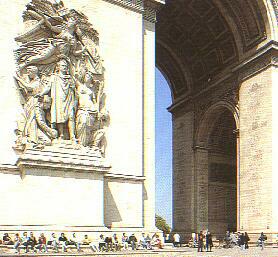 right with the Champs in your back) also known under the name “Marseillaise”.
The Triumph of 1810 is on the left (peace with Austria), a scene from
right with the Champs in your back) also known under the name “Marseillaise”.
The Triumph of 1810 is on the left (peace with Austria), a scene from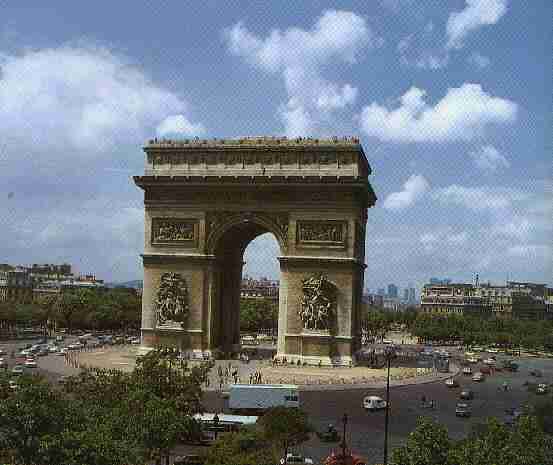 the 1814 revolt on the right and the peace of 1815. All names of the Napoleon
victories (or slaughters, call it as you wish;-)), as well as the names of his
660 generals and officers are engraved in the Arch complex. By the way, Victor
Hugo was very upset because his fathers name was not mentioned on the arch
together with the 660 names. Don’t cross under ANY circumstance the
place de l’Etoile between the mad traffic, you get killed for sure!! Take the
tunnel from the Champs Elysees or the avenue de la Grande Armee, and you will
realize what grand and impressive building this is. 50 meters high and 45 large.
You can take an elevator to the top with one of the finest panoramic views of
Paris.
the 1814 revolt on the right and the peace of 1815. All names of the Napoleon
victories (or slaughters, call it as you wish;-)), as well as the names of his
660 generals and officers are engraved in the Arch complex. By the way, Victor
Hugo was very upset because his fathers name was not mentioned on the arch
together with the 660 names. Don’t cross under ANY circumstance the
place de l’Etoile between the mad traffic, you get killed for sure!! Take the
tunnel from the Champs Elysees or the avenue de la Grande Armee, and you will
realize what grand and impressive building this is. 50 meters high and 45 large.
You can take an elevator to the top with one of the finest panoramic views of
Paris.
Under the Arch lies also the ‘Tombe du Soldat Inconnu”. (Unknown Soldier)
since 1921.
An eternal flame burns since that date.
Since then, the Arc de Triomphe witnessed all great events of Parisian life.Two
well known personages did the same thing in an interval of 4 years: Adolf Hitler
and General de Gaulle. They paid respect to the Unknown Soldier before
descending triumphantly the Champs-Elysees on foot!
A few anecdotes about the Arc (extr. from my favourite guidebook"Le guide
du Routard,available in all good book stores): (quote)a bizarre clod fried a few
eggs over the flame of the unknown soldier, an aviator Charles Goddefroy,
ignoring the interdictions, succeeded in 1919, before the stunned eyes of a few
photographers, to pass under the Arch in his aeroplane. A real feat of strength,
he had only 3-meter margin on each side (unquote).
Let’s now get on the Champs-Elysees, but that’s for next article.
Bibliography:
--Vie et histoire des arrondissements de Paris,ed.Hervas,1985-1988, 20 volumes-
Le piéton de Paris, by L.P. Fargue, ed.Gallimard 1997-Dictionnaire historique
des rues de Paris, by J.Hillairet, ed.Minuit 1985, Guides du Routard 1998,
ed.Hachette, Parijs, een wereldstad, by Hilaire Verbert, ed. Nelle 1996, De l’Arc
à Concorde, by J.Boucher, ed. Presses Cité 1993.
|