|
What else is there to see in the 8th arrondissement?
PARC MONCEAU, green lung of Paris (entrance Boulevard Courcelles, Place
Rio de Janeiro). Preferred park of Marcel Proust it is still a symbol
of elitarian Paris but also a paradise for children. Imagine that in the 18th
century the park was a haven for hunting of the duke of Orleans. He lived there
but he didn’t like his garden so he ordered to change it into a land of
“illusions”. It became a landscape park in English style. 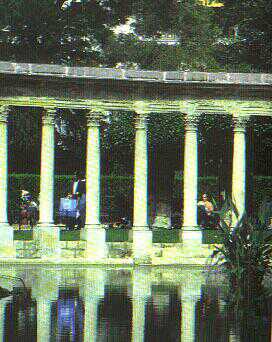 The designer,
Hubert Robert had the idea to build “modern” romantic ruins, recently
restored that still gives that park its rococo atmosphere. A small lake, Roman
(?) pillars, and other “curiosities” like a small pyramid and a stone
arch…..Notice that the actual surface is only half of the original domain in
the 19th century. Real estate promoters… The designer,
Hubert Robert had the idea to build “modern” romantic ruins, recently
restored that still gives that park its rococo atmosphere. A small lake, Roman
(?) pillars, and other “curiosities” like a small pyramid and a stone
arch…..Notice that the actual surface is only half of the original domain in
the 19th century. Real estate promoters…
The CATHEDRAL ALEXANDRE NEVSKY, Russian-orthodox church of 1859-1861.
Located between the parc Monceau and l’Etoile it is surprisingly beautiful
with its neo-Byzantine façade, and five gilded bulbs. Every Sunday at 10.00 the
services are in Russian of which the most important is that of the “Great
Russian Easter”, celebrated with fast. The deep man voices choirs may not be
the Bolchoi but it gives people emotions and nostalgia. After the service, all
this people visit the neighbouring (Russian) restaurants.
And finally let’s not forget three important but all different museums:--
musee Jacquemart-Andre---musee Nissim-de-Camondo---musee Cernuschi.
The MUSEE JACQUEMART-ANDRE, on Boulevard Haussmann and looks deceptively
ordinary from the street . It is the ancient home of the Edouard Andre and
Nellie
Jacquemart couple (big collectors, especially of Italian art, who traveled all
around Europe to acquire the works you can see here) was considered as one
highest quality places to vision art in the first 20 years of the 20th
century. The museum claims 250,000 visitors annually He was an
architect, she painted. When he died in 1894 Nellie continued to dedicate her
fortune to her collector’s passion. A recent "renovation" tries to
give it his former place back in the quartier du Roule on the boulevard Haussman.
The museum is especially visitor-friendly. An audio guide, available in six
languages, is included in the admission price, and the former dining room of the
mansion has been turned into a delightful tearoom where the museum-weary can
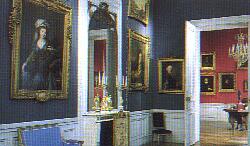
recuperate.The interior is worthy of the collection, including a spectacular
monumental staircase leading to a balcony dominated by a Tiepolo fresco. The
French school is well-represented, with paintings by Fragonard, Chardin, David
and other 18th-century masters. Edouard Andre cherished the great Flemish
painters, focusing his collection on portraits by Rembrandt, Van Dyck and Hals,
among others. A Van Dyck portrait of a magistrate, a gimlet-eyed character who
gives off an aura of knowing and seeing everything. Three rooms on the first
floor were specifically designed as "the
 Italian Museum," for the
couple’s extraordinary collection of early Italian and Renaissance art, which
includes most of the important painters and sculptors from the period."St.
George and the Dragon" by Uccello. There is also a cozy setting for a small
but outstanding selection of Nelie’s beloved English painters, including
Reynolds and Gainsborough, along with ethereal examples of the Eastern art she
brought back from her travels to exotic climes. Italian Museum," for the
couple’s extraordinary collection of early Italian and Renaissance art, which
includes most of the important painters and sculptors from the period."St.
George and the Dragon" by Uccello. There is also a cozy setting for a small
but outstanding selection of Nelie’s beloved English painters, including
Reynolds and Gainsborough, along with ethereal examples of the Eastern art she
brought back from her travels to exotic climes.
Just a few minutes stroll from the Musee Jacquemart-Andre is another Parisian
gem, the Nissim de Camondo Museum. This, too, is a monument to devoted art
collectors of the era of the Belle Epoque. But instead of housing a fairly
wide-ranging collection, like the Musee Jacquemart-Andre, the Camondo is
testimony to one man’s cultivated passion for a rather narrow piece of art
history—the second half of the 18th century. Thus, visitors get a rare,
in-depth perspective that more inclusive collections cannot emulate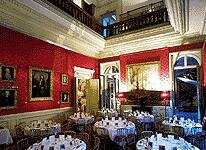 . .
The de Camondos were a Sephardic Jewish family whose Constantinople-based
19th-century banking empire earned them the sobriquet, "the Rothschilds of
the East." For their services on behalf of Italian unification, Italy’s
King Victor Emmanuel granted them a hereditary title.
By the late 1860s, they had established themselves in Paris, where a branch of
their bank, opened earlier in the decade, flourished. When the younger son,
Moise de Camondo, inherited the family townhouse abutting the Parc Monceau, he
razed it and had the famed architect Rene Sergent build a new one. Completed in
1914, on the eve of the First World War, it was inspired by the Petit Trianon at
Versailles.
The interiors were carefully designed to accommodate Moise’s growing
collection of the antique furnishings and 18th-century art and decorative
objects he loved so dearly. To a modern visitor, the result is a remarkable
simultaneous time trip to two eras: aristocratic pre-revolutionary France and
the Belle Epoque of turn-of-the-century Paris.
Moise’s ardor for the 18th century resulted in one of the world’s finest
collections of French furnishings of the period, like he magnificent
library, for example, a study in harmony.
Creations of royal cabinetmakers, exquisitely turned gold wall sconces,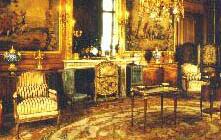 rare
examples of Sevres porcelain, silver dishes commissioned by Catherine the Great,
furnishings from the collection of Queen Marie Antoinette, and paintings by
royal favorites of the period. But the house was also a home, and, especially in
the meticulously preserved bedrooms, kitchens, servants’ areas, and the formal
garden at the rear of the house, we can see how a wealthy turn-of-the-century
Parisian family lived. rare
examples of Sevres porcelain, silver dishes commissioned by Catherine the Great,
furnishings from the collection of Queen Marie Antoinette, and paintings by
royal favorites of the period. But the house was also a home, and, especially in
the meticulously preserved bedrooms, kitchens, servants’ areas, and the formal
garden at the rear of the house, we can see how a wealthy turn-of-the-century
Parisian family lived.
Moise de Camondo’s joy in his new mansion was short-lived. Three years after
completion of the house, his son and heir, Nissim, a fighter pilot, was killed
in World War I air combat. In a glass-topped cabinet in Nissim’s bedroom,
examples from the museum’s archives are displayed, including a touching
condolence letter from Marcel Proust written to Moise after Nissim’s death.
Moise died in 1935, leaving his town house and his magnificent collection to the
state-run Museum of Decorative Arts "to preserve in France ... the finest
examples I have been able to assemble of this decorative art, which was one of
the glories of France." Following his wishes, the museum was to be named
for his martyred son, Nissim.
Leaving the museum, one passes through the carriage gate at the entrance where a
plaque tells the final, saddest part of the de Camondo story. With brutal
simplicity it says that the last surviving Camondo, Moise’s daughter,
Beatrice, and her husband and her two children were deported to Auschwitz in
1944 where they were murdered for the crime of being Jewish.
Bibliography:
--Vie et histoire des arrondissements de
Paris,ed.Hervas, 1985-1988, 20 volumes- Le piéton de Paris, by L.P. Fargue,
ed.Gallimard 1997-Dictionnaire historique des rues de Paris, by J.Hillairet,
ed.Minuit 1985, Guides du Routard 1998, ed.Hachette, Parijs, een wereldstad, by
Hilaire Verbert, ed. Nelle 1996, De l’Arc à Concorde, by J.Boucher, ed.
Presses Cité 1993, Les 20 arrondissements de Paris,by Martine Constans (Guide
le la Renaissance du livre 1999)- Petits musees de Pars, des merveilles, de
P.Meunier (ed.Grasset 1992)
|
