|
Walking down the Champs-Elysees from the Arc
de Triomphe is impressive, although, like I said before the big renovation of
1994 didn’t prevent the proliferation of fast foods and the evident decrease
of quality and service in the cafes. Avenue of parades, celebrations,
demonstrations and processions. As well the German oppressor as General de
Gaulle marched triumphantly along this avenue. Every year on July 14 the French revolution is remembered and on Dec 31
more than 750.00 people invade the Champs to celebrate the New Year. But take
now the famous café “Fouquets”! Last of the great traditional cafes on the
Champs, having a big scandal in 1994 when the health inspection discovered
cockroaches in the kitchen! Perfect example of the decadence of all the glitter
and show of the Champs Elysees cafes and restaurants. You pass the Virgin
Megastore and the Disney shop, this entire not very French ambience.
Let’s get away from all this depressing facts and make a right at the avenue
Georges V, to see luxury hotels as the George V, American Cathedral and the
famous but super touristy Crazy Horse. Return to the Champs Elysees, have a peek
at the "Lido" cabaret, today quite uninteresting with its correct
nudes, grand cafes like the "Fouquets” (see my previous anecdote bout
this prestigious establishment (?)) and at no.68, the building Guerlain, of
1913, super example of the architecture of that epoch and at no.25, an office of
a bank in a splendid hotel style Second Empire. But let’s make a side trip to
the luxurious AVENUE MONTAIGNE.
 |
|
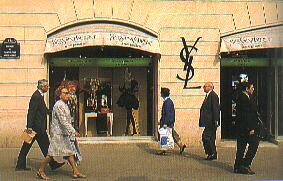
Avenue Montaigne |
Who could imagine that the Avenue Montaigne
(being called l'Allee des Veuves"(alley of the widows) not such a
long time ago), lined with taverns and badly frequented dens, is now
the summum of Paris elegance. Looking for an extra-marital experience,
people had just to come and look for some gallant adventure. Today,
with a little bit of luck you will see exquisite mannequins designers and
couturiers at Relais-Plaza, bar of the hotel Plaza-Athenée. At night the
trendsetters are principally to find in the restaurant “La Maison Blanche”
(5th floor of the Theatre des Champs Elysées) where waiters, dressed
in Yamamoto outfits, pour out the champagne! Dior,
Ungaro, Lacroix, Laroche, Scherrer, Valentino, Mugler, Ines de la Fressange,
Hanae Mo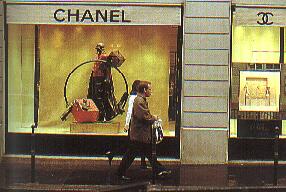 ri, Per Spook, Jilll Sander, Prada.
All display windows are very inviting to step
inside. Husbands, beware for you expenses!!! ;-) ri, Per Spook, Jilll Sander, Prada.
All display windows are very inviting to step
inside. Husbands, beware for you expenses!!! ;-)
Let’s return to the Champs-Elysées and the
"ROND-POINT DES CHAMPS-ELYSEES" (roundabout) with its luminous
fountains, work of Max Ingrand in 1958 is an important crossroad of the right
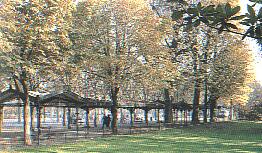
bank. This green square, designed by Lenotre has some benches where you can rest
a while overlooking the Champs, This was the place where the rich bourgeois came
to walk their children and take advantage of the fresh air (not today! ;-)), in
the shadow of the chestnut trees where Marcel Proust took some inspiration for
his books. Even today, some older elegant ladies take their grandchildren to
play in the sandpit. We are near, the avenue Montaigne, the theatre Renaud-Louis
Barrault whose restaurant is a very popular meeting place.
Stand up from your bench and let’s continue. 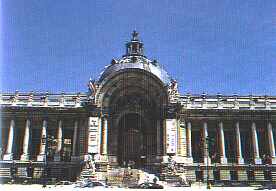 At the place Clemeceau on our right we have a full view on the GRAND PALAIS and
the PETIT PALAIS (housing the Parisian Musee des Beaux-Arts since 1902) in the
avenue Winston Churchill. Masterworks witness of the extravagance of the Belle
Epoque of the 1900 architecture. Le Grand Palais was built for the 1900 "Exposition Universelle"
together with the magnificent bridge Alexandre III, in Art Nouveau style. Works
began in 1897 following the designs of architects Deglane, Louvet and Thomas.
The edifice measures 240 m long for 40 m height. Its facade with ionic
pillars and monumental porch shows the quadriges of Recipon. The ensemble is a
successful marriage of different materials like iron, stone and glass. The
central cupola let the light go inside, offering a splendid view of the exterior
when night lights reflect. Being in restoration since
years (her pillars don't support the structure sufficiently), still houses great, prestigious
art exhibitions, attracting huge crowds from all over the world and creating
very stressing queues!
At the place Clemeceau on our right we have a full view on the GRAND PALAIS and
the PETIT PALAIS (housing the Parisian Musee des Beaux-Arts since 1902) in the
avenue Winston Churchill. Masterworks witness of the extravagance of the Belle
Epoque of the 1900 architecture. Le Grand Palais was built for the 1900 "Exposition Universelle"
together with the magnificent bridge Alexandre III, in Art Nouveau style. Works
began in 1897 following the designs of architects Deglane, Louvet and Thomas.
The edifice measures 240 m long for 40 m height. Its facade with ionic
pillars and monumental porch shows the quadriges of Recipon. The ensemble is a
successful marriage of different materials like iron, stone and glass. The
central cupola let the light go inside, offering a splendid view of the exterior
when night lights reflect. Being in restoration since
years (her pillars don't support the structure sufficiently), still houses great, prestigious
art exhibitions, attracting huge crowds from all over the world and creating
very stressing queues!
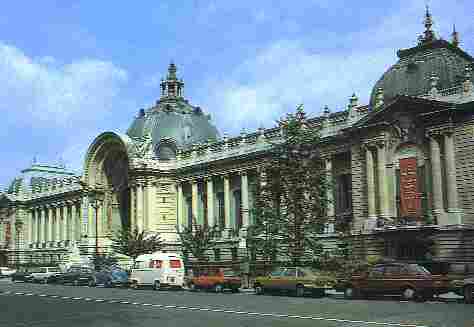
The PETIT PALAIS, just in front, building much
too often neglected by the visitors and that’s a pity. Together with Etruscan
Egyptian and Roman objects you can see medieval and Renaissance paintings. Also
masterworks of the Flemish and Dutch schools like Rubens, Jordaens, Teniers,
Rembrandt, Boticelli, Ruysdael, Breughel and French masters of the 18th
and 19th century like Fragonard, Nattier, Greuze, David, Poussin and also impressionists:
Monet, Courbet, Corot, Delacroix, Jongkind. Are also on display pieces of German and French watch and clock making of
the 16th and 17th century. Sculptures of Carpeaux, Rodin and Camille Caudel.
 |
|
Petit Palais |
Return again to the Champs Elysees and let’s now focus on the place de la
Concorde, a ten minutes walk away. Look at the very stately and expensive
restaurants almost hidden in the side gardens of the Champs like restaurant
”Laurent” and “Ledoyen” (right side). For me, this part from place
Clemenceau until place de la Concorde is the most beautiful of the Champs
Elysees.
 I didn’t mention in this article anything
about the origins of the champs Elyseés but let’s get a rest now and I’ll
do that when we will stand on the place de la Concorde in next article.
I didn’t mention in this article anything
about the origins of the champs Elyseés but let’s get a rest now and I’ll
do that when we will stand on the place de la Concorde in next article.
Bibliography:
--Vie et histoire des arrondissements de Paris,ed.Hervas, 1985-1988, 20
volumes- Le piéton de Paris, by L.P. Fargue, ed.Gallimard 1997-Dictionnaire
historique des rues de Paris, by J.Hillairet, ed.Minuit 1985, Guides du Routard
1998, ed.Hachette, Parijs, een wereldstad, by Hilaire Verbert, ed. Nelle 1996,
De l’Arc à Concorde, by J.Boucher, ed. Presses Cité 1993.
|
